Church bottoms
-
CAT -
CAST -
DE
PalmaMuch like an altar situated in the middle of the public space, the draped facade of Cort, presided over by a religious image of Blessed Santa Catalina Thomàs, confronted a varied public on Saturday that ranged from tourists—mobile phone in hand to record everything—to 'castellers' and strollers. At the main entrance of the town hall building, the Virgin Mary—although Cort has not specified which one.
The weekend was the culmination of an idyll that, in a subtle way, has become increasingly evident until it blew up in our faces. The main institutions of the Balearic Islands—the Government, the Council, and the Palma City Council—all governed by the People's Party, have been dribbling, dodging, and evading the non-denominational nature of the State in their much-vaunted Spanish Constitution for nearly four years.
Article 16.3 of the Magna Carta says that “no confession shall have a state character. The public powers shall take into account the religious beliefs of Spanish society and shall maintain the consequent relations of cooperation with the Catholic Church and other confessions”. The article is open enough to understand that the State has no official religion, but not to determine how the neutrality of public powers is preserved in this regard. That is why the Constitutional Court has historically interpreted this article by saying that no religion can be the official religion of the State, and this, therefore, includes the administrations that depend on it. The high court also says that public powers must remain neutral and not confuse their functions with religious ones, although this does not prevent them from cooperating with the different confessions to guarantee religious freedom.
This is where symbols come in. It is clear that the religious origin of a symbol is not enough to consider it unconstitutional, but a clash would indeed occur if it reasonably conveys an institution's adherence to a religion. The doctrine does not resolve the case of a religious image on the facade of a City Hall, but it does allow for the debate to begin regarding the appropriateness of a public institution making an apology for a creed by relying on feints and balances in the preservation of a tradition.
The images of the Virgin Mary and the Blessed at Cort are not the only religious icons that have been exhibited this weekend on the occasion of the Triumphal Float of the Blessed promoted by the Council. Can Balaguer, another public building owned by the municipality, has displayed for six days two damasks with a portrait of Saint Catalina Tomàs “custom-made by the nuns of Santa Magdalena for this occasion,” the City Council has informed.
The exaltation of Catholic fervor disguised as deeply rooted tradition reached its climax on the occasion of the parade of the Triumphal Float of the Blessed. The festival, which has its origin in 1792, commemorates nothing more and nothing less than the beatification of Catalina Tomàs. It was not until 2023 that the Council chaired by Llorenç Galmés began to speak of “recovering the splendor” of the festival; in 2024 the historic float, which dates back to 1868, was restored, and this year the Council has declared the parades an Asset of Immaterial Cultural Interest of Mallorca.
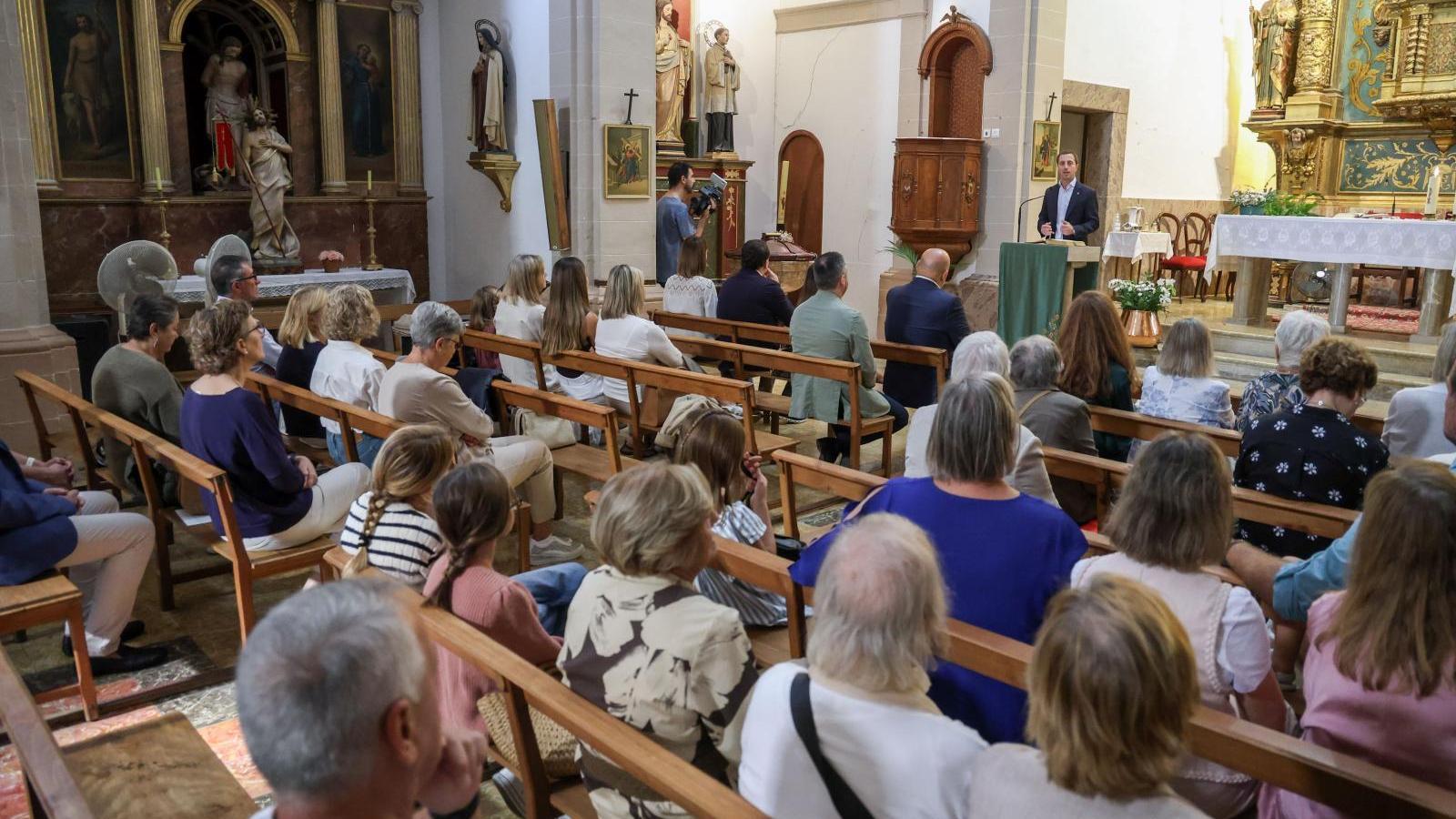
As if that were not enough, this same Monday, the president of the Council of Mallorca, Llorenç Galmés, appeared on the altar—much like a priest officiating a mass—at the church of Establiments. The most purist will say that he went there because the island institution has financed with 20,230 euros the restoration works of the main portal through a nominative subsidy to the Bishopric of Mallorca, but the reality is that the courtship with the Church is blatant and evident: Galmés did not make a press call for an institutional act, but rather summoned the press to a mass for the completion of the works. Also present at the liturgy were the vice-president and councilor for Culture and Heritage of the Council, Antònia Roca, and the mayor of Palma, Jaime Martínez.
These are just the latest examples of an infatuation that cannot be hidden and that, behind the argument of preserving shared historical and cultural heritage, recovers and promotes Catholic symbols and rituals from official spaces. The most dangerous thing is that, when they do so, they return to it the public centrality that it had taken so many years and efforts to undo after very long decades of national-Catholicism, and they blur the separation between civil power and the Church.
The poster for the 2024 Mare de Déu de la Salut festivities in Palma looked more like a mass prayer card than a call to celebration. Against a blue background, a white silhouette of the Virgin Mary with the Infant Jesus, surrounded by rays emphasizing her holiness. Devotion and religiosity turned into graphic design. This term, the Council has also recovered institutional participation in Corpus Christi, with the Royal Palace decorated, doors wide open, and a floral carpet. Even the flags were flown at half-mast as the Blessed Sacrament passed. This is without mentioning the events organized in Rome and Vatican City, with an audience of Pope Francis with Llorenç Galmés, the Bishop of Mallorca, and the mayor of Palma. The institution spent months promoting a commemoration centered on a saint. We have more examples, but this observatory does not intend to be an almanac.
It has been said many times that the appearance of Vox on the political scene has shifted the centrality of policies to the right. The far right has made some topics and frameworks more central, such as national identity, immigration, gender, historical memory, and also religion. And in the case of religion, the conversion of Catholicism into an identity heritage has been embraced by the right as part of an identity that must be defended against progressivism and other cultural influences.
This fact that occupies us today would be one more symptom of this. The institutional promotion of Catholic traditions, in a social context that is increasingly diverse and multi-confessional in Mallorca and throughout the Balearic Islands, can become one more element of exclusion. Who has the right to define shared heritage? Masses, images, and official gestures are sold as the preservation of a collective memory, but what they really do is maintain and reinforce the historically dominant confession at the center of public life.
The Diccionari català-valencià-balear says that being a churchgoer means being a person who goes to church too much. The president of the Council and the rest of the representatives should ensure that institutions and the Church maintain an effective separation. Because the efforts to build a non-denominational State have been hard, long, and difficult. Faith is free, but a public institution that hangs saints on facades and lowers flags before a religious icon is nothing other than turning tradition into a political statement.
