Tomeu Coll: “The inner life of Mallorca is over”
The photographer gathers in Santa Maria 20 years of images about the disappearance of a way of living and the transformation of the territory in ‘Fauç. Inner island, 2004–2024’

-
CAT -
CAST -
DE
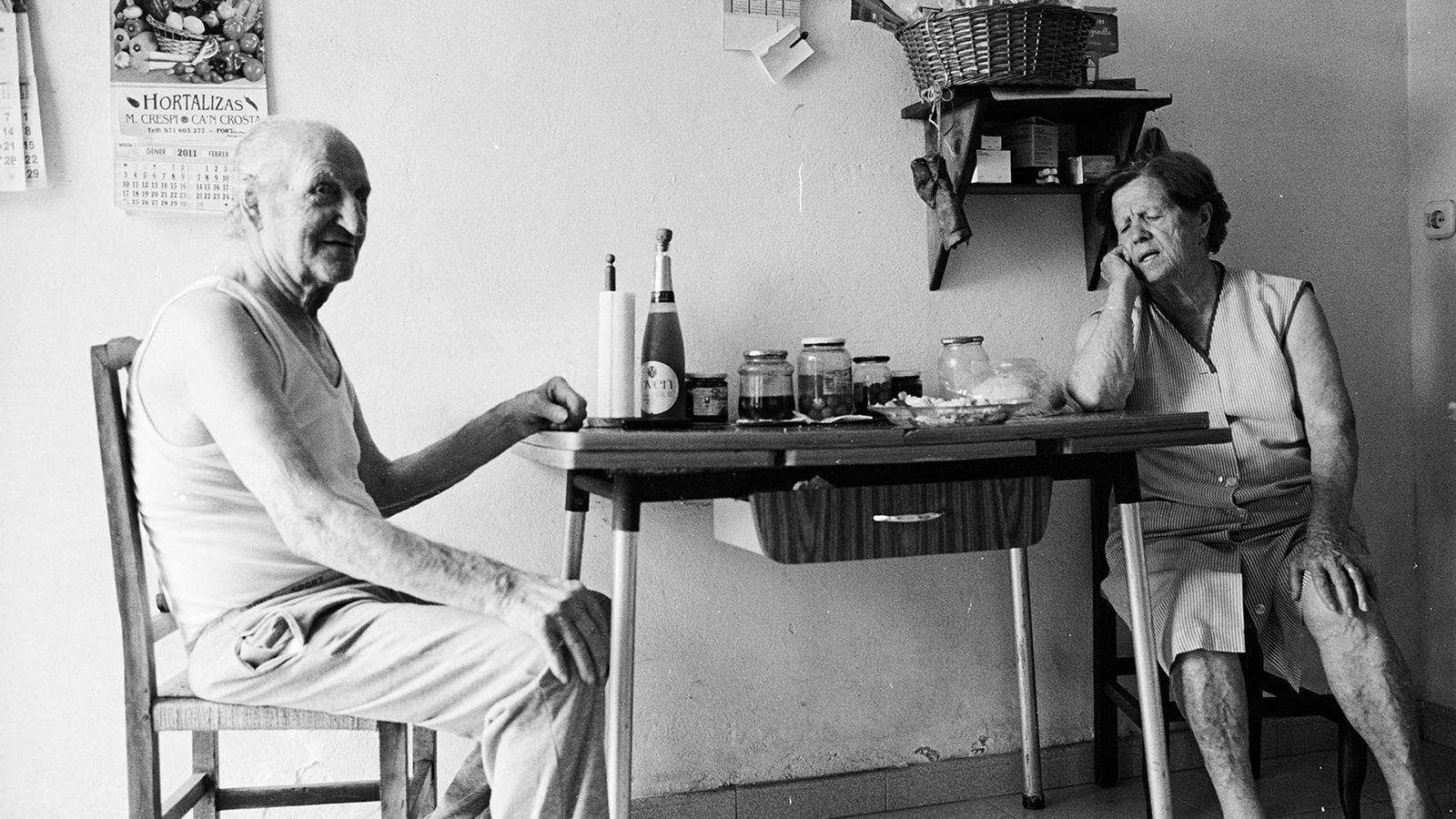
PalmaThere is a Mallorca that does not appear on postcards, which remains far from the sea and above all from the images with which the island has projected itself to the world. It is the Mallorca of the interior, of the old paths between villages, of the fields and the small farms that for generations sustained a way of life. The photographer Tomeu Coll (Sant Jordi, 1981) has been photographing this universe that has practically vanished for at least 20 years. The result is Fauç. Illa interior, 2004-2024, an exhibition that can be visited at the Espai Passatemps in Santa Maria from October 21st to November 30th.
The project starts from an intimate experience. Coll's grandmothers, born more than a century ago, never set foot in the sea. Their world was that inland Mallorca, a reality that the photographer has wanted to document from familial closeness, but without limiting himself to reconstructing his own history. Over time, however, the photographs have ended up depicting a transformation that goes beyond his ancestors to tell of the disappearance of a generation and of the spaces and ways of life that were characteristic of it.

The title, in fact, refers to an agricultural tool used to mow grass or cereals. Tomeu Coll has chosen it as a symbol of a rupture that, he considers, has occurred sooner than seemed inevitable. “I have used ‘fauç’ (sickle) as a symbology, because it is a tool that serves to cut. We have cut off an entire history of Mallorca's interior sooner than we thought, but it is not the end,” he tells ARABalears. The photographer, however, avoids the idealization of the past. He does not intend to reclaim a way of life as if it were necessarily better than the current one, nor to value the change as an absolute loss: “I do not want to judge the fact that this way of life is ending. It is true that we have cut it off in a bad way, but I do not want to say that the past was better; there were better things and worse things back then. And life goes on. I only bear witness to a time in a specific place, the inland Mallorca”.
This gaze is directed above all to an interior that has changed its function and imagery. “For some time now, everyone looks towards the coast and the interior has also become touristified, because people want to imitate there the life that is typical of the coast: villas, swimming pools and gardens instead of fields,” he observes.
From ‘Bad Lands’ to ‘Fauç’
Tomeu Coll began working on this project at the same time he was preparing Bad Lands, the work focused on Sant Jordi, his village, which he compiled in a book published in 2019 by the publisher Kehrer Verlag. Some of the photographs in Fauç come from that project, but others were left out because they had a too personal character. For years, he kept part of the photos until the passage of time allowed him to gather them into a single narrative. However, while Bad Lands focused on Sant Jordi, Fauç broadens the gaze and incorporates the paths that connect this village with Pòrtol, where the photographer now lives. These connections also have a biographical meaning: “My grandfather and grandmother met on a path between Pòrtol and Sant Jordi”.
In this territory, family memory coexists with older, sometimes uncomfortable stories. Coll recalls, for example, a story written by the historian Bartomeu Carrió, a distant relative of his, about a man from Sant Jordi whose grandfather had allegedly killed the grandfather of the photographer's grandmother. Coll has portrayed a descendant of that man, with weapons. These are images that connect the present with a past that still leaves its mark, without turning it into a closed explanation.
Death is a recurrent presence in Tomeu Coll's work. In Bad Lands he had photographed a dead horse and returned to it six years later. “The metaphor of the horse that I used in Bad Landsis very explicit. The horse, when it had recently died, was surrounded by life, grasses, insects, birds… Six years later, the photo shows that it was just a carcass”. Death also permeates the images in Fauç, but not as a conclusion. “I understand that death is life, it is regeneration”, he says.
Photographing before it is too late
The 20 years that separate the first photograph of Fauçfrom the last allow us to observe how the passage of time transforms both places and the way of looking at them. Some images seem to belong to a very remote past, while others, despite being recent, already contain the signs of an exhausted world. Photography, in any case, cannot keep that reality intact, but it can leave a record of it. “I want to bring that past into the present,” says Coll. Far from wanting to offer a nostalgic image, he relates different times and lets the photographs question those who observe them. In this sense, Fauç is also a way of looking at the present, that which has changed. Of the change, he says: “We saw it coming. With these photos, I try to ensure we cannot say we didn't see it coming.” Thus, Fauç moves in that space between loss and continuity; it shows what is no longer there, but which can still be explained.
