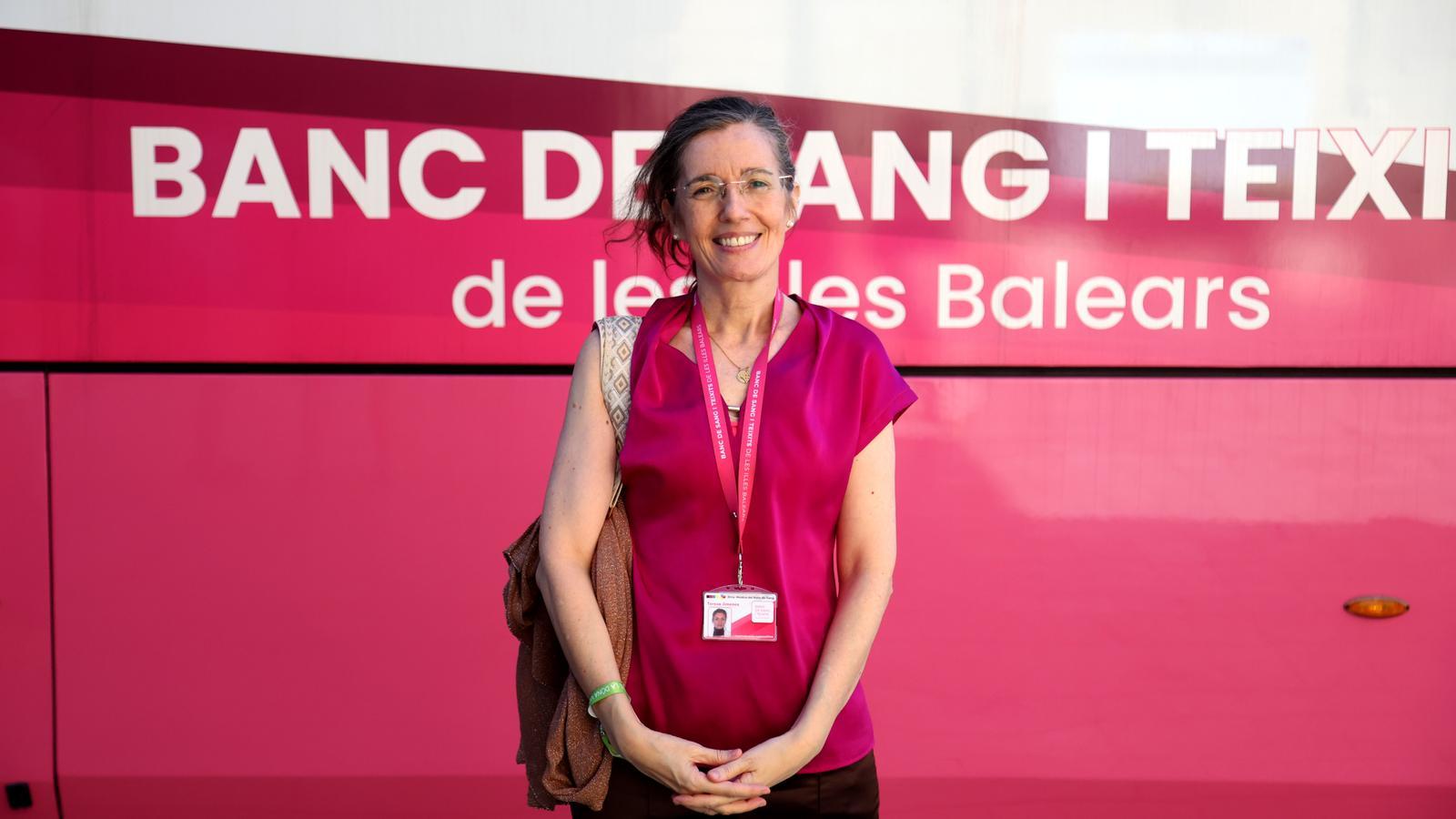
Teresa Jiménez: "Donating bone marrow has nothing to do with a puncture in the spine"
Hematologist and medical director of the Blood Bank of the Blood and Tissue Bank Foundation of the Balearic Islands
-
CAT -
CAST -
DE
PalmaTeresa Jiménez is a hematologist and medical director of the Blood Bank at the Blood and Tissue Bank Foundation of the Balearic Islands. She has witnessed firsthand the change in the recruitment of marrow donors in the Balearic Islands: from 44 new registrations in 2023, they went to 545 in 2025. Despite this increase, more are still needed, especially young people and those of diverse backgrounds. Jiménez explains what it means to join the Bone Marrow Donor Registry (REDMO), how compatibility is checked, and what happens if, years later, the call comes.
Many people confuse bone marrow with the spinal cord. What is it really and what is it for?
— Bone marrow is found inside the bones and is the factory for blood cells. The bone is not compact on the inside, but rather like a beehive. That is where the stem cells that give rise to red blood cells, platelets, and white blood cells are located. We can extract them by puncturing the bone or by getting them to come out into the bloodstream to collect them later. It has nothing to do with a lumbar puncture. A transplant may be necessary in cases of leukemia, lymphoma, bone marrow aplasia, and some genetic diseases. A patient with leukemia may have malignant cells that reproduce abnormally. To try to cure them, chemotherapy must be administered, which eliminates the malignant cells, but also the normal production of the marrow. The patient is left without cells and needs a donor's marrow to survive. While the new marrow has not yet engrafted, they need transfusions because they do not have enough defense cells, red blood cells, or platelets. Without blood donations, bone marrow transplants cannot be performed.
What do donor cells do inside the recipient?
— They take command. It is as if they were saying: "Now we are your bone marrow and we will produce your blood components." The stem cell must take root again and start producing blood, like a plant that is moved to another pot and needs time to take root. That is why compatibility is so important. The immune system attacks what it recognizes as foreign. The donor's cells must be as similar as possible to the recipient's so that the organism does not reject them.
The Balearic Islands went from 44 new registrations in the REDMO in 2023 to 545 in 2025. How is this explained? Have the figures been calculated using the same criteria?
— Yes. We started to take the reins of the project and we appointed a new manager, Xavi Ruiz, in charge of recruiting donors from the Blood Bank. The success is due to his management, the coordination with the regional Transplant coordination and the colleagues from the Blood Bank, and the dissemination throughout all the islands. Before, we did not have a person dedicated to the project nor resources to develop it. When there is someone who can dedicate time and effort to it and act as a connecting link, things work.
Currently there are 7,609 registered donors in the Balearic Islands. Which profiles are especially needed?
— A large part are also blood donors. The challenge is to incorporate younger ones, between 18 and 40 years old, because their bone marrows have a more suitable microenvironment to facilitate the graft. A person can register up to 40 years of age and remain on the registry until 60. We also need donors of different ethnicities. The Balearic Islands have a genetically very diverse population due to their history and because they receive people from many parts of the world. If a person of Latin American origin resides here, we also need donors of that origin. The more diversity there is, the more possibilities we will have to find someone compatible for each patient.
What must a person from the Balearic Islands do to enter the registry?
— Registering does not mean that they have to extract your bone marrow. Only two small tubes, eight milliliters of blood, are taken to check for genetic compatibility. The results and contact details are entered into the database, because we need to be able to locate that person. This is how one enters the REDMO. A donor can be in the registry for years without being compatible with any patient. If a patient does not find a compatible relative, they search the registry. The call can come months or years later. A second sample is taken because the donor's health may have changed and, if compatibility is confirmed, the extraction center requests a third one before organizing the donation.
Why is it so hard to find two compatible people?
— We study histocompatibility antigens. We are all original and unique, even within a large family. Genetic recombination makes finding someone with identical or very similar antigens extremely difficult. We need a very large database and, among those compatible, we choose the youngest.
How is the donation made?
— The most common and innocuous procedure is performed using peripheral blood. For three or four days, the donor is administered a growth factor via a subcutaneous injection. It is as if we were telling the bone marrow: "Knock, knock, we need the stem cells to enter the bloodstream." Then, an apheresis is performed. The person is connected to a machine: the blood leaves, the cells we need are selected, and the rest returns to the organism. Usually, one session of several hours is enough, although sometimes it must be continued another day. Cases where direct extraction is performed through bone puncture are a minority. It depends on the diagnosis and the donor's consent, and it is done under general or epidural anesthesia. Joining the registry does not mean saying yes forever. Consent must be given for each procedure.
What discomfort can it cause? Do the cells regenerate?
— The growth factor can cause a flu-like condition, with muscle and joint pain. The bone marrow responds and an inflammatory phenomenon occurs. Clinicians say that when bones hurt a lot, it is usually because many cells are being released. The donated cells regenerate completely. Blood cells, like those of the skin or hair, grow continuously. The bone marrow is a factory working at full capacity. We always prioritize the health of the donor. I put it this way: the donor enters the Blood Bank healthy and must leave it healthy. We must not cause them any pathology. The priority is their safety and their freedom.
Is the donation made only once?
— Usually it is a single donation, in one session or two, depending on the response to the growth factor and the amount of cells collected. It may happen that the patient relapses months or a year later and the same donor is asked for help again, but it is not usual.
What happens if the recipient is in another country?
— The REDMO is part of an international network. If a person from the Balearic Islands is compatible with a patient in the United Kingdom, the cells are extracted here and sent there. It can also happen that a patient from the Balearic Islands finds a donor in Australia and the cells travel here. The donation is anonymous. The beautiful part is that you are generous not only with your community or your country, but with the entire world. Only about 25% of patients find someone compatible within the family. The remaining 75% must turn to the registry. The tragedy is that a person who could be cured does not find anyone compatible.
Of the more than 7,600 people registered in the Balearic Islands, are there many who end up donating?
— They are few, because this is a long-distance race. Every time we obtain a third sample we get very happy: it means that there is real compatibility with a patient. The more donors we have, the more possibilities there are. Spain must also have a registry capable of providing donors to patients. We cannot expect needs to always be resolved by other countries.
What would you say to someone who does not sign up out of fear?
— The most widespread false belief is that they will puncture your spine or immediately extract your bone marrow. Registering only involves having two small tubes of blood drawn. If a compatible patient appears, they will call you again, repeat the tests, and explain the procedure to you. We all know someone with a tumor, cancer, or leukemia. We want to help, comfort, and encourage them, but we can also become donors. Perhaps this family member or friend will be saved by a person who has donated in another part of the world. You can do the same. If someone were drowning, we would love to rescue them. A person with leukemia who needs a donor is also drowning. We can truly participate in the fight against leukemia by joining the registry.
Why is it hard to reach young people?
— Maybe we do not speak their language. It is probably our problem. Young people are very supportive: they are involved in the fight against climate change and in the care of animals. They must know that they can also save a person's life, often someone as young as them or even a child. If they understood it and knew it, I am sure they would donate. The satisfaction of having helped someone is priceless. Even if you do not know them, you do something for them. Generosity pays for itself.
After the growth achieved, what goal are the Balearic Islands setting for themselves now?
— We still need to increase the number of donors, because we are carrying a deficit. The goal is to reach between 600 and 800 new additions. We have made an extraordinary sprint and the entire Blood Bank is very involved. The experience of the Balearic Islands has attracted attention in state forums and they have asked Xavi to explain how he managed to recover the figures. We are an Archipelago, with donors in Mallorca, Menorca, Ibiza and Formentera. It is important that this work reaches the four islands.
