Miquel Mayol: "My son could have stayed at the workshop and been a mechanic, but I advised him to leave"
-
CAT -
CAST -
DE
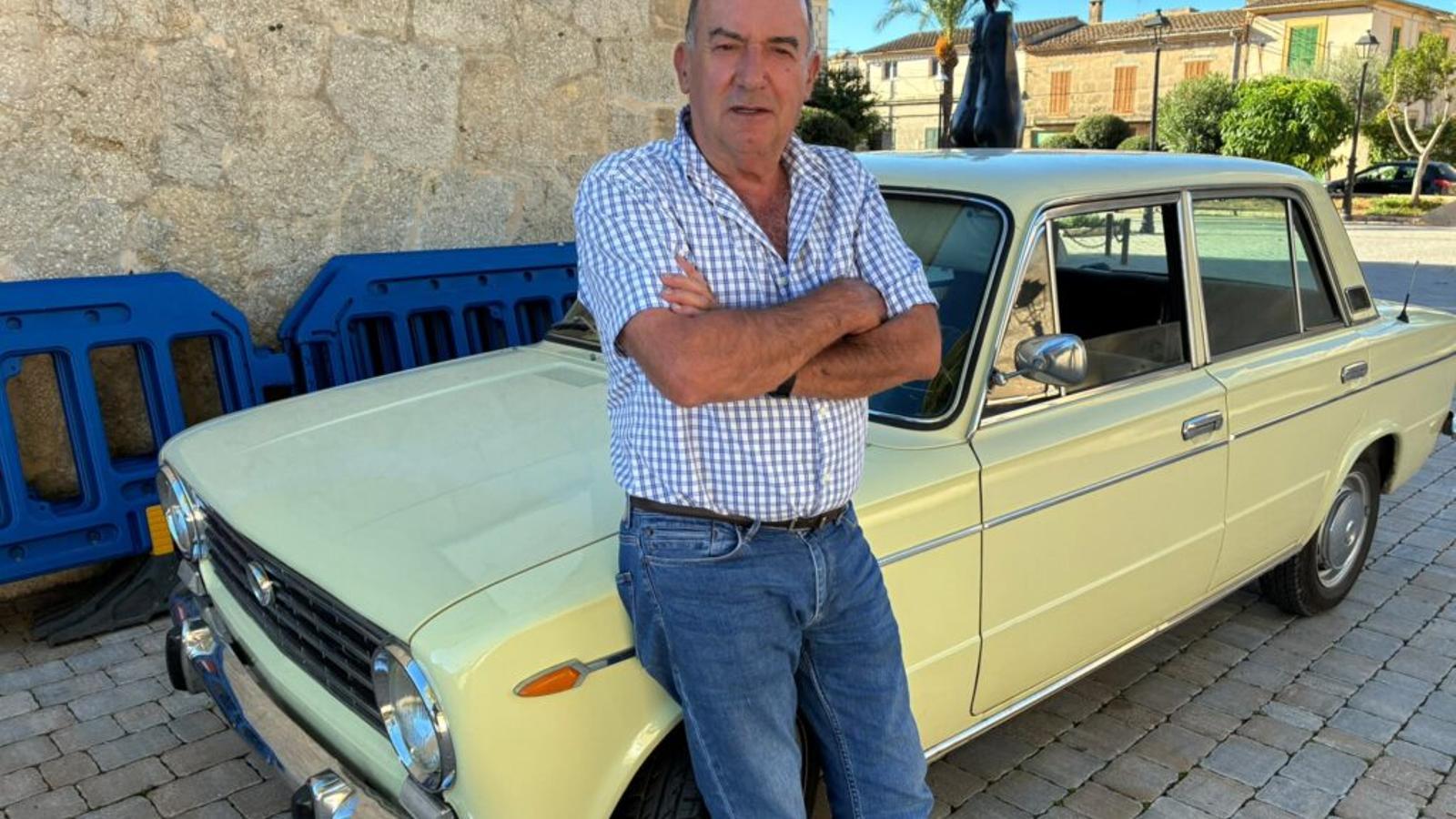
PetraMiquel Mayol Torrens, Cotó, (Petra, 1953) started working at 13 years old as a mechanic's apprentice in his hometown. He specialized as a panel beater and nowadays, once retired, he still dedicates himself to it, but only for those jobs and projects that motivate him. He has a collection of vintage cars of the SEAT brand, among which is a very 'special' one in which, however, he only wants his dog to get in.
You started very young...
— At 13 years old I was already working, something that they cannot do now. I showed up there one day on my own and they hired me as a mechanic's apprentice, I was apprentice number 13. There were 13 of us working there. There were mechanics, electricians, submersible pump technicians... Until I got tired of being an apprentice and cleaning engines, oils and dirt and things like that, and I decided to go ask for a job at the SEAT in Manacor.
And how old were you?
— I was 16 years old, because I remember that I went there on a moped, a 1968 Ducson 49, which I still have restored. With this moped I went to Manacor to ask for work from master Joan Montserrat Moyà, who was the owner. He told me that if I wanted to start, it had to be as a panel beater... And I had to ask him what that was: "If you want to start, you can start today," he told me. I went back to Petra, told the workshop that I was leaving, and the next day I was already in Manacor, where I worked for three years and learned the trade of bodywork, panel beating, and painting, among others.
And did they take you without asking you for anything else?
— It was nothing. I told them that I had been working as a mechanic's assistant for two or three years, cleaning engines. But I was very interested in learning how to do this job; I learned to weld, repair dents, and replace parts very quickly. When I had only been there for a few months, I remember there was a bodywork technician who I think got jealous of me because I showed so much interest. Look at how much I liked it, that during the Santa Praxedis festivities I went to Manacor to work. I remember they gave me a SEAT 124 that had been in an accident, which was a pile of broken parts and new sheet metal. The owner told me I had to fix the car and I succeeded. The owner congratulated me and gave me a tip.
And after Manacor?
— After two or three years, a gentleman from Artà named Massanet came, who owned the Automoto in Cala Millor, which still exists, and offered me double what I was earning. I was earning 1,600 pesetas a week. This was in 1972, the year I got my driver's license, because for a while I was still going around on the Ducson and later I got my car license. I took care of 59 rental cars. This was at the Plaça de les Bruixes in Costa dels Pins. I was in charge of the maintenance, the oil, the water, and taking the cars to the Euro Hotel and returning them once the rental had finished. Shortly after, about six months later, Tòfol Massanet, also from Artà, came along, who was an older man who also had a fairly large workshop and offered me more than where I was.
Everyone wanted you: were there few panel beaters or were you just very good?
— Man, I was good... [laughs] and it has been seen, because I used to do and have done great jobs and I still do some. Back then, you couldn't find a young bodywork mechanic who knew how to work, and now, even less so. And I went with them. There, in Artà, there was Toni Llabrés, Boter, they call him, and it seems he saw me working and proposed that he and I set up a workshop... I showed him a 25-peseta coin that I carried in my pocket and told him it was all I had to invest. He told me not to worry, that I should provide the work and he would provide the capital. And from that, the Llabrés workshop in Artà was born, which still works every day.

How was the return to Petra?
— At that time I had to do my military service, it was 1974, and I got tired of going to Artà. When I returned I saw things that I didn't like very much and one day I said that I was going to work in Petra, where the truth is that I had already taken steps and had already set up my own workshop on Ample street, we were renting there. After 10 or 15 years, I proposed to the employees I had that we should form a partnership together and buy the first workshop where I had started working at 13 years old, which was very close by. And we opened Talleres Mach. The partnership lasted less than a year, because the others were very young, they bought a boat and an apartment, and they saw that we were not moving forward because we had a loan. I went on buying their shares on the condition that I had to pay just as they had paid, in installments. And so, little by little, I went on paying them all off and I stayed with the workshop.
So, was that purchase like closing the circle?
— Yes. I bought the first workshop where I started working. In fact, Rafalet, the owner who had hired me at 13 years old, one day came and told me that he would never have thought that I, the little runt, the number 13 boy, the last one who had arrived who played pranks and did kid stuff, would end up being the owner of the workshop. I was 35 years old.
You were saying before that nowadays, especially young people, don't know how to do bodywork and paint... how is that?
— It happens just the same as with everything: the work is hard to do and everything that is made with the hands disappears, everything. As happens with stonemasons, carpenters... Now they don't know how to make boards anymore. It is a hard job that is disappearing, like the stonemasons. The people here don't want to learn the trade. My own son could have stayed in the workshop, but I advised him to leave, and he works for the Administration, during office hours.

And how come you didn't encourage him to continue with the workshop?
— So that you wouldn't spend your whole life working 15 hours a day. Many days I worked until 11:00 PM and with a 2-year-old girl. There was a lot of work and we had to struggle to pay for the expenses we had at home.
But deep down you liked it, and you still do it as a hobby and, in fact, it has led you to collect cars... How is it that you like and have so many cars of the SEAT brand?
— Of course! If I hadn't liked it, I wouldn't have done it. This thing about SEATs comes from when I worked at the dealership in Manacor and I have always had a preference for this brand. I have a collection of 7 or 8 restored SEATs. A couple of 600s, 1500s, 124 specials... We used to go on excursions with the 600 clubs all over Mallorca, we would go to Lluc, to Sóller, about twenty cars together to spend the day. In the summer it is impossible to drive. Everything is sheet metal and they don't have air conditioning, which means that if in the summer you get into this car in the sun you melt, we can't go out.
What is the most special or curious restoration you have done?
— I have a very special one. Nobody wants to get in it, only the dog wants to get in [laughs]. It is a SEAT 131 station wagon with the back part completely made of glass, with a good rear door. It has a galvanized sheet metal floor with a cart in the middle. I bought it from the Calvià City Council. It was the municipality's hearse and it had been stopped for 12 years inside a garage at the Calvià cemetery.
And how was it that you bought it?
— About seven or eight years ago, the Calvià City Council posted an advertisement that they were selling it, and I bought it. It is from around 1985. I restored the entire engine part. I had a problem when I got inside, because I didn't fit. My belly hit the steering wheel, I couldn't fit, because the driver who had always driven it was a very small man who was one meter twenty tall and very thin. Only he could fit. I had to dismantle all the interior panels, piece by piece, and shorten the space by 15 centimeters to be able to fit inside and drive it perfectly.
And do you walk it a lot? They must stare at you when you pass by...
— Of course, I drive around and people look at me from afar, not so much up close [laughs]. Sometimes I go by car to a property we have and I take a path where people go to run and walk, and when they see me coming from a distance they step aside and I stop and tell them that if they want to get in, there is room [laughs] and they all take two more steps back and tell me to continue.
And are you still continuing to buy?
— Yes. Now I have one of the first 600 that came out, it is from '57. I have it to do a little restoration on it and get it running. Everything that is interesting, if I can, I buy it.
And how do you find out that these cars are being put up for sale?
— Usually, they call me directly. It's like a network. They pass the phone to each other and offer me cars. Also, sometimes, they ask me when they need a part. The other day they were on an excursion in Menorca and one broke the gear shift; from right there they called me for a 127 gearbox and I had one. I have a warehouse full of old spare parts.
How is it that you keep so much? Did you already like it when you discovered that it had value or did you do it thinking that it would go out of style?
— I have it to pass the time. No, I didn't think it would go out of style! I thought that, in the end, everything would have to be thrown away, and nothing has been thrown away. Everything is made use of and serves a purpose. What I have is a private warehouse where I keep many classic parts and spares. It is a useful place that serves me to store all this heritage. The other day they asked me for a SEAT 600 steering wheel and look, I had one.
What do you think about today's cars?
— With today's car you only go to the dealership, to the official service. As soon as you enter they already charge you 100 euros, just for making the file they charge you another 100, and you can only go there because with the computers and the machines they already tell you where the breakdowns are. Nowadays everything is machines and connections to a screen.
It was very different before.
— Do you see this SEAT 124? Well, with an adjustable wrench, a 10-11 wrench, and two screwdrivers, one Phillips and one flathead, you could take apart and put back together the entire engine. With four or five tools from a small drawer you had nearby, that was enough to do any job like those. It is what I still do.
The trade has changed a lot. What future do you see for small town mechanics?
— As they retire, everyone will be closing down... Old cars are no longer being fixed, now everything is electric and modern. The old mechanics that existed in the villages will come to an end in a few years. One closes, the other retires, the children no longer continue... and the cars of the past are no longer repaired. It's a pity, but that's how it is. Nowadays, if they don't earn quick money, people don't want to work; they want little work and lots of money.
