Fascism murdered them in Manacor; 90 years later, they have returned home
Santa Coloma de Farners recovers the memory of Daria and Mercè Buxadé, repressed by the Francoists in the capital of the Levant in September 1936
-
CAT -
CAST -
DE
ManacorThey were raped, insulted, humiliated, and murdered in a public act. With all the cruelty that one is capable of imagining, Daria and Mercè Buxadé Adroher were killed in Manacor on September 5, 1936, by order of the bloodthirsty fascist Arconovaldo Bonaccorsi, the self-proclaimed “Count Rossi”. They were not alone; they were accompanied by three other women, nurses who had enlisted as volunteers with Captain Alberto Bayo's expedition in Mallorca.
“There was a rabid hatred in Manacor”. With this synthetic and harsh phrase, the historian Antoni Tugores summarizes the situation that was lived 90 years ago in the only place in Mallorca where there was an open war front to try to defend the II Republic.

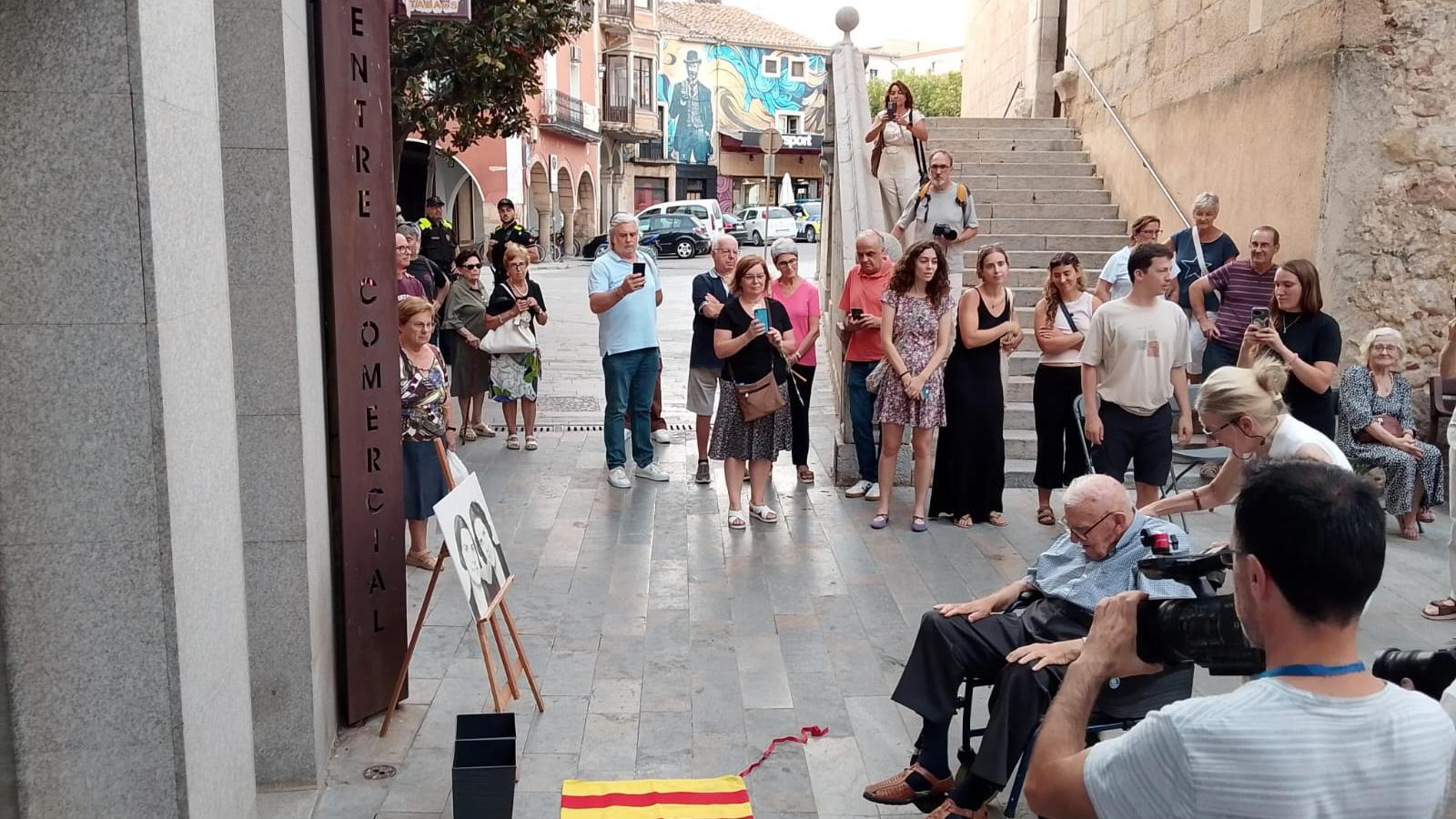
Santa Coloma de Farners, the town from where the parents and grandparents of the Buxadé sisters came, paid them this Saturday the first major tribute since that fateful day, nine decades ago. It was at the initiative of La Bulla, an entity formed by young people that has managed to involve the City Council and a good part of the municipality in a cycle of memory developed over months. "Many people from Farners did not know this story. No matter how little sensitivity you have, it is a story that reaches very deep," explains Antoni Tugores, the historian who has delved into the life and murder of the two sisters.
La Bulla wanted to take advantage of the 90th anniversary to "reverse the unjust situation" that had condemned Dària and Mercè Buxadé to silence and oblivion. "We wanted to place them in the position they deserve to have in Santa Coloma and make their story known with the rigor of historians," explains Ernest Morell, a member of the entity. The commemoration, he adds, also aims to be "a reminder of the horrors that fascism entails, in a very delicate moment that allows us to see that we are not vaccinated against it." "The defense of memory and democratic values is not only the responsibility of the left, but of everyone," he warns.
Tugores had already presented in Santa Coloma de Farners, nine years ago, They Died Twice, the biography of Daria and Mercè Buxadé. However, a good part of the residents no longer remembered it and a new generation has wanted to recover their memory. "That such a young association has been able to organize all this has a lot of merit. The town has wanted to look back and has found a way to vindicate them, even if it is late," he points out.
With this objective, La Bulla has organized over the last few months screenings, conferences, presentations, recitals, and public memory acts. The cycle began with the screening of the documentary Milicianes and a colloquium with the playwright and researcher Jaume Miró and the historian Julià Rodríguez, where the latest research on the identity of the fifth female militia member was presented. The central act of this cycle took place on Saturday, just as 90 years had passed since the murder. The day began at the Joan Vinyoli Library, where Tugores reconstructed the "human adventure" of the sisters: their life before traveling to Mallorca, their participation in the republican expedition, and their final days before being murdered.
After the presentation, a conversation moderated by journalist Gemma Busquets brought together relatives of Daria and Mercè. More than twenty members of the Buxadé Adroher family, some having arrived from Ireland, participated in a meeting marked by emotion. Among them was 92-year-old Carles Buxadé, nephew of the two nurses, who has persevered for decades in the search for the fate of his aunts. “Daria and Mercè have managed to return home,” said Ann Buxadé, great-niece of the militia nurses.
"Carles' stubbornness to know what had happened to them is at the origin of our friendship and all this collaboration," recalls Tugores. Carles Buxadé and his daughter Ann provided the historian with much of the information that allowed him to reconstruct their trajectory. The meeting also brought together other branches of a family marked by the complexity and wounds of the Civil War, including the Mexican family, which has provided the DNA samples necessary to attempt to identify the remains.
The tribute continued on Pare Lluís Rodés street with the placement of two Stolpersteine memory stones dedicated to the sisters. Attendees included, among others, the mayors of Santa Coloma de Farners and Manacor, Pep Prat and Miquel Oliver; the Director General of Institutional Relations and the Parliament, Xesca Ramis; family members of the victims, and representatives of La Bulla. The day ended with the inauguration of a twelve-by-fifteen-meter mural, the work of Roc Blackblock, and a musical performance by Carme Vives from Manacor.
"It was a very solemn act, with a huge crowd and an immense level of participation and attention," relates Tugores. For the historian, however, the most intense moment was the reunion with the family: "It had been many years since we last saw each other. There were many reasons to be moved."
The tribute has also allowed for the establishment of a bridge of memory between Santa Coloma de Farners and Manacor. While the stones were being placed and the mural was being inaugurated in the Catalan municipality, flowers and poems were once again being deposited at the Son Coletes cemetery in memory of the five murdered nurses, at the initiative of the Col·lectiu de Dones de Llevant. "Twinning these two towns in the tribute to the sisters is a very important symbol," asserts Tugores. "When you see a town close this circle, you feel that it is the reparation we ask for. For many people, it was a discovery; for the family, it was like closing a wound."
The historian recalls that the tribute at Son Coletes began in 2010, together with Antònia Matamalas and the Col·lectiu de Dones de Llevant, because they believed that the five healthcare workers deserved "specific attention and care." "In their murder, there was also sexism: it was not tolerated that a woman could actively participate in the tasks of the war," he states. This year, although Tugores could not be there because he was participating in the acts in Santa Coloma, the tribute brought together more people than ever, and many others came throughout the weekend to leave flowers and poems.
Incomplete reparation
The reparation, however, is not yet complete. The discovery of four women's bodies buried together at Son Coletes in 2023 reinforces the conviction that they correspond to four of the five murdered nurses. The poor state of the remains, however, has not yet allowed for sufficient genetic material to be obtained to identify them. "We know it is them and, if we could only identify one, we could confirm the identity of the group," explains Tugores.
It also remains to definitively confirm the identity of the fifth militia member and the authorship of the diary that has allowed for the reconstruction of their final days. An investigation by Jaume Miró and Julià Rodríguez identifies, almost with total certainty, Josefina Garcia Prats as the fifth murdered woman and as the likely author of the diary. The documentary hypothesis is very solid, but it is still necessary to locate the original manuscript and obtain confirmation through DNA. "The most important thing is to be able to identify all these women at Son Coletes and confirm the identity of the author of the diary," concludes Tugores.
Ninety years later, the search remains open, but the names and lives of Dària and Mercè Buxadé have already begun to occupy the public space from which fascism wanted to erase them.
