The right not to be liked by the Police
The reiteration of actions against certain political expressions, the apparent lack of proportionality, and the opacity of investigations force us to ask ourselves if police neutrality is truly guaranteed
-
CAT -
CAST -
DE
PalmaAny given Monday, in a classroom of any Primary school, in any town in Mallorca, any officers from one of the State's security forces and bodies, teach the children the benefits of their work. Some bring dogs so they can pet them, others will explain to them that their mission is to protect them.
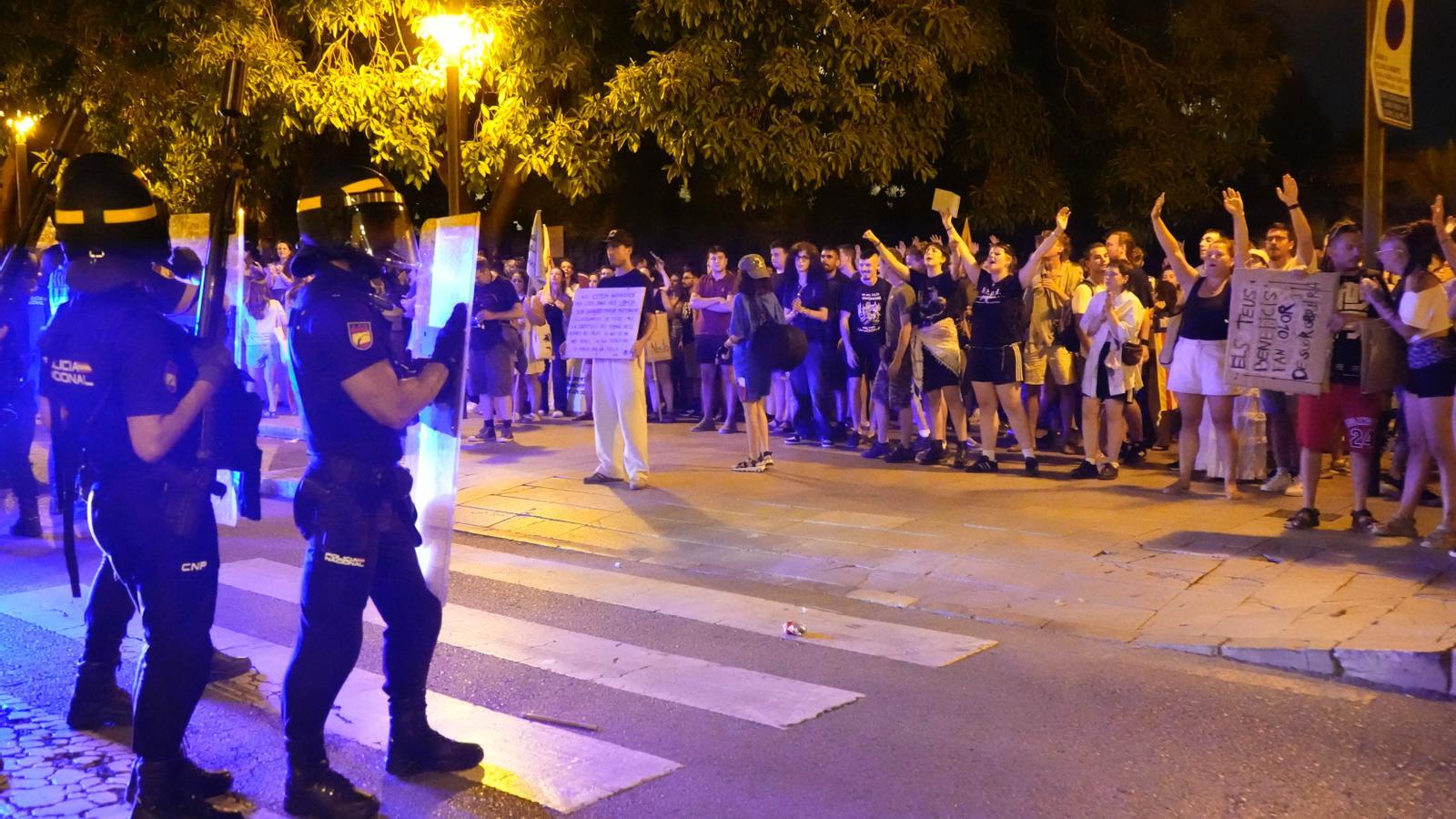
First practical class in cognitive dissonance for some of the children who have attended these sessions: the demonstration on July 26th in the city against the tourism model. There, with their eyes wide open, they see live how everything those officers, full of good intentions and jokes to try to win them over, had told them, vanishes. How they play these tricks, these adults.
The mobile phone footage of the disproportionate aggression by the National Police against a young Barça fan this Sunday near Elche's stadium reminds us too much of the charges by the same Spanish police force just a month ago in Palma. More or less, and seeing the images, the pattern is disturbingly similar: perfectly legitimate political expressions end up provoking a police response that the images hardly justify. In other words: citizens treated as a threat not for what they do, but for what they represent.
In both cases, Elche and Palma, internal investigations have been announced by the respective Spanish government delegations. As of today – a month after the events – the State government's Delegation in the Balearic Islands has not yet made public any results regarding these inquiries.
The cases are not isolated and suggest a police culture that deserves examination and indications of a structural problem. Cases keep occurring where the State's machinery is set in motion to lecture people it considers to be on the wrong side of History. Carrying a Catalan flag: bad. Being critical of the tourism model: bad. Having a certain political or ideological stance: bad.
Brief non-encyclopedic compilation: the charges of October 1, 2017 in Barcelona against very dangerous grannies who were carrying a ballot paper in their hand. The arrests with handcuffs of two women who had made graffiti on five real estate agencies in Santa Maria, searches and a questionable action. The charges by riot police against the 15-M movement in Palma in 2011, which left about twenty injured. The charges by the Guardia Civil with tear gas in Felanitx in 2011, who were armed with a stuffed kika and a damaged pallium. The disproportionate intervention of the National Police and the Local Police of Valencia against the residents of the Cabanyal neighborhood in 2010, who wanted to prevent the demolition of the neighborhood's buildings. The pursuits, arrests and charges during the Valencian Spring of 2012, which denounced the cuts in public education. In this last case, the head of police even referred to the protesters as the enemy. The enemy were underage students, that is, children, who were asking for adequate classrooms, heating, or, simply, to be able to go to the school toilet and find toilet paper there.
And it ends. Let's also remember the Confeti case, which also resonates in this thread: “No damage or harm of any kind was caused (...). No claims of any kind were made. Public peace was not disturbed (...) and, above all, no act of violence of any kind was committed,” stated the ruling, which ended with the acquittal of all the accused, for whom the Public Prosecutor's Office had requested 29 years in prison. And here the problem is aggravated when the State's response turns peaceful protests into cases that drag on for years.
We have a serious social problem if the security forces and bodies too often show signs of incapacity to apply the principles of congruence, opportunity, and proportionality when faced with peaceful demonstrations or actions that, as inferred from multiple actions, they contradict. Their function or action cannot vary based on sympathy towards the ideological expression assumed by citizens.
We already know that Article 104 of the Spanish Constitution states that security forces and bodies will have the mission of protecting the free exercise of rights and freedoms and guaranteeing citizen security. We also know that Organic Law 2/1986, on security forces and bodies, establishes that in the performance of their duties, they must act with absolute political neutrality and impartiality and, consequently, without any discrimination based on race, religion, or opinion. We also know that this same law states that they must maintain and restore, where appropriate, public order and security. And here is the loophole that allows the unjustifiable to be justified. But the debate is not whether we like the Police's actions in general, but whether they must respond to democratic obligations.
It may bother me and even offend me that more and more police officers are wearing bracelets with the Spanish flag, but I can't and shouldn't do anything about it. For the same reason, an officer may be offended that a Barça fan is wearing an Estelada flag, and in a democratic state governed by the rule of law, they should also not be able to do anything about it because, in a democracy, feeling offended does not empower anyone – and even less so those who exercise authority – to restrict rights.
Citizens have the right not to be liked by the Police. They have the right to express ideas that make them uncomfortable or contradict them, because their function is not to decide which opinions are acceptable, but to ensure that all can be expressed within democratic limits.
May the gray echoes of not-so-distant past times not cloud the democratic principles set by a Constitution, paradoxically, so often claimed.
