They denounce the closure of the Estalella coastline for "serious impact" on protected habitats
The GOB says that this action diverts the passage of people and bicycles towards sensitive areas of the Natura 2000 Network and puts threatened coastal vegetation at risk
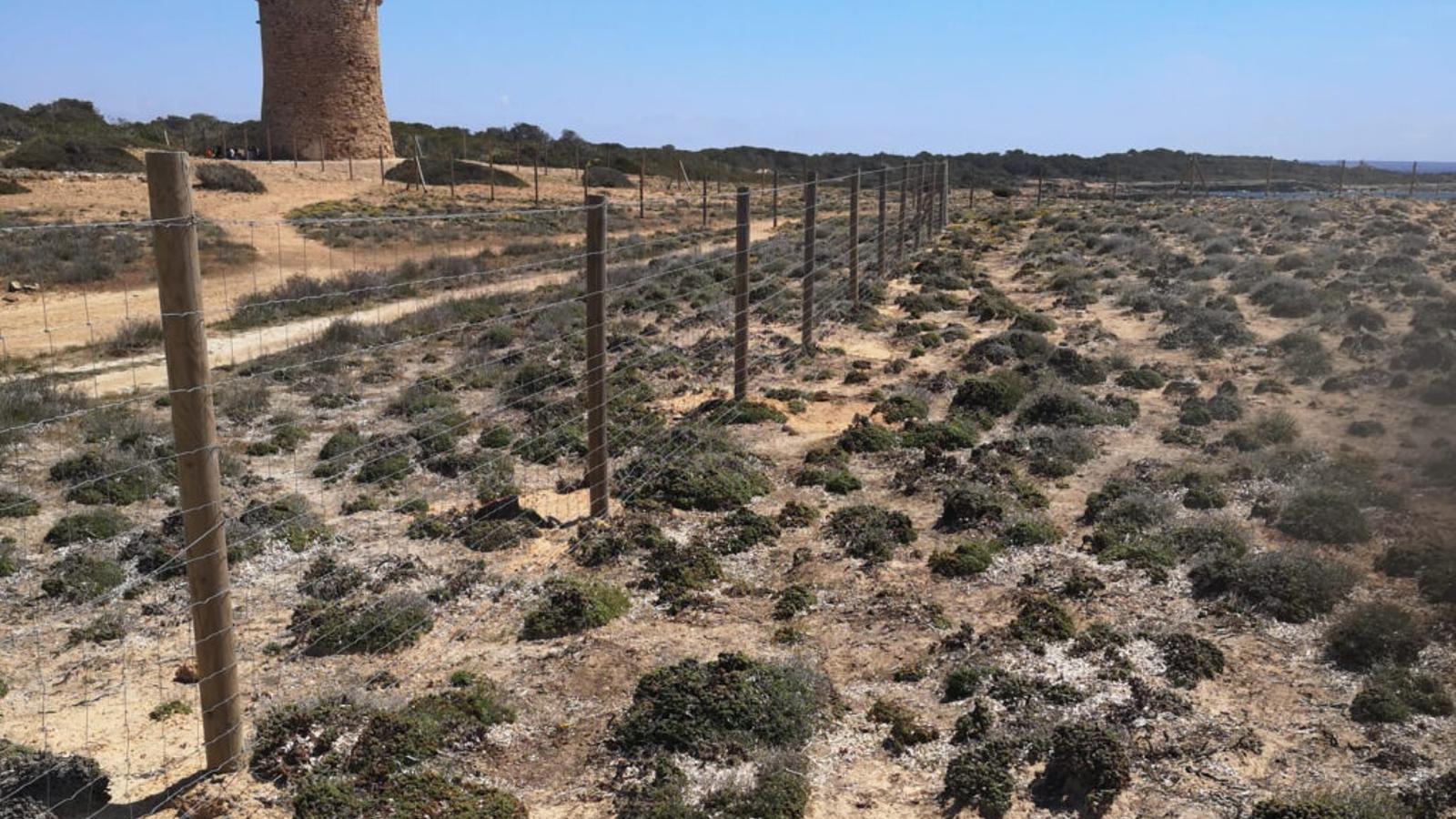
The GOB has warned that the recent closure of the coastline of the l’Estalella estate may cause "irreversible impacts on habitats and species of high ecological value" included within protected areas of the Natura 2000 Network. The closure, carried out with wooden posts and game netting along the entire coastline bordering the estate, prevents passage along traditional paths previously used by hikers and cyclists between Racó de s’Arena (l’Estanyol) and Pas de Vallgornera. It should be remembered that this route had been authorized by the Llucmajor City Council as a hiking trail.
The entity also warns that part of the closure posts have been fixed with "unsuitable materials" such as cement or concrete, and that in some sections existing vegetation, including bushes, pine trees, and junipers, has been removed. Likewise, it has been confirmed that one of the Natura 2000 information signs, located at the entrance of the estate in the Vallgornera area, has been incorporated within the enclosed perimeter, hindering its informative function.

According to the GOB, this closure now forces users to walk off the paths, directly onto the coastal rocky shore, where there are no established trails. This fact not only increases soil erosion but also causes direct trampling of plant communities of high ecological value.
These communities are part of Habitats of Community Interest listed in the European Habitats Directive and are found in this area in a remarkable state of conservation. Specifically, they correspond to the habitats: cliffs with vegetation of Mediterranean coasts with endemic Limonium spp. (1240), low formations of Euphorbia near cliffs (5320), and endemic thorny shrubs of the phrygana type (5430).
These habitats host plant species with restricted distribution and high sensitivity to trampling, such as Limonium minutum, socarells (Launaea cervicornis), lettuce plants (Euphorbia pythiusa) or the rare Coris monspeliensis. The forced displacement of people and bicycles towards these areas can cause their rapid degradation and disappearance, especially in sections where the available space between the closure and the cliffs is less than 10 meters.
Furthermore, walking off-trail involves moving stones and rocks, altering invertebrate microhabitats, among which several endemic species of tenebrionid beetles stand out.
Faced with this situation, the GOB has requested from the Directorate General of Natural Heritage and Forest Management of the Ministry of Agriculture, Fisheries and Natural Environment whether the repercussions of this closure on the habitats of community interest that justified the declaration of the Site of Community Importance (SCI) Cap Enderrocat–Cap Blanc have been previously evaluated.
