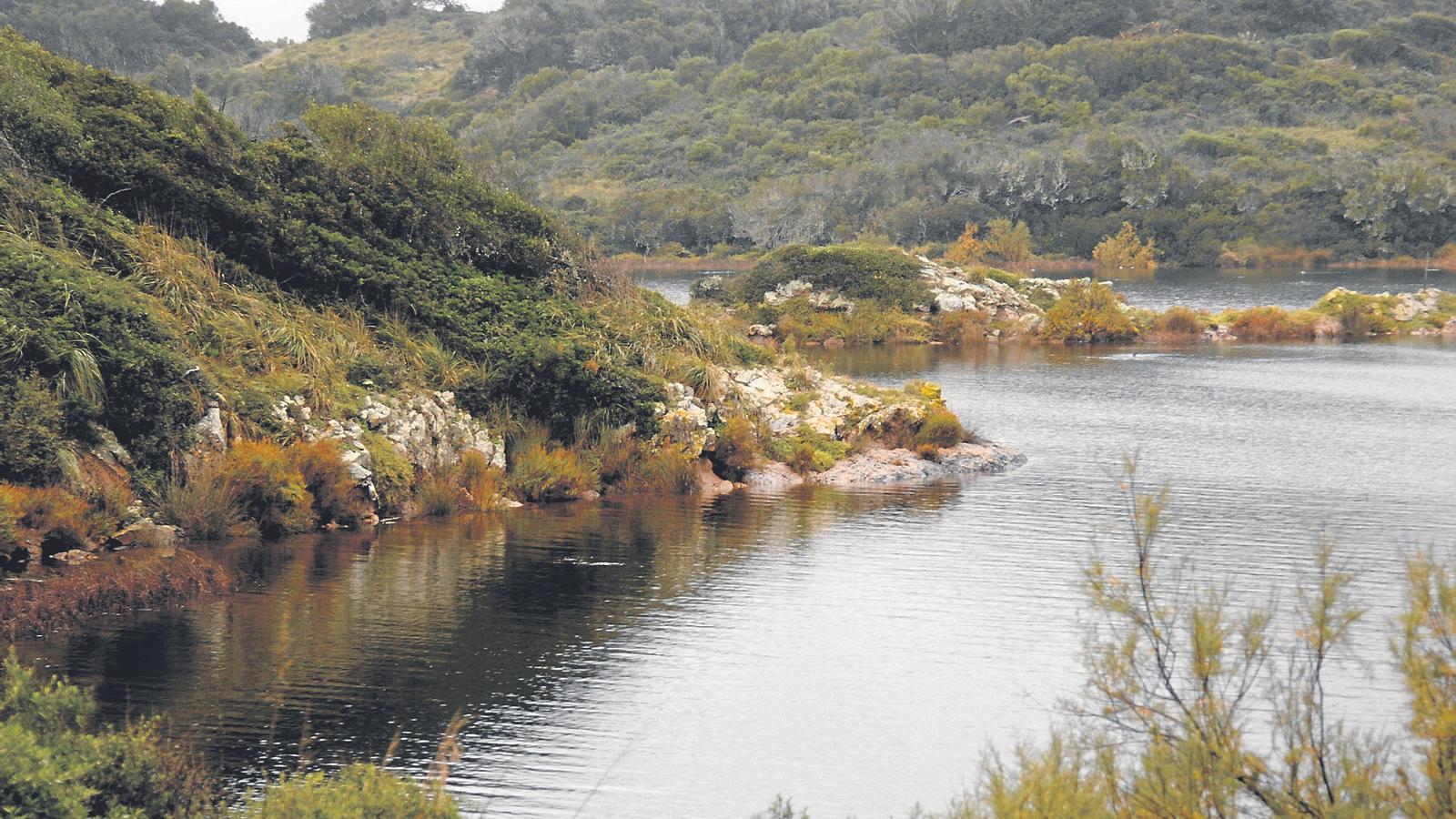
El Trenc de Menorca is at the Albufera del Grau
The GOB warns that the Omnibus Law could resurrect the old Shangri-La urbanization, which still has about forty chalets standing in the middle of the heart of the reserve

-
CAT -
CAST -
DE
PalmaThe Omnibus Law not only threatens Trenc. In Menorca, where citizen mobilization in defense of protected areas began in the 70s, there is also a natural site that could be altered by the prevailing political casuistry at Consolat de Mar, the old – aborted in time – Shangri-La urbanization, in the Albufera del Grau Natural Park.
The GOB coordinator in Menorca, Miquel Camps, recalls that over the last half-century there have been several attempts to legalize the little more than 40 out-of-compliance constructions scattered throughout the most territorially protected area of the island. "Whoever has tried has always encountered a strong conservation structure, but the new law, which allows direct alteration of areas of environmental relevance like this one, could facilitate it from now on. It is very dangerous that such an important decision now depends on an agreement of the Governing Council," explains Camps.
"The current situation, with a Government that has allowed the legalization of hundreds of illegal buildings in rural areas, leads us to fear that they also want to provide coverage for these constructions in the Albufera," he admits. "The price they have now, out of compliance, is very different from what they could achieve on the real estate market if they are legalized," adds Camps, who recalls that "the legalization process promoted by the current Government has already multiplied the value of many rural plots, now converted into chalets, which were built 40 years ago in Menorca without any kind of permit."
The modifications promoted in this regard by the political sphere – he emphasizes – "are not accidental at all. If it's being bargained, it's not for a supposed administrative streamlining, since the situation of the Natural Resources Planning Plan (PORN) that governs these areas is modified every 15 years. It is clear that if something is moving, it is because there is an intention behind it."
The Shangri-La urbanization was stopped in the 70s, when there were no regional laws protecting natural areas yet, but it was too late to prevent some constructions from being built. Nearly fifty are still standing, 50 years later, scattered in the middle of the Albufera del Grau Natural Park, in the heart of Menorca declared by UNESCO as a Biosphere Reserve.
They are all out of order in a maximum protection zone and some are even rented out to tourists. They obtained the relevant license by taking advantage of regulatory loopholes and can still be maintained in this location for at least 12 more years. The 50-year term that the administration agreed to grant them in 1988 expires in 2038, at which point all these homes will have to be expropriated and demolished.
However, the questionable urbanistic situation of some of these constructions has alerted the Consell de Menorca, which has detected a few villas covered by licenses granted in 2013 and 2014, when the Territorial Island Plan (PTI) already restricted tourist activity in the countryside to buildings prior to 1960.
The Minister of Territorial Planning, Núria Torrent, has set her sights on the Albufera when it comes to prosecuting illegal tourist rentals in Menorca and has already deregistered 21 of the 34 licenses granted in the area. Another 12 are in process, awaiting the expiration of deadlines to also deregister them. Only one house has been able to justify its activity and, therefore, will be the only one of the existing ones that can be legally rented to tourists.
“Charming house in the heart of nature and Menorca's most important Natural Park, with a wide diversity of animal species,” advertises the real estate agency Engel & Völkers, which offers one of these houses with a pool, 110 square meters built and a 900 square meter plot, as “the best option for those seeking tranquility, the ability to walk in nature, and at the same time, be close to the beach and the amenities offered by a city.” In fact, the Albufera is located just seven kilometers from the city of Maó.
Deprotection measures
The Omnibus Law also now facilitates the possibility of planning new population growths in the Balearic Islands without requiring what was previously mandatory, the Water Resources report that guaranteed whether or not there would be enough water to supply future developments. The GOB sees this directly as “a suicide, and more so in the current situation in the case of Menorca, where the majority of water bodies are overexploited or contaminated. It is a way to unblock projects that are stalled by reports that are not authorized because there is not enough water. And if the Government promotes it, it is due to a commitment it must have with some private entity, not because there is any real public interest.
It is not the only impact of the latest legislative changes on the protected territory of the Islands. “We are going backwards by reducing exposure periods, in transparency, by lowering the Natura 2000 Network...”, complains Camps. But the recent modification of the Law for the Conservation of Environmental Relevance Spaces (LECO) also allows hunting on islets and ravines and deliberate forest fires to cease to be considered a serious infraction. “These are changes that have no logic and that advance in deprotection, not in simplification,” he concludes.
The frustrated attempt of the PTI
Also in Menorca, the island council has taken steps during this term to deprotect the island. The modification of the Territorial Plan (PTI) promoted by the PP government last year, and which was halted by the institution's own technicians, intended, as the secretary herself warned, to "alter the model of Menorca". The document, signed by the Minister of Territorial Planning and which the Popular Party later retracted, changed 95 out of 140 articles of the Plan and modified "substantially the fundamental objectives and principles" of the PTI.
It empowered the Council itself and the island's town councils to delimit and regulate new rural areas and to allow housing on all rustic land, except for protected land. It also gave the green light to establish hotels in the countryside without being tied to agricultural activity, lifted the ban on golf courses and sports facilities that involve high water consumption, and opened the door to creating routes with electric vehicles on rustic land. Likewise, it was intended to favor new facilities around saturated tourist areas, until the secretary warned that it was not justified and that doing so "could mean a deprotection of the territory".
"What they wanted to modify was very worrying," remarks Miquel Camps. "It removed all kinds of guarantees, it did not limit the construction of swimming pools, it allowed any building on rustic land to be converted into housing, and it even added the creation of new places to the tourist load study. The intentions we see in the Council and the Government at a territorial level are very worrying".
A year later, however, no proposal to modify the PTI has been fully implemented, not even after signing an agreement with the Consell de Mallorca that seemed to require the technical approval of an institution external to the modifications that the house staff resisted supporting. So far, it has not been reported that the Consell de Menorca has made use of it.
So this summer, citizen mobilizations are more focused on curbing growing tourist overcrowding than on proactively warning the political class about the rejection that certain actions may provoke. The massive demonstration in defense of Trenc has, however, helped to raise awareness that one cannot let their guard down.
