Madò Farta: "We must lose the fear of defending our territory and our language"
Activist

-
CAT -
CAST -
DE
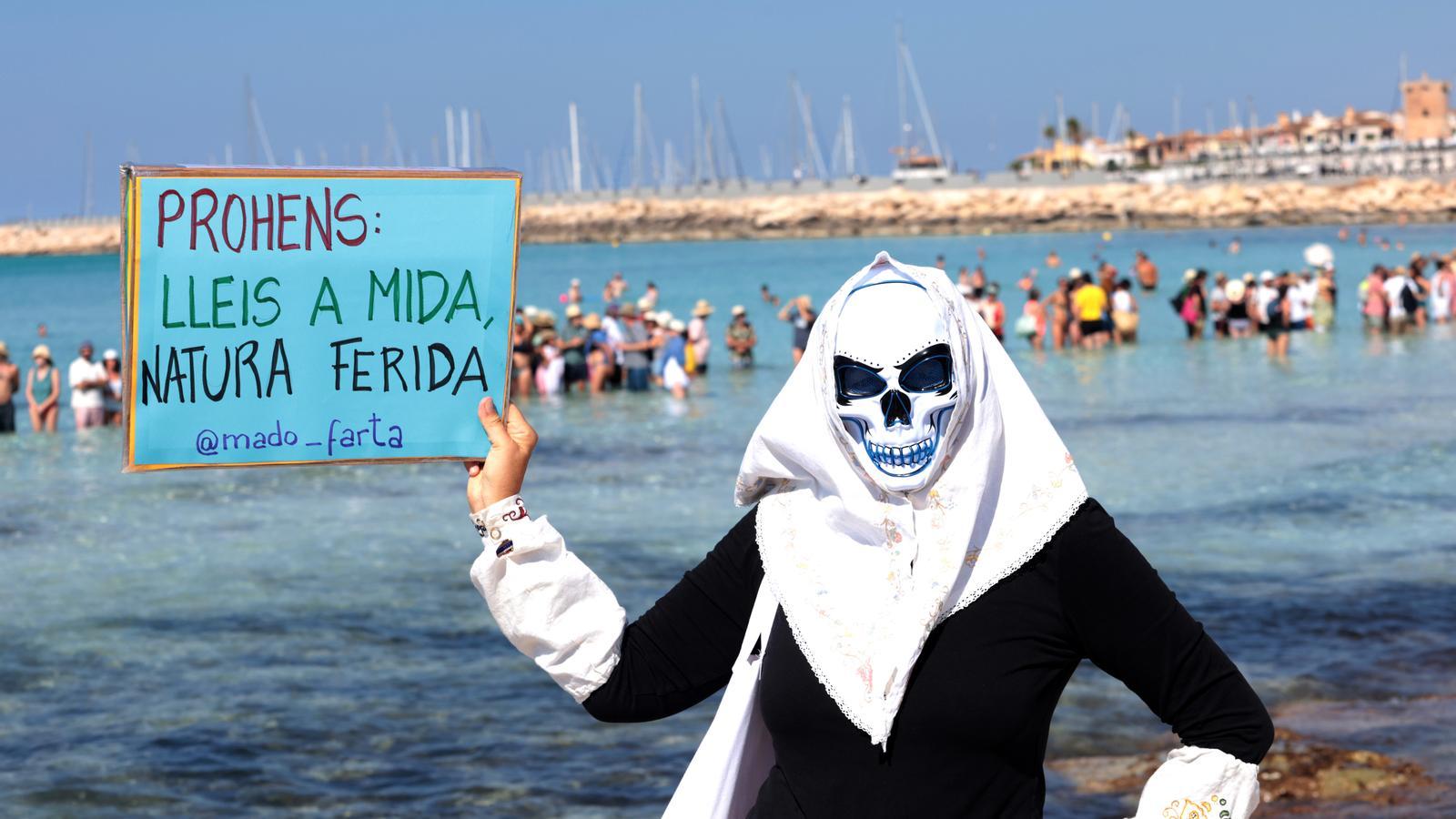
PalmaWith her face hidden behind a skull mask and dressed as a peasant woman, Madò Farta began to make noise —despite being a mute figure shrouded in mystery— on social media in June of this year. Since then, this figure, halfway between a bogart and a feminist water spirit, has appeared both alone and supporting other calls, in most —if not all— of the protests against tourist overcrowding convened throughout Mallorca.
Madò Farta has gone from being an Instagram profile to becoming a symbol of the protests. At what point did it surprise you to see that the character had transcended so much?
— I think the clearest moment was when I decided to go to the Trenc protest and I saw all that response from people. The way they received me and the signs of support, gratitude, and affection completely surprised me. I remember that moment because I felt a mix of emotion and responsibility. On the one hand, it was very powerful to see that what had started as a symbolic action had connected with so many people. But, on the other hand, I also had a moment of dizziness and thought: "This is getting out of hand." Not because I was afraid of the message, but because I became aware that Madò Farta was no longer just a person behind a mask, but represented a feeling that many people carried inside and perhaps had not found a way to express. That is a very great responsibility.

What is the last straw that made Madò Farta be born?
— It wasn't a single drop. It was the sum of many small concessions that we have normalized: seeing how the territory changes at a dizzying speed, realizing that it is increasingly difficult to live in our land, losing spaces that felt ours, and constantly feeling that there is no alternative. But, if I have to be honest, I think this is also part of my way of being. In my home, since I was very little, I have never been one to settle for a "because yes" or a "because I say so." I have always needed to understand things, to be explained the why, and at the same time, to feel that I too could contribute a proposal or a different way of seeing them.
What is Madò Farta like behind the mask?
— She is an absolutely normal person. She works, has a family, friends, worries, and a life like any other Majorcan woman.
Some say that movements against overtourism are "tourism phobia".
— I think it's a very convenient label because it avoids getting into the fundamental debate. It's not tourismophobia to ask for an island to have limits. It's not tourismophobia to defend that people can access housing or that the territory is not exploited to the limit. Tourists are not the enemy. The problem is a model that for decades has confused growing with growing without limits.
And there are also those who say that tourism is untouchable because it is the engine of the economy of the Islands.
— No one denies the importance of tourism. What we question is that it has become a dogma that prevents any debate. Precisely because it is so important, we should ask ourselves if it is intelligent to depend almost exclusively on a single sector and take it to the point of saturation. A strong economy is not one that grows without brakes, it is one that guarantees quality of life for the people who live there.
The mobilizations against mass tourism have grown throughout the Balearic Islands. Have you noticed a change in social perception? Is the public now less afraid of criticizing the model? Or the opposite?
— Yes. I think something has changed. Years ago, many people expressed these concerns only in private. Now, more and more people are doing it publicly, and that is very significant. There is still fear. There are people who think that talking about this will make you look bad or get you labeled. But this fear is starting to crack, and that is healthy for any democratic society. However, there is a contradiction that really catches my attention. Every day I talk to very different people and, regardless of their age, profession, or way of thinking, many agree on the diagnosis: overcrowding is excessive, housing is inaccessible, the territory is at its limit, and the quality of life has worsened. And, despite this broad consensus, it seems difficult to transform this shared concern into collective decisions. Sometimes I have the feeling that we continue to vote out of inertia, habit, or because we think things cannot be any other way. That is why I believe that, more than losing the fear of criticizing the model, we must also lose the fear of demanding changes and assuming that our vote is a tool to build the Mallorca that we say we want. If a majority shares a problem, it should also be able to demand coherent solutions.
Do you think Majorcans are losing their identity?
— I believe that identity does not disappear overnight. It weakens when we stop taking care of what sustains it. Language, landscape, people, traditions, the way we relate to each other... all this needs space to continue to live. If everything ends up subordinated to an economy designed exclusively for tourist consumption, it is evident that this identity suffers. Defending it is not looking back with nostalgia; it is wanting to have a future. What we should lose is fear. The fear of speaking loud and clear. The fear of defending our language, our territory, and our way of life without being labeled or made to feel guilty. Loving Mallorca is not going against anyone. It is loving our home. And a society that is afraid to express what it loves is a society that runs the risk of letting others decide for it. That's why I believe that, if we have to lose something, let it be fear. Identity, on the other hand, we must take care of because it is what makes us who we are.
What is the most urgent measure you would apply if you could decide on the policy of the Balearic Islands tomorrow?
— I would put a real ceiling on the number of visitors. I think it is the decision on which many other things depend. Without assuming that Mallorca has a limited capacity, it will be very difficult to effectively address housing, mobility, water consumption, land conservation, or quality of life. We cannot effectively manage what has already exceeded its own limits.
If you could sit down for an hour with Marga Prohens tomorrow, what would you ask her?
— I would ask her that, for an hour, she stop looking at statistics and listen to people. But, above all, I would ask her for something even more difficult: that for a while she stop being president and live the Mallorca that so many residents live every day. That for a day she share the anguish of a family looking for a house to live in without having to dedicate almost their entire salary to it. That for a week she do the job of a chambermaid, so that she understands what it means to sustain one of the most powerful industries in the Islands through physical effort, often invisible. That for a year she accompany a young person who has been forced to leave Mallorca because here they have not found a future...
Now I will ask you a real question that has been asked in Miss contests: if you could enact a new law, what would it be and why?
— I would enact a law that placed the quality of life of residents at the center of any decision regarding the territory. Of the residents, regardless of their nationality, as long as they wish to be part of this community, respect it, and contribute to it. I would also establish very clear limits on land speculation. I would prohibit new constructions on the coastline and in areas of great landscape value. There are places, like the Mola d'Andratx area, which for me symbolize how far we have come. When you contemplate a mountain covered with large villas, many occupied only a few weeks a year, you inevitably ask yourself: was this the future we wanted for Mallorca?
