Why does Palma not have a large urban park?
Experts explain how the city's growth, tourist pressure, and urban planning decisions have left the City without a large green space comparable to those in many European capitals

-
CAT -
CAST -
DE
PalmaPalma is one of the few European capitals without a large central urban park comparable to those in cities of similar size, such as Oviedo, Vitoria, and Seville, or to the large historical gardens present in many other cities. Why does the city not have a large green lung today? The enigma now resonates more strongly amid the climate crisis, tourist saturation, the need for green refuges against heatwaves, and discussions about Palma's water resources capacity to accommodate the 46,000 new inhabitants projected for the next decade.
For many specialists, the lack of a large urban park is not accidental nor the result of a temporary oversight, but the direct result of how Palma has developed for over a century. Professor of Geography Macià Blàzquez recalls that many European capitals inherited large aristocratic gardens or spaces linked to power. "We have not had any component of the ruling class, especially the aristocratic one, that promoted a Versailles-like garden," he explains. According to him, this historical absence marked the city's urban future.
The large expansion plans also did not reserve spaces of these dimensions. Blàzquez recalls that key figures in Palma's urban planning, such as Bernat Calvet, Gabriel Alomar, and Manuel Ribas Piera, did not foresee any large central park. Palma was built with a different logic.
Very specific structure
The doctor in Geography Maria Lluïsa Dubon agrees that the urban configuration itself conditioned its evolution. "We start from a very specific previous structure. The historic center of Palma is one of the largest in Europe and the city is shaped like a scallop shell, with the maritime facade at the bottom," she explains. This morphology, she adds, already guided urban growth.
Dubon also highlights that Palma did not have large properties susceptible of being turned into urban gardens, as did happen in other capitals. "In Madrid there were spaces like El Retiro and the Parque del Oeste. Here there was no such availability of land," she points out.

For decades, the city considered that it already had its great green lung: Bellver forest. Both Blàzquez and Dubon agree that Bellver has historically performed this function. "The same urban planning legislation requires five square meters of green space per inhabitant and this is more than sufficiently covered by Bellver," points out Blàzquez. This circumstance, according to the geographer, contributed to consolidating a denser city with fewer green spaces in the interior. "Palma has never worried about having green spaces, because it already had Bellver," he summarizes.

But the model is now showing its limitations. Experts agree that high temperatures, urban densification, and the lack of shaded areas in many neighborhoods have turned green spaces into a climatic and public health necessity.
Dubon insists that the debate should not be limited to the creation of a single large park. "Climate refuges distributed throughout the city are fundamental," she defends. As she explains, a large central park – which is what happens with Bellver forest – can be far from a large part of the population, while small green spaces spread across neighborhoods can have a much more direct daily utility.
At the same time, experts agree that tourism development has profoundly conditioned Mallorca's urban priorities. Blàzquez maintains that tourism has historically been promoted in enclaves created almost from scratch, such as Magaluf or Playa de Palma, and that a large part of public resources have been allocated to sustain them.
"The needs of the tourist, and especially the tourism entrepreneur, are paid for by all of us," he states. The geographer cites continuous investments in Playa de Palma in infrastructure, lighting, and the rainwater collector (CAZ) as an example. This infrastructure alone has a cost of around 11 million euros, after the latest budgetary injection of 1.65 million.
"Palma is a town that supports tourism"
According to Blázquez, the residential part of Palma has ended up acting as a "support town" for tourism, as happens in the Caribbean tourist enclaves, such as Varadero or Punta Cana with the support towns of Cárdenas, Matanzas, and Verón. Meanwhile, initiatives that could generate new green spaces in the non-tourist part of the city have been reduced or transformed. The geographer gives as an example "the case of a plot in Son Pisà, initially planned as a park, which will now have a lucrative use".
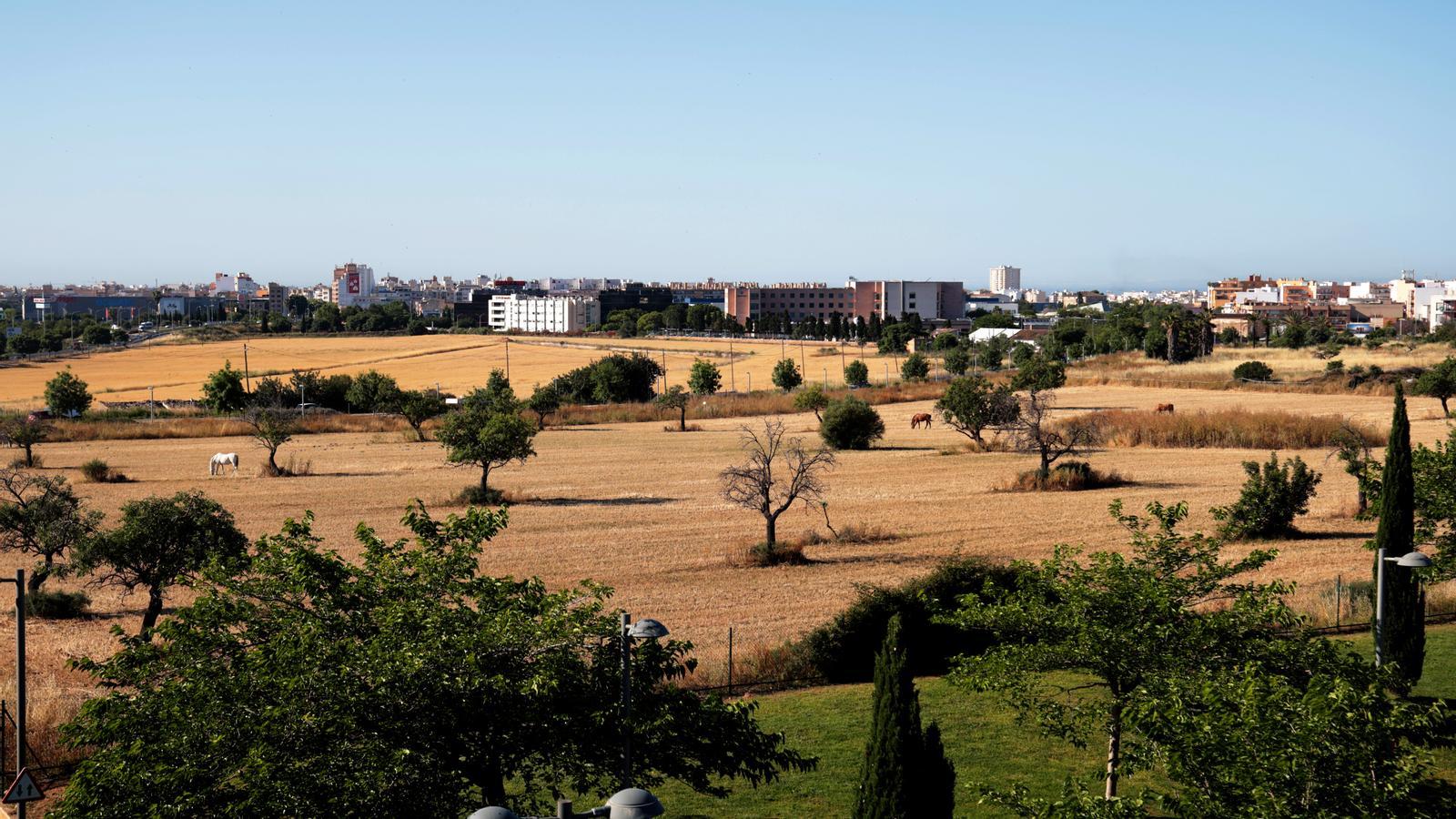
During recent years, one of the main alternatives proposed – to the General Plan of 2023 – for introducing large green spaces has been the metropolitan agricultural park. Dubon explains that this project, inspired by British green belts, aims to create an agricultural belt around Palma to curb urban sprawl and preserve rural land. The proposal particularly affects areas of the Pla de Sant Jordi, in the east, and the northern area of Palma, from Son Sardina and Son Espanyol to La Real and the surroundings of the UIB. "The planned delimitation is one of the largest in all of Spain", highlights the geographer.
Containing the city's oil stain
The objective is twofold: to contain urban sprawl and to maintain productive spaces capable of providing food sovereignty on an island that is highly dependent on external sources. Both Dubon and Blàzquez believe that currently there is a moment of regression regarding urban development. "At this moment we are in a phase of regression after having taken important steps," laments Dubon. Blàzquez, for his part, believes that current urban policy clearly opts for growth and densification.
This perception coincides with a context marked by the housing crisis. Experts acknowledge that Palma needs to expand its residential offer, but they warn that the debate cannot be detached from urban and environmental quality.
The Palma City Council, meanwhile, claims some ongoing projects to increase green areas. The main one is the rehabilitation of the Tirador velodrome, where a park with nearly 12,000 square meters of green surface is planned, more than half of the total area. This project would end up joining the Canòdrom park and the Riera park, thus completing the so-called green wedge.
