In Menorca one can no longer live
The general increase in prices and record influx of visitors impoverishes the local population, which suffers from the housing emergency and has had to modify consumption habits

-
CAT -
CAST -
GER
CitadelMenorca is on track to break the record for visitor arrivals this year. The latest data from Aena counts more than 3.1 million passengers at the airport through August, 2.5% more than last year, when historic figures were reached. Meanwhile, the island's inhabitants are suffering from the housing emergency and have had to change their consumption habits. Because in Menorca, one can no longer live, by any means, like before.
Hotels are also recording record occupancy data this summer in Menorca, with prices also soaring compared to previous years. On the third weekend of September, on theBooking portal, it is impossible to find any accommodation for two people on the island that is under 100 euros. The cheapest, at 101 euros per night, corresponds to an end-of-season offer from a hotel chain in Macaret (Es Mercadal).
But the monthly survey prepared by the business association PIME raises a red flag: only one in five restaurants has increased its turnover compared to the summer of 2025. The reason, beyond the high temperature, can be found, according to the association, in the growth of the supply of prepared meals in supermarkets. Only a portion of visitors and fewer and fewer Menorcan families can afford the prices of tourist services and complementary offerings.
Via Menorca
The GOB-Via Menorca campaign warned about it: the growing saturation that the island suffers during the central months of summer not only punishes natural resources, but also aggravates job insecurity and the difficulties in accessing housing.
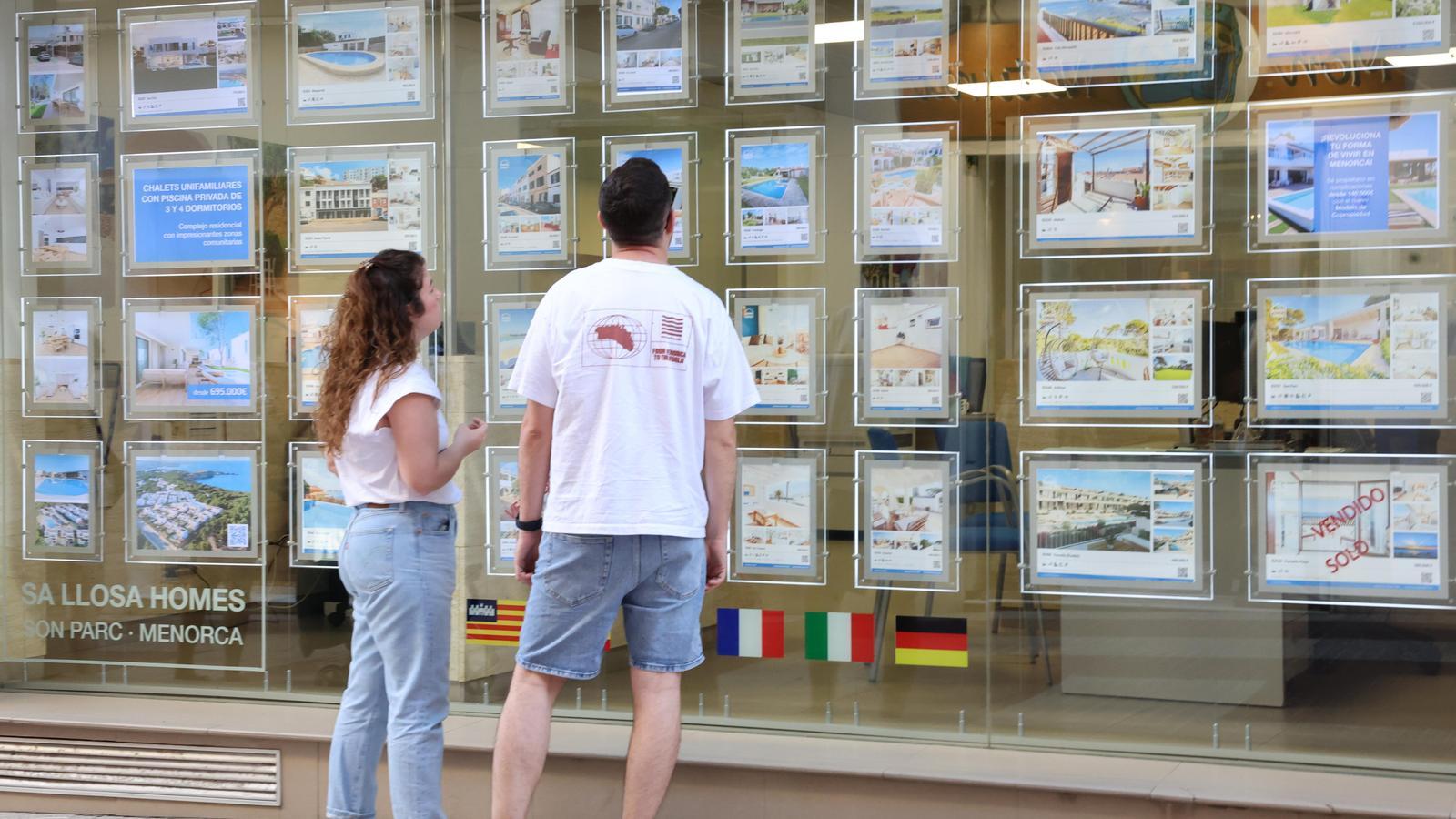
The establishment five years ago of the Hauser & Wirth gallery on the Isla del Rey in the port of Maó –which receives more than 70,000 annual visitors– has increased the arrival of high-purchasing-power tourism to Menorca. A phenomenon that has translated into the opening of other renowned galleries and that has been noted especially in the real estate sector, where the majority of properties on the coast have passed into foreign hands. The price of housing has become so expensive that it is inaccessible to a large part of the resident population. This trend has been reflected in other sectors of the local economy, such as the supply of accommodation and catering, which have also raised prices, often out of reach for Menorcan families and for national and British tourists with fewer resources who still visit the island. In some establishments in the center of Ciutadella, for example, a glass of wine exceeds five euros and the price of common and usual dishes on all menus, such as hamburgers or pizzas, is much closer to 20 euros than to 10.
“The tourist complains to us because they say that Menorca is expensive, but we make them see that those who live here pay it all year round,” comments the president of the Menorcan restaurateurs, Antoni Pons. The businessman, with a business open for years in Ferreries, admits that restaurants have had to raise their prices significantly in recent years because “raw materials, the collective agreement, electricity, gas, and health and occupational risk obligations have also gone up.” “If people who go to the supermarket notice it, it is also normal for the price of dishes to become more expensive. It seems that we are bleeding the tourist dry, but that is not the case. Most cannot avoid paying for the ticket, the rental car, and the stay, but they can avoid eating lunch and dinner out. They spend in the restaurant just what they have left in their budget.”
The increase in visitors coincides with an impoverishment of the resident population, which has difficulty even finding a place to live. According to INE data, over the last four years the average price of housing in Menorca has grown between 50 and 60%. This is the case of Ciutadella, where it has gone from an average price of 2,349 euros per square meter in 2022 to 3,564 euros in the first quarter of this year. In Maó it has also skyrocketed: from 1,754 euros per meter four years ago to the current 2,812. A TINSA report places Alaior as the Balearic municipality where the price of housing has grown the most in the last year.
The one that has suffered the most is the residential rental supply, almost completely annulled by the tourist one. In the middle of September, outside the central months of the season, finding a rental apartment for the whole year through the reference real estate portals has become almost impossible. Of the 144 accommodations available on the island right now on the Idealista portal, only 25 can be rented all year round: the remaining 119 (82%) are seasonal. There are only two apartments that are rented for under one thousand euros per month: a 50-meter apartment for 850 euros in Arenal d'en Castell (Es Mercadal) and a 50-meter apartment for 950 euros per month in the urban center of Maó. The most economical offer in Ciutadella is an apartment in Cala Morell for 1,200 euros per month. A duplex in Es Migjorn Gran, the smallest municipality in Menorca, is rented for 1,350 euros per month.
“There are people living in precarious situations, inside cars or vans, or even on the beach, a situation that previously only occurred on other islands and is now present in Menorca,” laments Roser Román, architect and former island director of Housing at the Council. “Not to mention those who are struggling while living at their parents' house, with the worsening of health conditions that this entails,” she adds. In fact, one of this year's courses at the School of Public Health held at the Llatzeret analyzes the close link between housing, social inequalities, and health.
The ‘cohousing’ formula
To address this, beyond the new residential developments launched by Ibavi and the changes the Council is preparing to the Island Territorial Plan (PTI) to allow building one more floor in all the island's municipalities, Román proposes the cohousing model. It is a modality successfully implemented in other European countries that promotes housing as a good exclusively for use and avoids real estate speculation.
As president of the Niu Ètic association, Román has managed to get Ibavi to cede a third of the plot in Es Mercadal where it will build a development of 35 social housing units to promote a first housing cooperative on public land in this location. An initiative that the architect also wants to extend, in contact with the town councils, to other municipalities in Menorca. "The most important thing is to change the model of relationship between the Administration and the citizens. It is necessary for the citizenry to be more organized, committed, and responsible, and for the Administration to stop being so paternalistic and offer facilities to be able to give a new use to empty plots and buildings. Acting on public land makes it more accessible, since the price of land is so exorbitant that it is inaccessible to many people," she explains. The added problem is that "the procedures are eternalized and solutions may take time to become effective," she adds.
Although a good part of the Minorcans considers that tourism should not grow anymore, AENA plans to expand the airport's capacity so that in 2031 it receives 4.5 million visitors. The PP and Més per Menorca have expressed their opposition to it. Also the GOB, which asks the State that the 170 million it plans to invest in the Menorca airport serve to "improve the services necessary for the population and to move towards a more sustainable model, and not to increase the capacity to attract more and more tourism." "Much less on an island that is a Biosphere Reserve, where the conservation of natural and territorial values is incompatible with a policy of continuous increase in tourism pressure," says the entity. "An island that only knows how to receive visitors ends up forgetting that the most important thing is to take care of the people who live there and the territory that sustains them," sentences the GOB.
Minorcan economist Guillem López Casasnovas estimates the extra cost of living we suffer in the Islands at 16%. This is the calculation from a recent study by the Generalitat, which the former Bank of Spain board member considers accurate, given that wages and purchasing power in relation to the prices of goods and services are lower than in other regions. "Those who also suffer are the immigrants themselves, who come with the belief that we are a wealthy community and then—due to the rising cost of food and housing—cannot manage to access the most basic goods to have a dignified life," he points out.
López Casasnovas says that even the CPI grows more in the Balearic Islands than anywhere else, "but especially for those imported products that least benefit the local economy. That is why—he highlights—there are queues at supermarkets like Mercadona and not at municipal markets to buy meat or fish."
