Eight million promised and museums still closed: the failure of cultural reforms in the Balearic Islands
Four years after the agreement between the Ministry and the Government, only the reform of Can Sales has been completed, while facilities such as the Museum of Mallorca, the Museum of Muro or the MAEF continue to await urgent works

-
CAT -
CAST -
GER
PalmaFour years have passed since the General Directorate of Culture of the Government, headed at that time by Catalina Solivellas, and the Ministry of Culture announced an ambitious plan to renovate the main state-owned cultural facilities in the Balearic Islands. The State had committed to investing up to eight million euros in four different venues –the Museum of Mallorca, the Can Sales library in Palma, the Ethnographic Museum of Muro, and the Dalt Vila headquarters of the Archaeological Museum of Ibiza and Formentera (MAEF)– within a period of precisely four years. The forecast, therefore, was that at the beginning of 2026 all these interventions would have been completed.

In May 2026, however, only at Can Sales has the planned renovation been completed, with an investment of almost two million euros, and activity has been able to resume normally. Meanwhile, the Etnogràfic de Muro continues awaiting a comprehensive rehabilitation that has not yet arrived; the archaeology rooms of the Museu de Mallorca remain closed, as does the Dalt Vila headquarters of the MAEF. To all this have been added other interventions that were not foreseen in that agreement and that during this period have become urgent, in spaces such as the Arxiu del Regne de Mallorca or the MAEF headquarters at Puig dels Molins. It seems that no one has a completely clear idea of when they can be carried out, nor how, and that the involvement of various institutions –often up to four: the state administration, the Government, the corresponding island council, and the competent town hall– has not only failed to accelerate or ensure their completion, but has also made it more difficult and delayed. And this, despite everything being signed and supposedly on track in 2022.
Headquarters and closed rooms
When it is almost 120 years since the founding of the Archaeological Museum of Ibiza and Formentera – in 1907 – its headquarters in Puig des Molins and Dalt Vila are awaiting interventions of different magnitudes. The first one is open and pending the rehabilitation of the facade, which is currently covered by a mesh to prevent detachments. “An assessment was made that recommended protecting all the slabs, as there were unstable ones,” states the center's director, Hortènsia Blanco. Regarding the Dalt Vila headquarters, it has been closed since 2010 and has no approximate opening date. “There was a very ambitious project that planned to expand the area, but it did not go ahead in the end,” explains Blanco, who emphasizes that throughout this time very important excavation campaigns have been carried out, the results of which have not yet been able to be exhibited. “Urgent recovery work has been carried out in the chapel of the Salvador and in the University hall, where elements worthy of display have been discovered. For this reason, we will make occasional and restricted visits, also as a way to make visible what is being done and to demand the pending reform,” shares Blanco.

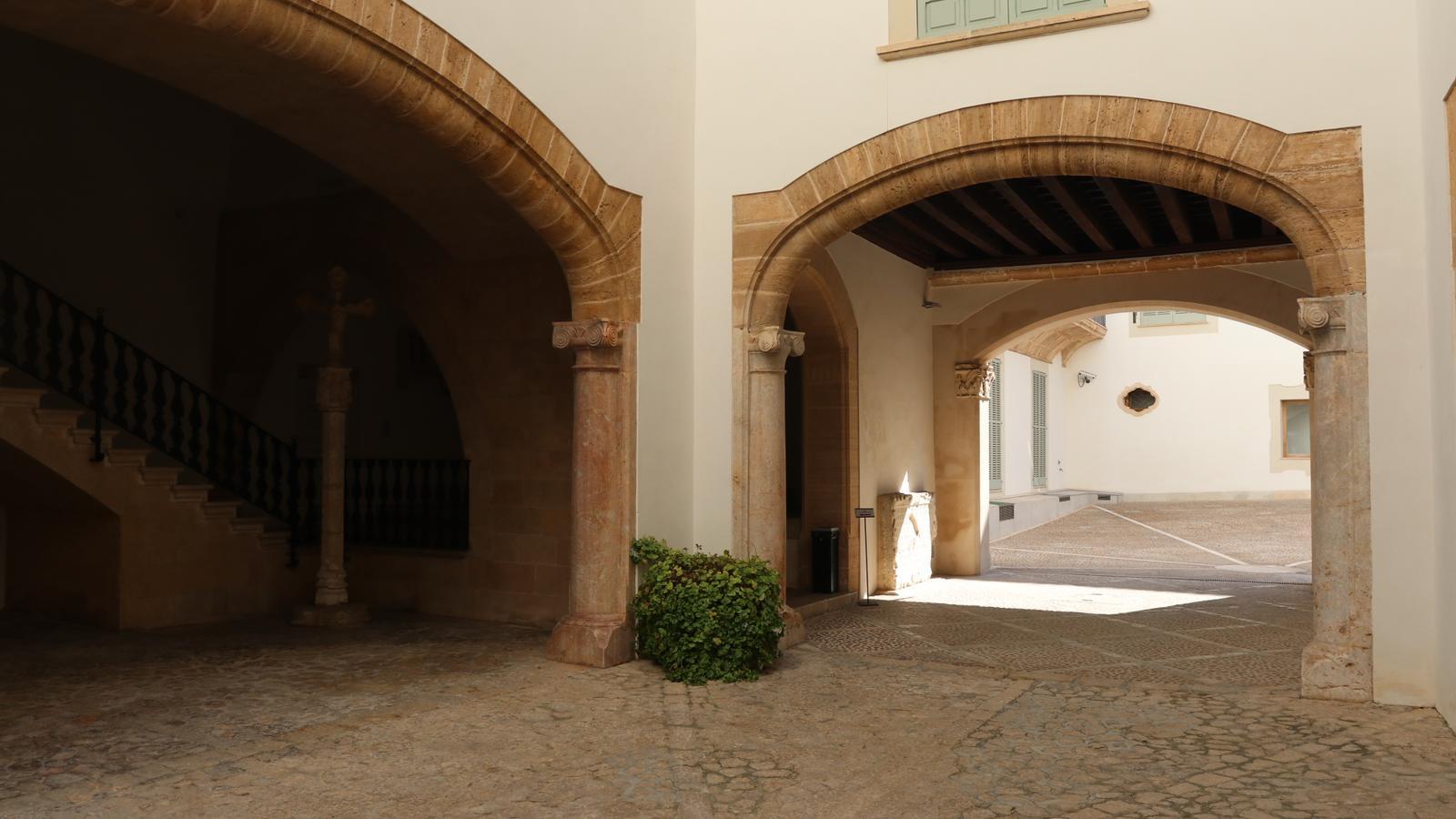
Another of the most emblematic cases is that of the Museum of Mallorca, a state-owned facility, whose management responsibilities were transferred to the Consell de Mallorca in 2019. 10 years earlier, in 2009, its archaeology halls were closed, and since then they have been awaiting a series of interventions that, according to the director of the Museum of Mallorca, Maria Gràcia Salvà, could be completed within a year if the marked calendar is met, which has not happened so far. At the moment, the air conditioning tasks for the 13 halls, which are currently empty, and the tender for the execution of the museographic project approved two years ago, still remain pending.
“The contracting of air conditioning services has already been greenlit and is expected to start by the end of the year. It is an intervention that could last for a few months”, explains Salvà, “but we have requested that the contracting of the museography execution, which is already done, be carried out in parallel in order to reduce the time between the completion of the air conditioning and the opening of the halls. Although several interventions have already been carried out and we have the entire museographic program ready, with the restored pieces and the written panels and posters, until all the air conditioning is completed, we cannot start talking about reopening them”.
In any case, the current director of the Museum of Mallorca emphasizes that the delays that have occurred so far have had various causes, although she immediately points out that in no case has it been due to a lack of involvement from technicians. “For example, regarding air conditioning, we contacted a Mallorcan company two years ago that later backed out”, she states. “Then there is also the whole political issue. In recent years, there have been requests for intervention from local politicians, who have called for the Ministry's intervention, and the response has not been enthusiastic, to be honest”, she adds.
The Government's involvement
Along the same lines, the current Director General of Culture of the Government, Llorenç Perelló, who took office last February after having been director of the Institut d’Estudis Baleàrics for almost three years, states. "It is enough to see the situation of the Archaeological Museum of Eivissa and Formentera, where, since last summer, a series of detachments have occurred on the facade that led us to have to install a mesh. This is problematic not only because it prevents the visitor from enjoying the experience comfortably, but because it endangers the safety of people and also of property. What we see is that it is more interesting to invest in other places, who knows if for political reasons".
In this regard, Perelló points out the problem, also of air conditioning, that affects the Archive of the Kingdom of Mallorca, and where the Government is considering seeking alternative financing methods to resolve it with its own means. "During the summer, the deposits reach very high temperatures that endanger the materials stored there. Our objective is that it be solved before the summer of 2027", he shares, although they cannot yet specify the figures. However, it seems that these claims made by the Government are only recorded in the sectoral meetings that periodically take place between the counselors of the different autonomies and representatives of the Ministry of Culture. Although the Consell de Mallorca has convened several meetings and public claims have been made about these interventions, the last one, in May of last year, so far does not seem to have been, by far, a priority issue on the agenda of the department headed by Jaume Bauzà, responsible for maintaining these types of conversations with the State. In fact, even though the competencies in the management of some of these facilities have been transferred, the Government is still responsible for the obligations related to relations with the General Administration of the State and the entities dependent on it, as stated in the various laws on the transfer of competencies.
And the management?
In any case, according to the latest action plan of the Directorate General of Infrastructure and Cultural Facilities of the Ministry available on the institution's website, which corresponds to the interventions planned for 2024, the amount to be invested in the Balearic Islands did not reach 1% of the budget allocated to this matter throughout the State. Among the actions, the adaptation of the archaeology section of the Museum of Mallorca was cited, with the commitment to carry out the work, and the rehabilitation of the Ethnological Museum of Muro, which was then presented as an intervention "pending credit". However, as the consulted professionals rightly point out, the problems in the operation of these facilities are not only related to the reform and adaptation of the spaces but, above all, to the day-to-day management and operability, which cannot always be ensured with the resources allocated to them and which, in practice, depend on various institutions. "We do all the work we can, with the hands we have," summarizes Maria Gràcia Salvà.
