The Principal Theatre of Inca hosts the most innovative version of 'Cosi fan tutte'
The daring proposal of Miquel Àngel Raió, with Bernat Quetglas at the helm, directing the Orquestra de Cambra de Mallorca, will offer two performances this weekend with projections and costume changes in full view of the public

Palma“I am on the threshold of fullness”, Mozart wrote in a letter in 1790, the same year as the premiere of Cosi fan tutte, or La scuola degli amanti. Christoph Wolff recounts this in his essay and makes it the title of the book that, translated by Ramón Andrés, was published by Acantilado. It tells, among many other things, that the libretto Da Ponte presented to Mozart bore the title that remained as the subtitle, but Mozart found the one we all know more suitable, for musical reasons, and surely some others. It should be noted that Da Ponte never acknowledged the name by which it has gone down in history and in his Memoirs; he only mentions it once in a small paragraph, where he recounts writing a third piece for a singer, to whom he gives no name, but it was Adriana del Bene, known as La Ferrarese, his lover at the time. They were El pastor Fido and La xifra, by Salieri, and La scuola degli amanti, by Mozart, “which occupies third place among the sisters born of this most celebrated father of harmony”. Not a word more. It is clear that the interpretation of the work between one and the other was conceptually very different, at least regarding the title. Mozart, for his part, gave prominence to female behavior, while Da Ponte sought, and found, a philosophical and groundbreaking reading, as well as much more researched and profound.
That's how they all do it or the school of shame

Show gears
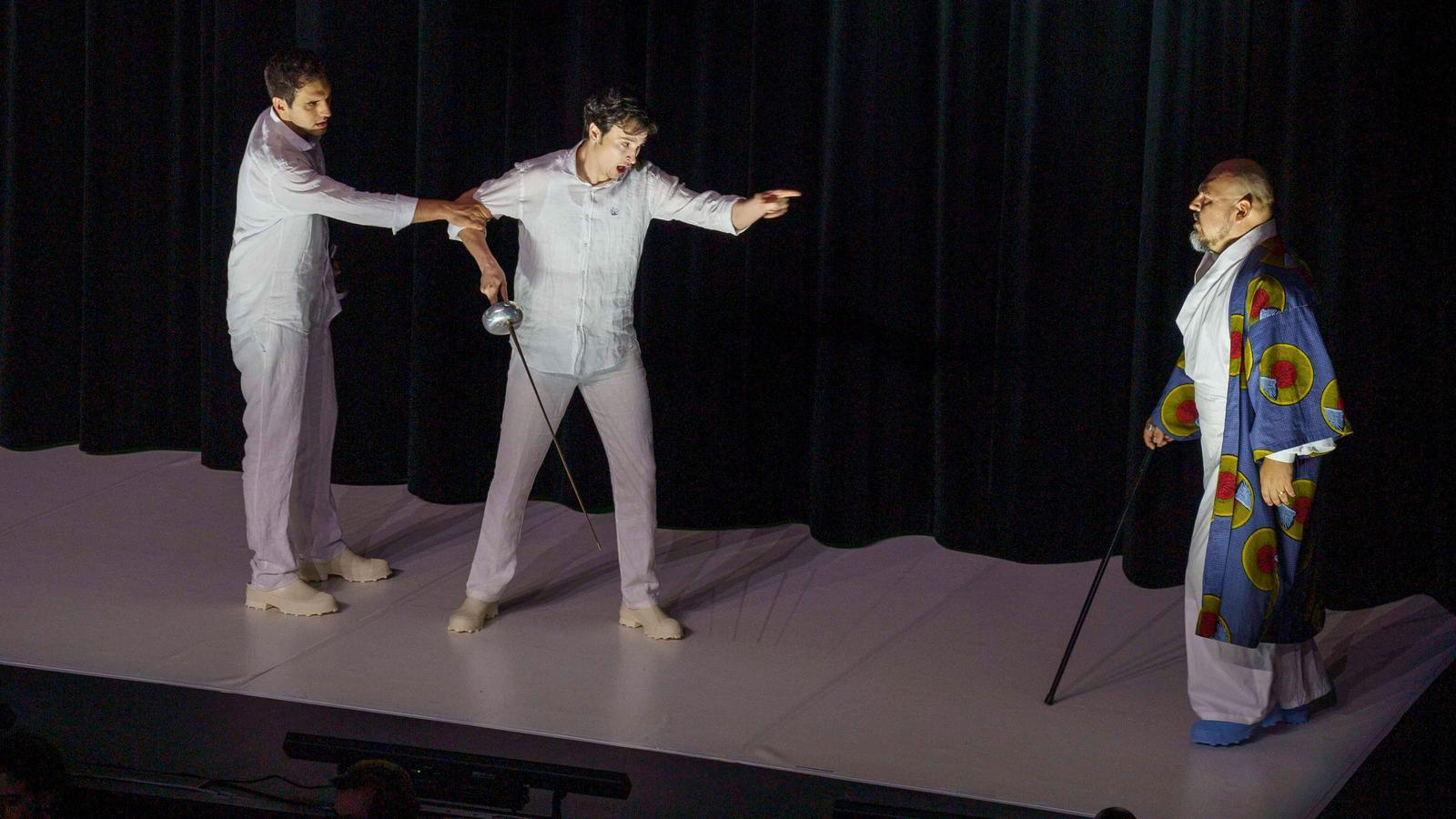
If until now the operas of each season of the OCM and the Principal Theatre of Inca were almost staged but without sets, for the occasion they have taken a step forward with a sustainable and recyclable approach and format, in which students from Adema, based in Inca, have participated, with projections by Raió himself as a tool to change the location of the action. On the other hand, the action develops with costume changes in view of the public, "showing its gears". A major challenge that demonstrates how and where the Principal Theatre of Inca is growing.
The program reads: "The scenic proposal aims to open questions rather than give answers. How far can we control what we feel? To what extent are we true to ourselves? And what does a society that needs to put love to the test say about us? Così fan tutte speaks to us –with clear irony– about one of the great timeless themes: love as a game, as a mystery, and as a mirror of our human condition". Quite explicit, this decalogue of intentions and declaration of principles.
An express production
Bernat Quetglas says it is an express production. “What normally takes a month to come to light and find its footing, we have done in just ten days”. “It has been a pleasure to study and interpret a mature work by Mozart, where each musical moment contains a great narrative charge. Surely a more solid piece musically and structurally than The Marriage of Figaro”, the first collaboration between Da Ponte and Mozart. Of course, he also acknowledges that the effort to take this step further has required and demanded additional effort that will surely be rewarded, such as, for the moment, being able to schedule it two days in a row.
One of the most interesting characters among the six protagonists of the opera is undoubtedly Despina, the maid of Fiordiligi and Dorabella, the two young ladies who fall into the trap devised by Don Alfonso, and who is played by Irene Mas. She defines him as “very interesting, very real, who undergoes a suggestive process of transformation during the opera, which makes entering it a pleasure and a puzzle, although I am sorry that she is also deceived. When you have covered and understood all her layers, you are left with the task of understanding others from the point of view of what you have already achieved”. With a tone of satisfaction, she describes it as “an encouraging job, where Raió has changed his usual register, while Cecilia Ligorio, the assistant director, has very effectively conveyed how to deliver the recitatives, and thus be able to understand them with all the intention and scope, because it is here that the core of the plot lies, rounded off by music that ensures nothing escapes, that explains everything”.
