What 30 years of the Night of Art leave us
A strong fabric is not only the one that attracts the most audience or sells the most, but also the one that makes its own artistic scene grow
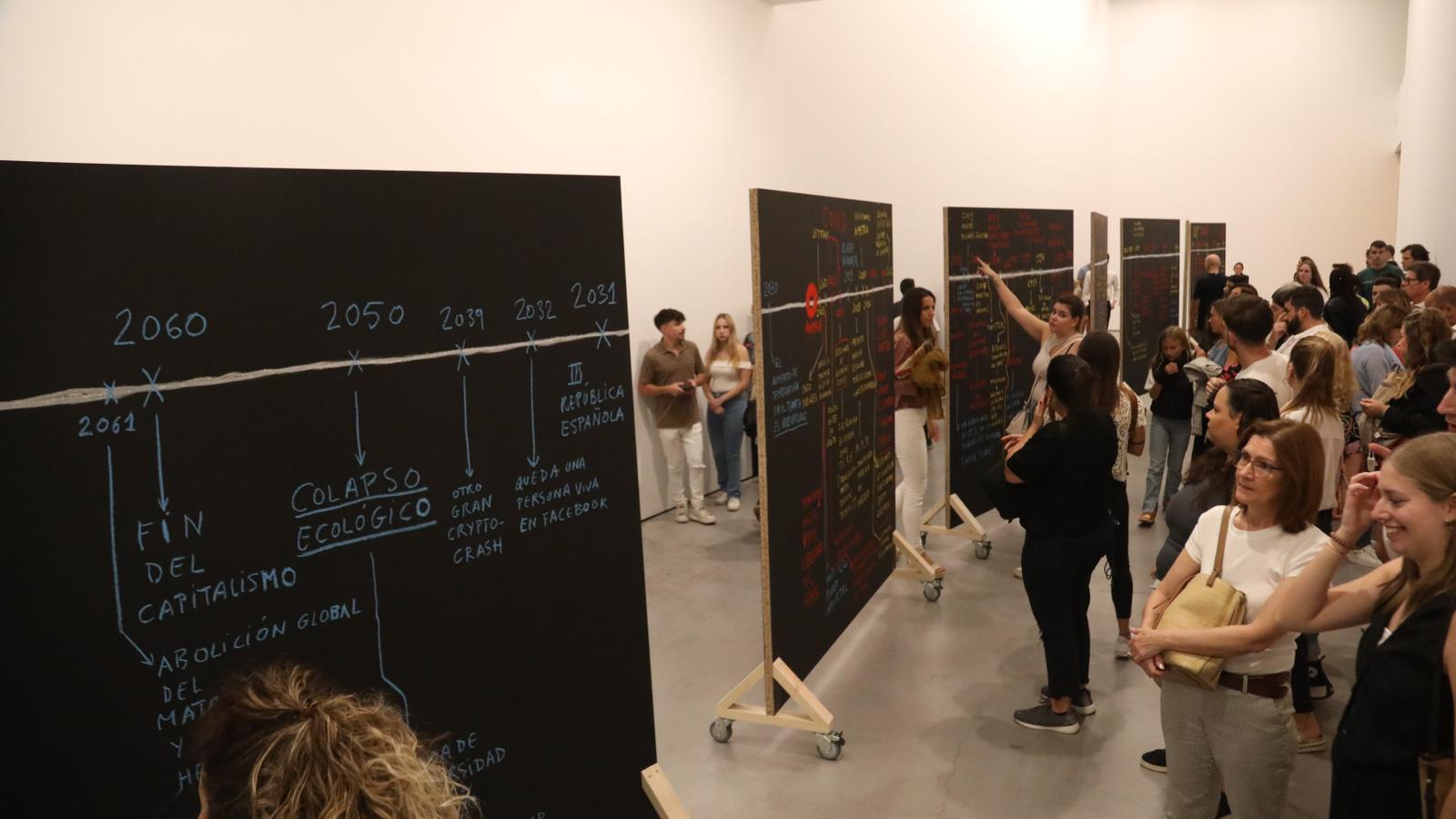

PalmaThere are not many cultural initiatives around us that can boast of having reached 30 years. The Nit de l’Art has achieved this, and that is no small feat. Born in 1997 as an initiative by some gallery owners in Palma such as Pep Pinya (Pelaires), Xavier Fiol, and Joan Guaita, among others, it was conceived with the desire to join forces—perhaps thinking that the more there are, the more noise is made—and, above all, with the purpose of bringing art closer to the citizenry. It has been many years since the Nit de l’Art achieved a good part of these objectives. But what does it leave us and what could the Nit de l’Art leave behind, with the strength it has gathered in these 30 years? Perhaps it is a good time to ask ourselves that.
It is undeniable that the gallery owners have maintained the capacity for joint action. In these three decades, they have not only increased initiatives in the style of the Nit de l’Art: the Art Palma Brunch (which has been organized since 2005), the Art Palma Summer (since 2016), and the recently launched Mallorca PhotoFest (2026). They have also grown; the gallery owners' association itself has gone from being a small and closed group as the original AIGAB was, to the much more open Art Palma Contemporani, which now brings together 16 galleries. The fact of being capable of organizing joint activities of a more than significant volume, even if they are occasional throughout the year, is not a minor fact. It means that there is or there could be a solid fabric that moves the market and the public that artistic creation needs. If, in addition, as is the case, the gallery owners managed from almost the beginning to have museums, art centers, and other sociocultural infrastructures join in at the Nit de l’Art and the rest of the events, it means that there is or should be a support platform for artists that is sufficiently broad and strong.

Furthermore, right from the first editions of the Nit de l’Art, the public responded, and did so massively and in a very growing manner as the years passed. With as many people as the ones gathered each Nit de l’Art, the interest in art and in what galleries and public exhibition spaces offer should be more than guaranteed. In fact, if one only evaluates the capacity to attract crowds in quantitative terms, it could be concluded that this is one of the great successes of the Night and of those who organize it. Less clear is the answer to the question of whether all this has contributed to strengthening the artistic fabric, that is to say, to boosting creation, making galleries more solid and profitable, and increasing the interest in art on the part of citizens. Obviously, there is no single answer, but it is a fact that the vast majority of people who go to galleries and museums for the Nit de l’Art do not return for the rest of the year. And the pool of artists in Mallorca seems weaker today, if only because creators have to make a place for themselves within an international sphere that has entered our home. Furthermore, whether by casual coincidence or not, it is worth noting here that the artists' association, once so active in the defense of good practices and the rights of the collective, is now disbanded.
A strong fabric
In any case, it is not a matter of demanding that galleries exclusively program local artists, nor of confusing proximity with quality. It is a matter of asking whether the growth of the gallery circuit and its activities has been accompanied by an equally firm commitment to create, support, and provide an outlet for the artists working in the Balearic Islands. A strong fabric is not only one that attracts more public or sells more, but also one that fosters the growth of its own artistic scene.
The issue becomes more complex if we look at the evolution of the art world. If the Nit de l’Art is a product of the market, it functions increasingly in a digital and global way, and the flows of creators and businesses have been losing local references. On the island, the process has been greatly accentuated by the purchase of houses by foreigners and, in parallel, by the arrival of businesses dedicated to the sale of works intended to ‘decorate’ the homes they acquire. These businesses do not usually operate based on a roster of artists, as the galleries of the original core of the association did, and which, in any case, due to a general evolution, work with them less and less.
It is a fact, however, that the original galleries of the island, especially in events such as the Nit de l’Art, the Art Palma Brunch, the Art Palma Summer, and the Mallorca PhotoFest, could have taken advantage of the international exposure to give more prominence to local artists. That is not the path they have taken. It is enough to look at the list of artists and the spaces incorporated into the Nit de l’Art to verify to what extent this entire circuit has become foreignized, no more and no less than how the island itself has been foreignized. The risk for art is that Mallorca ends up being primarily a showcase and a market, and not so much a place of creation.
The Nit de l’Art has also become touristy. Not because artists or galleries from outside participate, but because more and more tourists flock to it, while residents, nevertheless, pass through as occasional visitors. One of the things that the Nit has not achieved is to instill in the citizenry the habit of approaching galleries during the rest of the year. It has managed to make art part of the revelry, but not of their customs.
So many Nits de l’Art
Furthermore, over time, the model has spread almost everywhere and, in Mallorca, most municipalities today have their own Nit de l’Art. It is good news that artistic languages are coming out of the galleries and reaching more people. But one must also ask what is being offered and with what criteria. The profusion of this model is a sign of its success, but also of danger. Massification – we have verified this well – is counterproductive and, above all, placing before the eyes of the citizenry works as art that are not, does not contribute to education or creation; it does not benefit artists, professionals, or the public. Quality is a value that is not subjective, taste is. Quality can be analyzed based on solidity, ambition, coherence, sensitivity, and the ability to develop one's own language. I said this because the Nits de l’Art could be an extraordinary tool for cultural mediation, discovery of creators, and audience building.
At this point, one might think that these 30 years of Nit de l’Art leave us with a wider and sufficiently articulated gallery network, a resilient cultural initiative, a recognized brand, and an indisputable ability to attract crowds. But around them, they have a weakened local art scene, a market increasingly detached from the territory, and the pending opportunity to turn the annual festival into a gateway to a more continuous relationship with art.
30 years is enough time to celebrate success. It is also enough to ask for more. Because the noise of the Nit de l’Art has been enormous. Now it should also serve to better listen to what happens inside the galleries, what artists are doing, and what the culture of these Islands needs so that it does not increasingly become just a showcase and less a territory of creation.
