The collapse of the classrooms: "Teachers do more hours of class to reduce the ratios"
One more school year, the diversity of the student body grows while the centers demand more resources to be able to provide individualized attention and guarantee a quality education

-
CAT -
CAST -
DE
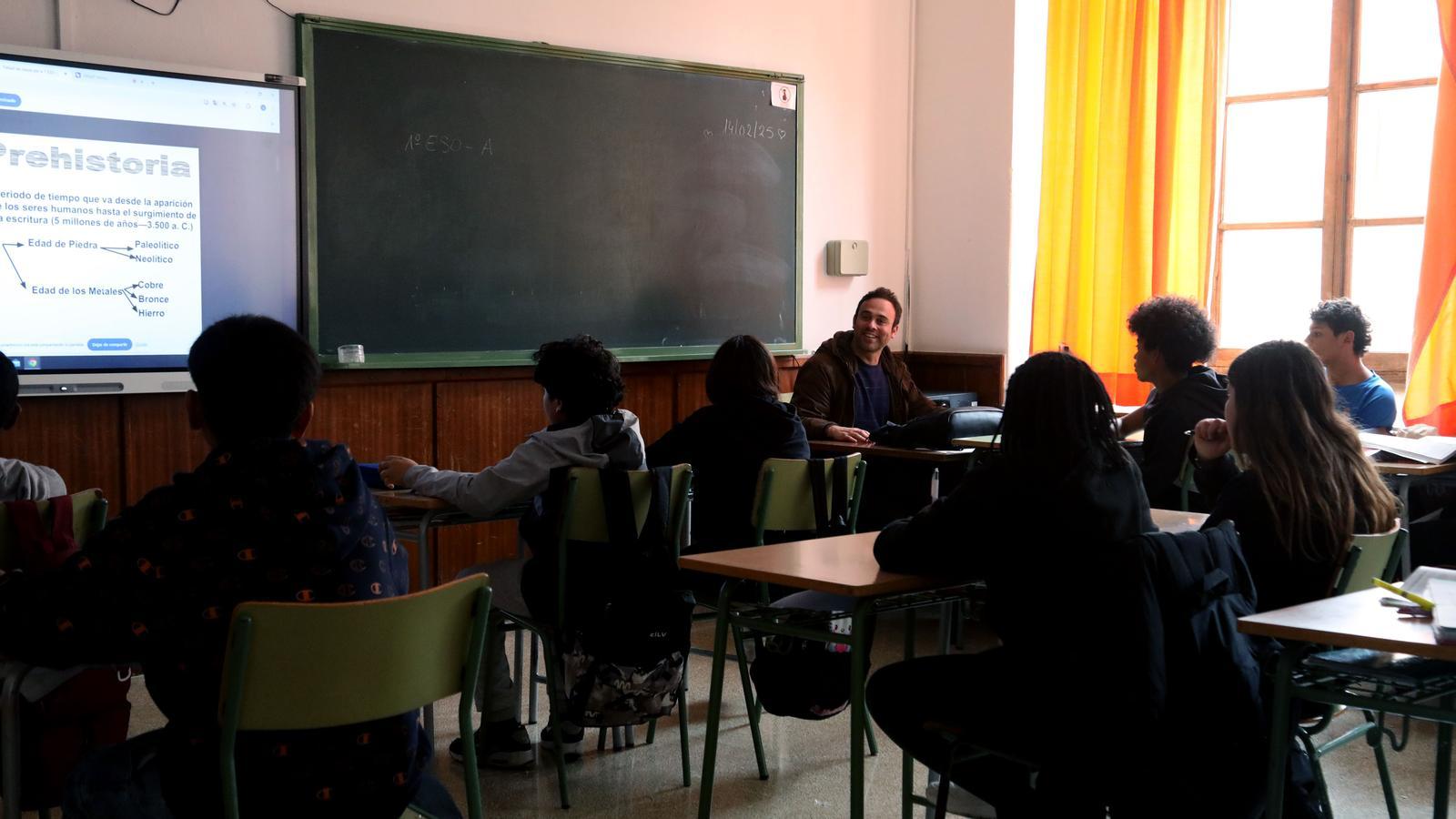
PalmaClassrooms in the Balearic Islands are increasingly overcrowded, but the problem cannot always be seen in a figure or a breach of maximum ratios. There are classes with 24, 25, or 30 students that comply with regulations and yet cannot give any more. The reason is that within classrooms, more and more different realities and requirements coexist: students with special educational needs, newcomers who do not yet master the language, learning difficulties, diverse rhythms, or social and emotional situations that require individualized attention. The educational legislature ends just as it began: with overcrowded classrooms and the vulnerability of the student body on the rise.
For the STEI, the problem is that the education system continues to measure the pressure on classrooms mainly based on a numerical maximum that does not reflect the current complexity of the groups. “It is not the same to have a certain ratio in a classroom where all students have similar needs as it is to have it in a classroom where there is a much greater diversity,” points out Vicenç Garcia. In his opinion, this reality means that a ratio that on paper is manageable may prove insufficient in day-to-day life: “With 25 or 30 students, the teacher cannot give each one the individualized attention they need.” The question, therefore, is not only how many students are in a classroom, but what resources are there to attend to them.

In Ibiza, directors describe this tension from the reality of the schools. Francisco Tienda, president of the Association of Secondary School Directors of the Pityusic Islands and director of the IES Quartó de Portmany, admits that the ratios are not necessarily excessive in all schools: at his institute there are 24 or 25 students in Secondary Education and they can reach 30 in Baccalaureate, in facilities that still have portable classrooms. The problem, he maintains, is what happens within these groups. “We are within the legal limits, but that is not enough to attend to everyone,” he states. Tienda thus points to a concrete consequence of the situation: “The level of attention required by students with difficulties is much higher” than before, in a context in which the diversity of the groups has also increased.
This forces schools to perform balancing acts. Tienda explains that some high schools take advantage of schedules to introduce co-teaching and place more than one teacher in the classroom. “This should be done as a baseline, but since that is not happening, we have to strengthen ourselves by playing with the schedules”. "In Secondary education, teachers have 18 teaching hours, but in my school we have reached agreements with the staff so that they do 20 or 21 hours of class in order to have more teachers in the classrooms and reduce the ratios. It is a formula to gain attention capacity that also highlights the pressure under which schools work", he says.
The consequence is that overcrowding ends up affecting all students, not just those who need more support. When a teacher has to attend to very different levels, rhythms, and needs simultaneously, they have less time to detect who is falling behind, adapt an activity, explain content again, or provide individual follow-up. “The teacher ends up doing containment work, trying to reach everything, when they should be able to dedicate time to teaching, accompanying, and detecting the needs of each student”, says Garcia.
Inclusion is one of the areas where this contradiction becomes most evident. The educational system is committed to schooling more and more students with specific needs in ordinary classrooms, but this inclusion requires resources. “When there are not enough human resources or adequate spaces, inclusion becomes a statement of principles”, denounces the STEI representative. He gives the case of a student who needs specific support: “You can have a NESE student in an ordinary classroom, because that is what the inclusive model establishes, but if the teacher does not have the necessary support, if there are not enough specialists, and if the classroom is saturated, that student does not receive the attention they need."
Tienda provides an example of the scale that this situation can reach. A four-form entry school may find itself in the first year of secondary school (ESO) with four students with Autism Spectrum Disorder (ASD) who need personalized attention and have only one technical educational assistant available. "Individualized attention staff will be very necessary, and there are fewer and fewer of them," he warns.
More conflict
The lack of resources also has consequences for coexistence. “Saturated classrooms also end up affecting coexistence and the ability of centers to provide an adequate response to the problems that arise,” says Garcia. With more students and less room for individual monitoring, it is more difficult to prevent conflicts or detect difficult situations in time. And this pressure ends up reaching the teachers. Tienda speaks of “a lot of burnout” and a job that “is becoming less and less attractive”.
Families share part of the diagnosis. Xavier Ferriol, president of the Federation of Families of Mallorca (FAPA), considers that “ratios continue to be very high and this makes it very difficult to work within the classrooms”. But he insists that overcrowding cannot be separated from material conditions. “It is not just a question of having more or fewer students, but of the conditions in which one works”. There are centers, he points out, where there is a lack of adequate spaces and resources.
SIAU also, through Joan Crespí, places classroom overcrowding among the main problems of public education during this term. The union considers it worrying that schools have to face increasingly complex classrooms while resources do not grow at the same pace. SIAU denounces that lines and teaching staff have been lost in public schools while lines in charter and private education have increased.
Infrastructures are another piece of the same problem, and throughout the Balearic Islands, there are many buildings constructed in the sixties, seventies, and eighties with maintenance deficiencies. “We are chasing needs. I have furniture from the 80s, completely obsolete,” laments Tienda. The principals also denounce that IBISEC does not have enough capacity to respond quickly to the needs of the centers. “We save a little each year in case we have to resolve something, because if we have to wait for them, we could die,” he says. SIAU agrees with the diagnosis of a lack of resources in public centers and demands that educational infrastructures be up to the level of current needs. The union points out that the deterioration of material conditions adds to classroom overcrowding and further hinders the ability of centers to provide an adequate response to the students.
Air conditioning is probably the most visible example of this distance between the needs of the centers and the Administration's speed of response. FAPA recalls that for years families have been buying fans for schools and high schools. Tienda warns that the pace of the air conditioning plan is insufficient: “At the rate we are going, it will be 2050 when everything is air-conditioned”. For Garcia, the problem is broader: “The infrastructures are basic and are not up to the current needs of the educational system”.
The charter school, an oasis?
Not all sectors perceive the increase in classroom pressure in the same way. Kiko López, president of the UCTAIB Education sector, asserts that cooperatives have not noted such a sharp rise and argues that “diversity is not a novelty.” “The world is diverse and the solution is inclusion,” he states. In his view, the challenge is to maintain the school as “a space of trust for families and students.” He also points out that today, needs are detected with greater precision that were previously grouped under much more general diagnoses.
The debate, therefore, is not whether diversity is a problem, but whether the system has the necessary resources to address it. This will be one of the major issues of the final year of the legislature, which will coincide with union and regional elections. The unions will demand a new boost to the measures pending from the previous Framework Agreement and will put new demands on the table. But the underlying issue goes beyond knowing how many students legally fit into a classroom: how many can a teacher attend to before overcrowding prevents them from attending to each student as they need? It is at this point that a ratio stops being an administrative figure and starts to determine the quality of education.
