Seven almuds do not make a barcella
We explain how to prepare little pomegranates at home

PalmaBread, a staple food for humanity, seems to have originated by chance. It is said that the first inhabitants collected wild cereals and then used the grain by crushing it between two stones to make porridge. It is believed that one day, someone forgot some of this porridge near the fire, or perhaps poured it intentionally onto a hot stone. The result was a dry, flat, and crispy paste, the first unleavened bread (without yeast) in history. Bread as we know it today, fluffy, with crumb and volume, was born in ancient Egypt. Chance again played in its favor when some forgotten shepherd captured some of the yeast fungi that live suspended in the air. That dough swelled and when they found it, they decided to bake it. The result was truly a miracle: a soft, tasty, and much easier to digest bread.
The domestication of cereals and their trade grew in parallel with the consumption of bread. Grain could be sold, bought, stored, and exchanged, but it also had to be measured. The first units of measurement appear in the earliest agricultural civilizations: the sil, the ban, and the gur in Mesopotamia; the hekat in Egypt: the efa and the homer from the Hebrew world, the medimnos of the Greeks, the Roman modius, and the Islamic mudd are some examples of the variety of units that were used. Since it was misleading to measure grain by weight, as humidity made it change, capacity measures were used.
Fraud
Antoni Riera Melis explains in Els cereals i el pa en els països de llengua català a la baixa edat mitjana (Institut d’Estudis Catalans, 2017), that in the central stage of this period the units of measurement for cereals were local and quite numerous throughout Europe, which favored fraud. Despite attempts to simplify it to protect consumers and speed up commercial exchanges, the units of measurement caused many complications because they could vary in space and time. Thus, a quartera of wheat was not the same in Tarragona as in Mallorca, nor did it have the same capacity in the 12th century as in the 13th. The Balearic Islands have preserved for centuries a highly structured system of measures for grain and other dry products. Among these units, the almud, the barcella, and the quartera stand out. The almud (from the Islamic mudd) as a small measure (approximately 1.95 liters), the barcella as an intermediate unit, and the quartera as a large measure. This classification became the standard for grain management in agricultural contracts, taxes, and markets. Its structure was very regular and easy to use: one quartera was equivalent to six barcelles and thirty-six almuds, allowing for simple conversions. This system of measurement remained in force for centuries without major changes. However, with the implementation of the metric system in Spain in the 19th century, a process of progressive substitution began.
In the context of rural society, the festival of "les mesurades" stands out, a very important celebration for Menorcan farmers that normally took place during the month of August, when the wheat and the rest of the cereals had already been harvested. This day served to measure the annual production and determine which part corresponded to the owner and which to the lord. On the day appointed to hold them, the owner and the sharecropper, the staff of the place and the families of all gathered on the threshing floor; one of the messengers took measures and more measures from the pile of wheat, and passed each one the boxwood or rake; if they managed to fill a hundred, the one that made a hundred was not leveled, but went to the top, and then the measurer threw the rake as far as he could and they marked with a stake the point where it had reached; immediately after, a refreshment of "resolis" was made and they threw their hats in the air; then another person continued the measurements and threw the rake when it reached the hundred again and tried to throw it further than the first until the whole pile had been measured. The day ended with a abundant snack and a very lively dance.
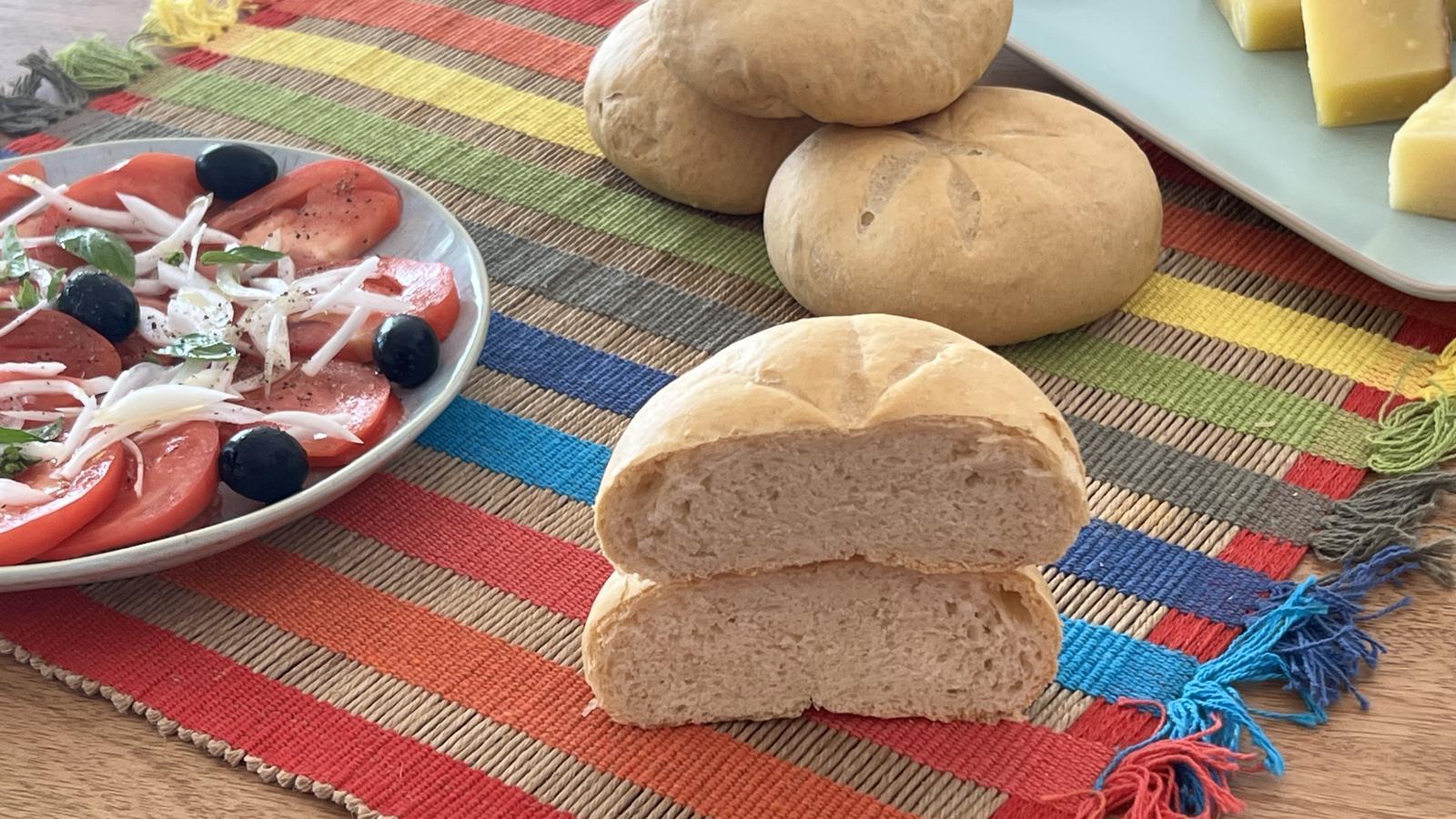
Today's recipe is very appropriate for snacks and parties, a round and soft bread roll that is very simple to make. Now that it is hot, it is the best time to prepare soft pastries and this one, in an hour, you will have it ready.
We will mix the warm milk with the yeast and dissolve it. We will add the water and oil and, then, the flour and salt and knead until we have a dough that does not stick to our hands. We will knead it for a while and divide it into 8 or 10 portions. We will make balls and let them rise in a basin, covered with a cloth. After 30 minutes, we will make a cross on top with the help of a knife and let them rise for another half hour or until we see they are ready.We will bake them at 180 ºC for about 20 minutes. We will let them cool and they will be ready to eat.
l 450 g strong flour l 100 g waterl 100 g milkl 50 g oill 25 g pressed yeast l 1 pinch of salt
