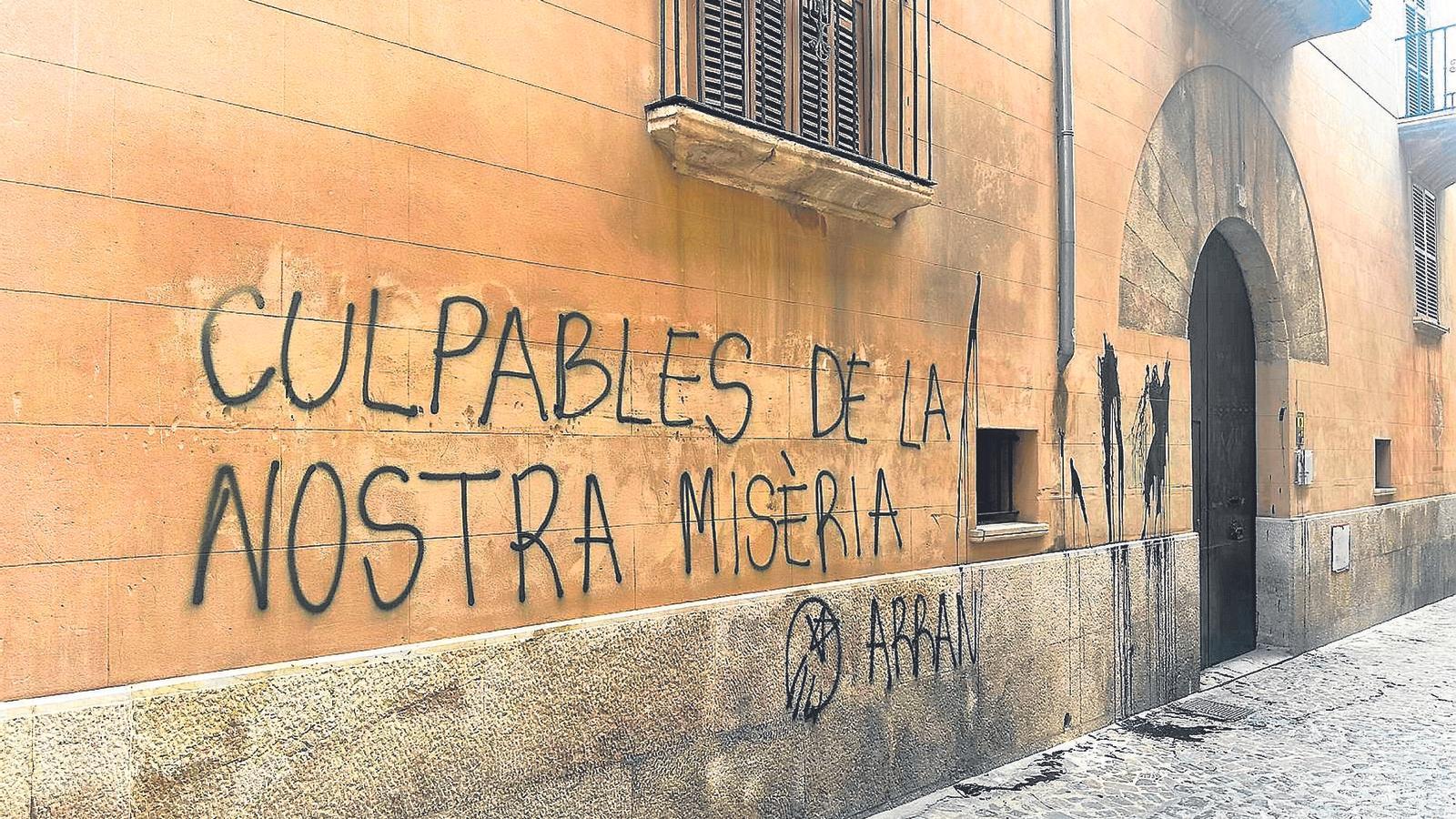
The first major protest against over-tourism this legislature did not originate in a coastal municipality, but in the Pla de Mallorca. The Banc de Temps de Sencelles was the driving force behind the May 2024 demonstration in Palma, with the slogan ‘Mallorca is not for sale’. It brought together around 25,000 people, according to the organizers. This highlighted that social discontent was transversal and linked to difficulties in accessing housing.Mobilizations against over-tourism soon joined in Eivissa and Menorca, as well as coordinated actions on the coast with the slogan ‘Let’s occupy our beaches’. In July 2024, the protest called by Menys Turisme, Més Vida brought together more than 50,000 people in Palma with the slogan ‘Let’s change course: let’s set limits on tourism’. In parallel, small, constant acts of protest have taken place: from the outdoor dinners organized by Brunzit in Palma to denounce gentrification to graffiti against tourism in government and real estate offices. Consolidation of discontentIn the last year of the legislature, this social discontent has had three major moments. The human chain against the deregulation of the Trenc Natural Park in July 2026 directly targeted the Government, as it criticized the Omnibus Law recently approved by the Executive. On July 26, the most massive anti-over-tourism demonstration to date took place: 70,000 people, according to the organization (25,000 according to the National Police), marched through the center of Palma. From ‘I have the right to live where I was born’ to ‘We will eat tourists’, the demonstrators’ slogans reflected the multitude of negative effects that an out-of-control tourism model can have. But the protests continued: on August 8, about 2,500 people took to the streets again in Sóller with the same complaints. The season is not over yet, nor is the protest: on August 29, a human chain has been called from Plaça d’Espanya to the Consolat.u
Concern grows in the PP about anti-massification protests
The popular mayors frame the neighbors' unease in two areas that the Government admits are complex to address: high housing prices and mobility problems. Several municipalities are promoting exclusive rental offers for residents.

-
CAT -
CAST -
DE
PalmaThere is an atmosphere of unease within the Popular Party ranks. Social discontent over mass tourism has put the party on alert. The Government has struggled this summer to avoid being the target of criticism: it distributed posters attributing 115,000 tourist places to the left and blamed the Spanish executive for the police charges at the Palma demonstration. But in recent weeks, another front has opened up: protests are increasingly present in the daily lives of municipalities. The mayors are the ones who receive complaints firsthand, focused on transport problems and the lack of housing. The Executive claims containment measures, but is aware that these problems have not been resolved.
“The pressure against the Government is there,” admits a source from the Executive. The graffiti with the message ‘Tourism kills’ that appeared a few days ago at the Ministry of Tourism headquarters is a symptom. Social unrest, which intensifies during the season, reached its most multitudinous expression in the demonstration of July 27th in Palma. But the wear and tear that the Government has suffered – and which various PP sources admit – has been cumulative: from the human chain to demand the protection of El Trenc to the protests against the detention of two activists in Santa Maria and the protest dinners in Brunzit in Palma, through the slogans heard during the concentration against the touristification on August 8th in Sóller: “[Marga] Prohens, listen, we are fighting”.
“The PP can feel pointed at,” says the Popular mayor of Sóller, Miquel Nadal. Municipal sources close to the party leadership agree in expressing concern that the protests could wear down the brand. They express, like the mayor, a sense of injustice. “Now, curiously, there is more tension,” Nadal continues. “But the problem is not from three years ago, and in the previous eight years the left governed,” he adds. A source from President Prohens’ team summarizes it this way: “We are taking charge of the citizen movement, but we also understand that an attempt is being made to link it to the PP government, and we are being asked to act on it.” “Surely, this can affect electoral behavior,” opines a government official in turn: “It depends on whether citizens believe it or not, because we have laid the groundwork for improvement”.
Housing, a headache
Several PP sources consider, therefore, that behind the complaints about tourist saturation there is a greater unease due to the difficulties of access to housing and mobility. Four mayors consulted by ARA_Balears say they have had this same perception in contact with residents and some have conveyed it to the Government.
“Prohens has to swallow it and act, even though he has done more than [Francina] Armengol,” opines a local PP official. “We have to control growth, tourist apartments, immigration, and housing prices, because many young people, without parents to help them, cannot access them,” assures this source. As explained by various consulted voices, the dialogue between the Executive and the PP city councils is fluid. Party sources point out that in recent weeks several mayors have conveyed this concern to the president. However, they qualify that “the reality in each town hall is diverse: there is no homogeneous position”.
The mayors consulted by ARA_Balears agree in pointing to housing and mobility as the main sources of resident complaints. “In Alcúdia we cannot speak of a generalized situation of overcrowding, although we have specific moments of high attendance,” points out the mayor Fina Linares. “Where we do have a significant concern is in housing, because rental prices are through the roof,” she adds. Nadal agrees: “In Sóller, the price is so high that only people from other countries can access it.” The mayor of Calvià, Juan Antonio Amengual, expresses himself in the same vein, who, despite not perceiving an “anti-tourist sentiment” in the municipality – he details that many residents work in tourism – admits that “the increase in tourist housing and illegal offerings have done a lot of damage”. For his part, the mayor of Alaró, Llorenç Perelló, also highlights the problems residents have in finding a place to live. All of them emphasize that they are working with the Balearic Housing Institute (Ibavi) to build affordable rental housing, in some cases limiting access to non-residents of the municipality. For example, Sóller and Alaró want to request a minimum of 18 and 20 years of residency in the town to access them, respectively.
Vehicle limitation, on the horizon
The other major issue pointed out by the mayors concerns mobility, with Sóller being one of the most affected municipalities. “One of the problems we are now encountering is that everyone comes here by car,” explains Nadal. Perelló also warns of the parking problems in Alaró, while Amengual points to the traffic jams on the ring road: “Right now, it’s our Achilles’ heel.” In this regard, the limitation of vehicle entry into Mallorca, which will begin to be processed in Parliament from September, is perceived by the mayors as a key tool. The president of the Consell de Mallorca, Llorenç Galmés, was forced to postpone its approval due to Vox’s opposition. Finally, he pushed it forward thanks to the support of the left, while the far-right eventually abstained. “Vox has realized that it cannot openly position itself against this, because it is a transversal outcry,” say sources from the Executive. However, the delay has cast doubt on whether the measure will be implemented this legislature. “I am hopeful that it will be approved,” says Nadal. Despite having approved some containment and tourist rental limitation initiatives, government sources admit that, for now, “the street has not yet perceived the effect.” The same voices promise that human pressure indicators will have decreased by summer and these initiatives will begin to bear fruit. Be that as it may, the last tourist season of the legislature will have been marked by social protests. PP sources admit that they see a risk that part of this discontent will penalize them at the polls: especially since Prohens aspires to obtain an absolute majority. Nevertheless, they hope that the correlation of forces will not change. They rely on the wear and tear of the left after Armengol’s two governments – the PP constantly reminds us of this – to maintain their expectations.
