"What are we doing here?": the surprise of a musician of the Municipal Band at the event for Ceuta
The opposition parties reproach Martínez's government for the "partisan" nature of the institutional act that ended with shouts against Pedro Sánchez

-
CAT -
CAST -
DE
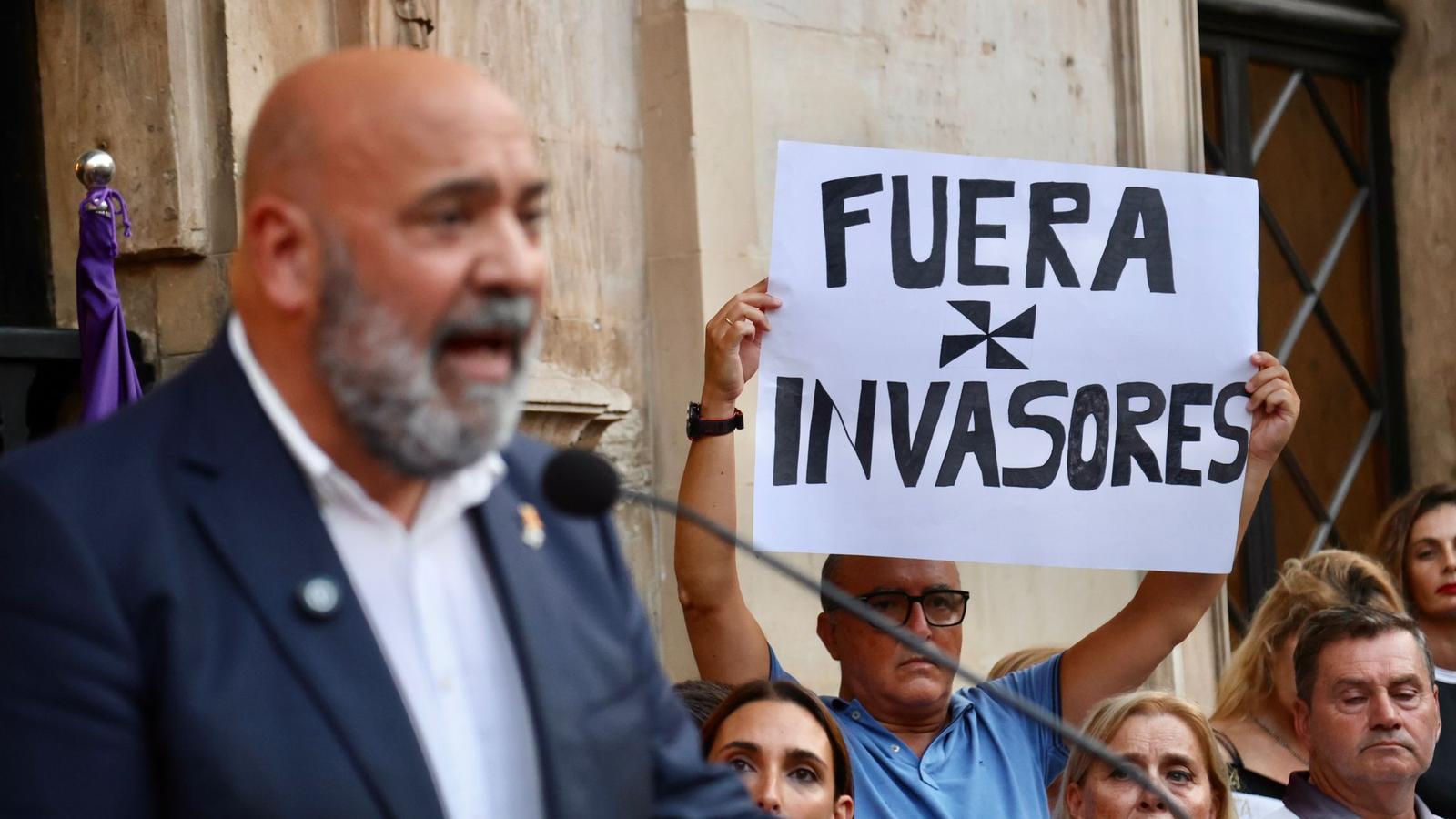
Palma"Holy cow! What are we doing here?". This was the reaction of some of the members of the Palma Municipal Music Band of Palma when, a few minutes before the start of the event in defense of Ceuta, they saw the atmosphere and heard the shouts against the Spanish government and Pedro Sánchez. One of the musicians explains that the ensemble had been requested by the mayor, Jaime Martínez, and that they approached it like any other institutional act. "But one thing is to be with the people of Ceuta and another is to want to oust a government", he summarizes.

The musician explained to ARA Balears that this Thursday there was "a bit of gossip" among the band members and that opinions were divided. Some consider that the group was indeed used in a partisan way, while others do not believe that the derogatory shouts were incited by the mayor or his speech, but rather that they were people who took advantage of the call to launch their own proclamations. Be that as it may, the musician believes that the Band should not be involved in "politicians' messes," but rather should limit itself to bringing band music to the citizenry.
The demonstration called in Palma in defense of Ceuta ended up becoming an act of criticism of Pedro Sánchez's government, a drift that has also provoked criticism from opposition parties. MÉS per Palma has especially denounced the use of municipal resources and the Municipal Music Band in a rally that it considers "clearly partisan," while the PSIB has questioned the speech of the PP and the Government of Marga Prohens regarding the situation of the autonomous city. For its part, Podemos has lamented the presence of neo-Nazi groups and the use of fascist symbols and xenophobic slogans.
The MÉS per Palma councilor Miquel Àngel Contreras has remarked that his "solidarity with the citizens of Ceuta is absolute," but also with "the drama of migrant people." What he rejects, he stated, is that the mayor of Palma, Jaime Martínez, "takes advantage of this situation to play party politics using institutions and resources that belong to everyone."
Contreras considered that a call initially promoted by the Spanish Federation of Municipalities and Provinces ended up transformed into a "clearly partisan mobilization on the part of the PP and the extreme right." In this sense, he focused on the participation of the Municipal Band: "The Municipal Band belongs to all of Palma, it is not the soundtrack of the Popular Party or the extreme right."
"Where does the City Council end and where does the PP begin?"
For the eco-sovereigntist councilor, the fact that the City Council contributed municipal resources while the mayor led the call blurs the line between institution and party. "Where does the City Council end and where does the PP begin?", he questioned. "Cort is not the PP's. The Municipal Band is not the PP's. Public resources are not the PP's. They belong to all the people of Palma", he concluded. "It is not acceptable for Martínez to use them as part of the PP's political scenography", denounced the representative of MÉS per Palma.
For his part, PSIB deputy Marc Pons agreed in pointing out the political character that the event ended up acquiring. As he explained, the PP had presented the call as a rally "in defense of Ceuta", but the insults against the president of the Spanish government and the chants of "Pedro Sánchez, son of a bitch" and "Pedro Sánchez, resign" evidenced, according to Pons, that the goal was to "wear down the government" rather than to support Ceuta.
"Where is the solidarity?"
Pons has also criticized the position of the president of the Balearic Government, Marga Prohens, and has described as "double standards and hypocrisy" that the Government shows concern for the situation in Ceuta, but refuses the reception in the Balearic Islands of 20 minor migrants coming from the autonomous city. "Where is the solidarity?", asked the deputy, who has demanded a coherent response regarding the situation of the minors. As he remarked: "Where is the idea of building Spain together if the only thing you do is favor insults to the president of the government, but for your responsibilities, of helping and welcoming some minor children, you say no".
Fascist symbols and racist slogans
The Podem councilwoman in Palma, Lucía Muñoz, has assured that the party had already warned before the demonstration that Jaime Martínez could use a call presented as institutional to oppose the Spanish government. "Yesterday it was proven," stated Muñoz, who considers it "especially serious" that the City Council of Palma called for a mobilization that, as she denounces, had been endorsed by neo-Nazi groups and in which "fascist symbols" were seen and "racist and xenophobic slogans" were heard. "One thing is solidarity with Ceuta and another is what we saw yesterday," she remarked.
Muñoz has also accused the PP and Vox of focusing their discourse on migrants and has argued that the underlying problem is that Spanish migration policy depends on Morocco. The Podem councilwoman has demanded that the Spanish government break relations with the Moroccan regime, demand greater involvement from the European Union in the protection of human rights, and guarantee "a dignified and humanitarian response" for the people who have arrived in Ceuta. According to Muñoz, this would be "the best way to show our solidarity with Ceuta".
141 dead people
According to data from Caminando Fronteras cited by the group, 141 people have died during the crisis that began on July 30, with 78 bodies recovered in Ceuta and 63 in Morocco. Miquel Àngel Contreras has lamented that this tragedy remains in the background due to political dispute and has argued that the situation in Ceuta should be addressed through "solidarity," public resources, and a humanitarian response.
"There are 141 dead people. People who have died by drowning or being crushed while trying to cross a border. This should be one of the first things we talk about when we discuss Ceuta. But the right and the extreme right prefer to erase these victims from the narrative and turn human suffering into political fuel to feed hatred and confrontation," stated Contreras.
