"He had the body of a truck driver and danced like a showgirl"
The Majorcan drag queen Jimmy Showman reviews more than half a century of spectacle and a life always lived in his own way

-
CAT -
CAST -
DE
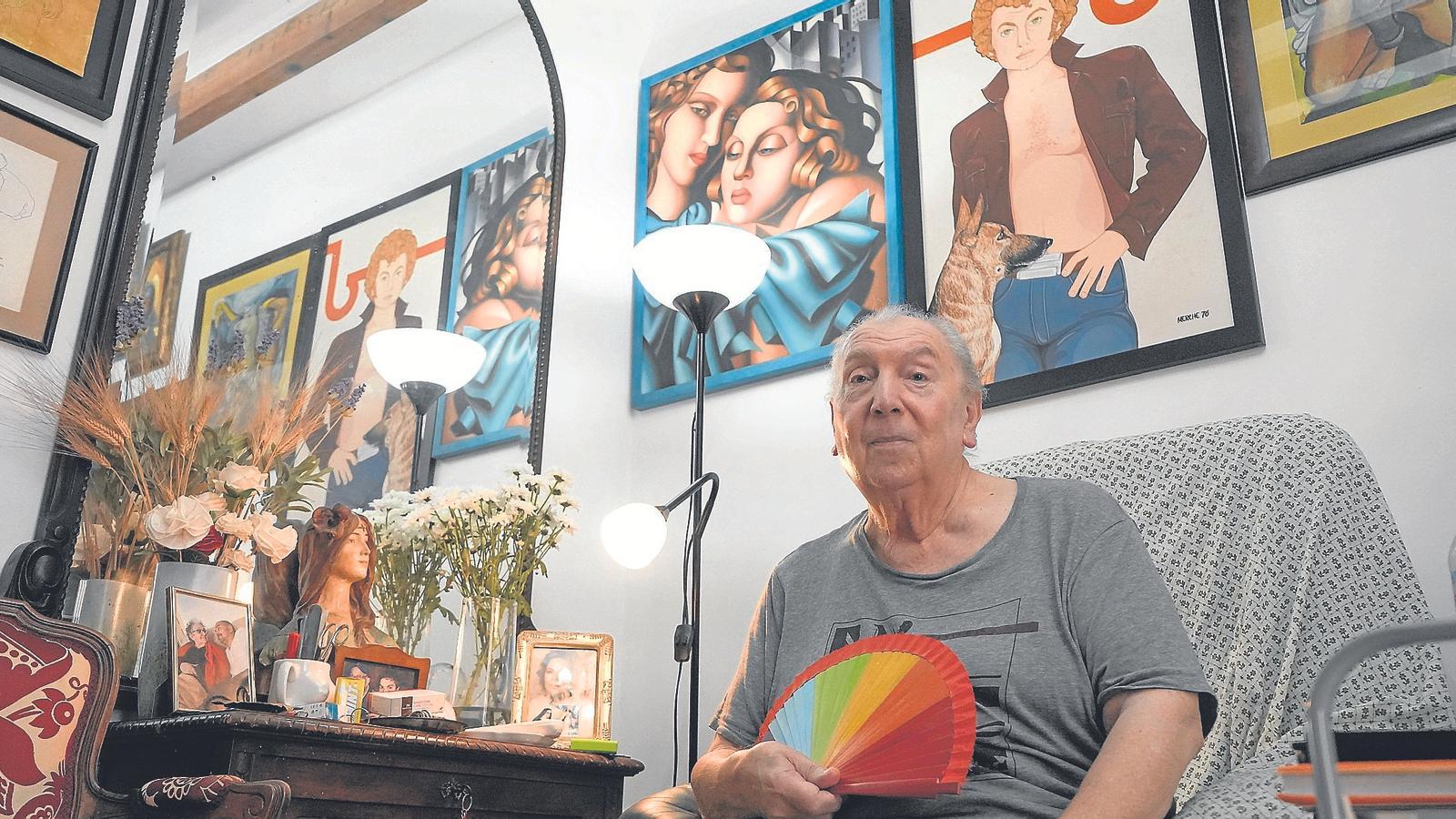
PalmaJimmy Showman, born Jaime Horrach Lillo, holds a piece of costume jewelry in the palm of his hand. “This isn’t plastic, it’s jet,” he clarifies while searching with his eyes for a hanger full of party dresses. Bright colors mix with feathers and sequins. The ground floor in Palma where he has moved is full of paintings, portraits, and remnants of a life on stage that won’t fit inside a house. Part of his wardrobe and his memories sleep in two storage units. Past 80 years old, Jimmy talks about the stage as if he had just come out of the dressing room. For more than half a century, he dressed as a woman to perform, without ever considering that it expressed a hidden identity. “I have always been me. I would finish performing, take everything off, and go out with a clean face. Heels, I almost never wore them, because they didn’t suit me well. Breasts, neither, unless the act required it, and sometimes I would go out without them because I had forgotten them. I would say to the audience: ‘Oh, I’ve left my tits in the dressing room again!’. And it was true.”
Son of a humble family from the Santa Catalina neighborhood, he grew up sheltered by his parents; she, a housewife; he, a ship captain. When he was nine years old, they moved to Tangier in search of progress. “We lived in front of the port, right by the Hotel Continental. We studied at the Cervantes Academy and I started to speak French, a little English, and Arabic. I associated with Hindus, one neighbor was Jewish and another, Spanish. Everyone got along very well. The city was wonderful.” Six years later he returned to Palma, and he only went back to Tangier for visits in the mid-70s. “When I saw what it had become, I returned to the ship crying. The currency exchange offices, the post offices, and the large French department stores had disappeared. Where there used to be jewelry stores, I saw chickens.” The colonial world had vanished, but the name Jimmy remained, after the English captain of the ship his father commanded.

The teenager who returned to Mallorca wanted to study archaeology. She liked to paint, model, and make things with her hands, a rarity in her environment. She would sneak away to take singing lessons. Until they discovered her sheet music. “In that Spain, if a girl wanted to be a model, dancer, or artist, or a boy wanted to dedicate himself to it, they were immediately considered to be of loose morals. They would label your reputation, but it has always been all the same to me. I have done what I wanted, very politely and working very hard. My family said no to me singing, and that was that. There was no drama. When I was able to do it, I did it”.
The hair salon
The gateway to artistic activity was a cousin's hair salon, where he helped out on Saturday mornings. Jimmy trained and opened a small one in his mother's living room. By the age of 21, he had already moved to a larger premises. He learned makeup, aesthetics, how to treat women, business discipline, and how to interact with artists. "I became the Spanish champion in women's hairdressing. Mine had air conditioning and an advanced atmosphere for the time." Through his hands passed Sara Montiel, the dancers from the best venues in Palma, and well-connected foreign clients. "They would ask each other, 'listen, where do you go?'. By the year '67, I was already working with a file where I noted down the name, the phone number, and the hair dye shade".
With the Jimmy hair salon –Jaime was already history– in full swing, he opened El Desván with a partner, “the only bar with a coffee machine” in El Jonquet; a place to stop by –even for King Juan Carlos– before ending up at Jack El Negro and the nightclubs in the area. “The nightlife back then was not the sordid place that people imagine. In my establishment, not everything was permitted. If I saw that someone was crossing the line by touching or kissing, I would go over and say ‘please, a bit of decorum’. In those years, you would go out with 5,000 pesetas, take a taxi, go to the bars and clubs in Gomila, end up eating a sandwich at La Tortillería, and return home with money left over. Now you can’t do anything with 50 euros”.

During the hospital nights when he was taking care of his father, Jimmy wrote El ocaso de virtudes, a tragicomedy in the style of vaudeville, a cabaret-style play in which he included musical numbers from Cabaret, Núria Feliu and Guillermina Mota. Since he could not find an actress to play the protagonist, he decided that he would do it himself. He premiered it at the Tiffany’s venue and it was so successful that he performed it for more than a year just in Palma, before starting a tour. “I would go out made up with cardboard eyelashes, blush, a tiny little mouth, without breasts and with orthopedic platform shoes”.
At the Tagomago hall they christened him Jimmy Showman. “What I did was not improvising a few steps with a wig,” he claims before sharing the credit among choreographers, dressmakers, and dance troupes. Jimmy traveled to Paris and London to buy music, fabrics, feathers, and crystal embroidery. “The clothes had to be well-made; the act, well-thought-out, and the movement, very well-rehearsed.” Afterward, everything fell into place and he offered the public his version “with mischief and without gratuitous vulgarity” of Mae West, Montserrat Caballé, Sara Montiel, Rocío Jurado, and Divine, among others.
He danced Swan Lake in a tutu that lit up. “I could sing, dance the can-can, do the splits, and carry a lot of weight. That is why now I have the knees I have. People would shout when they saw me moving with that agility. I danced like a showgirl with the body of a truck driver. That was the charm. People laughed with me, not at me. I wouldn't define myself only as a drag artist or comic actor. I was an all-rounder. And not just because of the kilos.”
When Jimmy debuted, it was months before Franco died. Working in show business meant obtaining an artist's card and paying a license that cost 1,100 pesetas a year. “I didn't have any major problems with the police or with censorship, but freedom was not an abstract thing: it depended on the work, the place, the people who protected you, and how you behaved. I never caused any scandal. My parents were decent and progressive people who always supported me and defended me. Professionally, I always fulfilled my contracts. You should never leave a venue angry or on bad terms”.

Jimmy sprinkles the conversation with names and places, in a flowing narrative that takes him to a number performing as Marie Antoinette, to anecdotes with Javier Gurruchaga, Camilo José Cela, Marifé de Triana, Carmen Sevilla, and to the moment when his friend Sara Montiel, "who knew a great deal about show business," turned his earrings around so that, when the stage lights hit them, "they would look like diamonds."
For him, drag was a rigorous profession based on comic talent and spectacle, which clashes with his analysis of the contemporary scene: "I have gone to Pride on the floats in Madrid, hired by nightclubs that paid for my travel, my apartment, and a week of work. When I finished the last one, I decided that wasn't my way of protesting. I don't criticize that everyone does what they want, but for that reason, I also don't like that everything is now called drag queen. A drag artist, a comic actress, and a drag queen are not exactly the same, and just because a word is fashionable doesn't mean it should erase the others; I was a drag artist and a showman. My way of demanding respect might seem old-fashioned, but I didn't want them to laugh at me or turn me into a caricature off-stage. If you want people to respect you, you also have to respect yourself. I have always been clear about that."
Rejection of drugs
Jimmy's discipline always included a rejection of drugs, in environments where they circulated naturally. "I saw it and it didn't bother me. I never wanted even a line of it. I didn't need anything to perform. I would order a whiskey and Coke and it would last me for the two hours of the show." In the 80s, the threat of AIDS arrived, which he learned about from the warning of an ex-partner. "He read it in German magazines and asked me to be careful and to take care of myself. I kept it in mind and thanked him for it. I have always been one for stable and long-term relationships; classic and faithful." The great love of his life arrived in his early youth. German, from a good family, 11 years older than him. It lasted six years. We kept in touch until he died, a few months ago, at 92 years old, in Ibiza. It was a very beautiful and sad story at the same time. I never forgot him."
He always lived well from show business and was able to help his family. “I have traveled a lot, I have bought what I wanted and I have enjoyed myself, always working.” But behind the feathers there was also deception and precariousness when it came to applying for retirement. “I discovered that for 6-month tours they had only counted 20 days for me.”
He said goodbye to the general public with a performance at the Auditòrium in Palma, where they dedicated “16 minutes of applause” to him. “I had to make a gesture for them to stop, because I was going to start crying,” he reveals. A group of former dancers from his shows, now grandmothers, went up on stage with white hair and rehearsal clothes to dance one last time together. “Seeing those little bodies still capable of lifting their legs... The people went crazy,” he remembers with pride: “That was proof that we hadn't been a whim: we were professionals and we had built a stage school.”

