Is it fair to pay your partner's mortgage?
In a context of difficult access to housing, many couples are forced to rethink how expenses are shared and what it means to live together in economic terms

-
CAT -
CAST -
GER
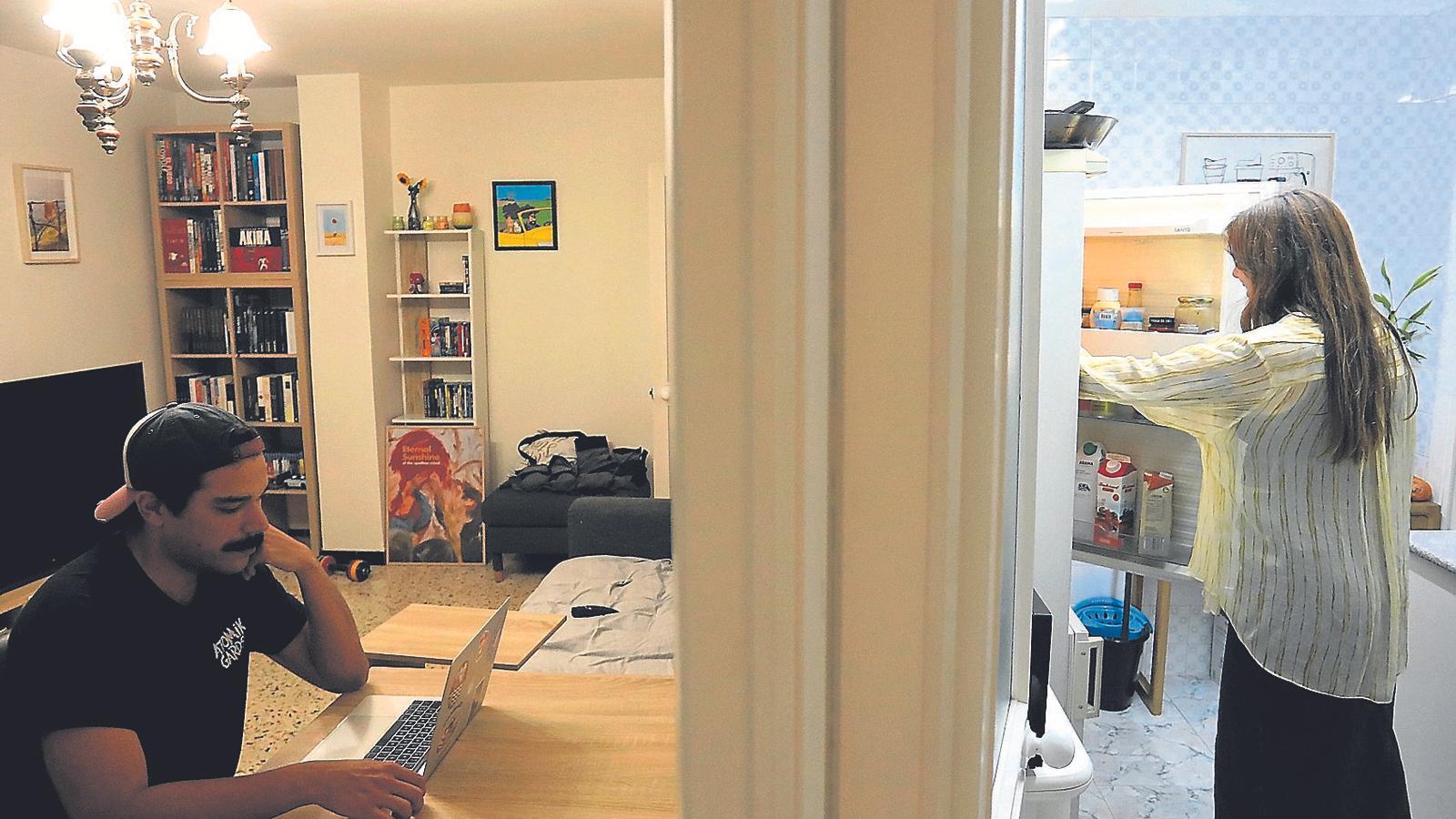
PalmaDiego is 34 years old, has a mortgage he took out when he earned 900 euros, and an opinion that divides groups of friends and colleagues: if his partner lives in his apartment, she pays. He explains it frankly: “I only have 90 square meters to speculate with, and I have to pay for them my whole life. Everyone speculates with me.”
Five years ago, his mother offered to pay the down payment for an apartment when he was sharing a 900 euro rent with his girlfriend. She found a bargain in a sought-after neighborhood in Palma. Two older sisters wanted to return to their hometown, selling soon in the post-pandemic context, and Diego closed the deal for 190,000 euros, aware that, without his mother's help, no bank would have granted him a mortgage. “I was left with a fixed payment of 600 euros. My partner paid a little more because she earned more than me. Also for food, because she wanted more premium products,” he recounts. When the relationship broke up, the dynamic continued. “I brought in someone else, because I always made it clear that I couldn't afford the loan alone,” he admits.
Why is it so clear to him that a couple should pay to live in his apartment? “My way of seeing it is that expenses should be shared 50%. If I earned 3,000 euros, I wouldn't charge them or if she had precarious work. I don't charge to get rich. What I do know is that I need an extra income”.
Sharing assets
The discussion changes depending on who earns more, who owns the home, whether living together implies sharing assets, and the real estate market situation. According to various reports, islanders allocated an average of 61% of their salary to rent in 2024, and the average rental price exceeds what any young person earns in the Balearic Islands: they need between 111% and 136% of their salary, according to the Observatory of Emancipation. In fact, only one in six young people live outside their family home.
Faced with cases like Diego's, some think, like Aina, that charging a partner goes beyond economic balance. "I told a friend to leave her boyfriend for asking her for rent. When the relationship ended, she left that house with nothing. I asked her if she had a contract, if she could deduct it." At this point, she tells Diego: "It's not your partner's problem that you can't pay the mortgage and have mortgaged yourself. You don't rent to your partner." For her, a romantic relationship should not function with market logic.
For psychologist Susana Ivorra, economy and emotions within a couple are inseparable. “Our relationship with money is not created solely based on financial education issues.” Variables come into play such as the existence of a balance in each member's economic situation and the division of common expenses. “Often this topic is a source of anxiety, disappointment, and even anger” in therapy. However, it doesn't have to make the payer feel like a tenant. “Not necessarily, if the terms are discussed, negotiated, and brought to the table, not in isolation, but in context, along with other matters that influence household finances,” she recommends. Despite everything, “a power imbalance can arise, especially if the other person does not own their home.” And the phrase ‘get out of my house’ “can become a thrown weapon and be used as a threat” in the context of a housing emergency. “It has impacted our emotional decisions and influences whether to separate or continue with a partner who, in other circumstances, you would have already left,” she adds.
Access to housing has changed the way couples understand cohabitation and commitment. “On the one hand, there is a need to protect what is one's own for fear of ending up with nothing, and some think ‘I won't move in with you, because if I let go of my rental apartment and the relationship doesn't work out, I might not find another one’; and, on the other hand, the fear of separating and the odyssey of finding a decent place to live. Today we can no longer talk about separation in therapy without asking about housing alternatives,” she acknowledges.
Separation of assets
From a legal point of view, family law specialist lawyer Maria Antònia Mateu changes the framework of the discussion. In the Balearic Islands, the system of separation of assets applies – as in Catalonia – a factor that influences how economic contributions within a couple are interpreted. "The question of whether or not it is fair to charge rent to your partner is a trap. We must differentiate between two types of expenses: family burdens and those that are not." The former include common expenses, derived from cohabitation, such as supermarkets, leisure, schools, and insurance. "Rent is also one of these," and spouses are obliged to contribute to it "in proportion to their economic capacity." The latter, such as a mortgage or any expense derived from ownership, correspond to the owner of the property. "If your partner did not live here, you would still have to pay the mortgage, whether they lived there or not," she argues.
Compensation
Does a partner who has contributed to paying off the other's mortgage have the right to claim compensation? “Yes, as long as they have contributed to family expenses and if there is no prior agreement,” points out the lawyer before explaining a “very common” factor. “When one partner has contributed more than the other, because they have dedicated themselves to work, while the other dedicated themselves to the home and family, this generates patrimonial inequality and can give rise to economic compensation. We carry a cultural fact with women who reduce their working hours or even leave their jobs to care for a second child,” she adds.
The lawyer considers it a problem that “people get married very happily without having discussed the matrimonial economic regime”. Furthermore, “there is no culture” of agreeing on conditions in the event of a breakup. “I would always recommend talking about it directly and deciding. And, if one contributes more than another, of course, it must be documented. If you pay off the mortgage because you have received an inheritance, you can record it with a simple document between the parties. Everything in writing: one member allocates an extra amount and the other acknowledges the debt”. Whoever sues has five years to claim from the separation or divorce. Mateu defends the continuation of the processing of the draft law on the matrimonial economic regime of the Balearic Islands. “It would provide more legal certainty,” maintains the expert, who recommends that couples get married, as a more guaranteeing option for resolving conflicts in a separation or divorce.
Breakup with children
Breakups with children add another difficulty. “The big problem is that the vast majority are mortgaged homes. You have to leave one, even if you continue to pay the mortgage. It is practically impossible to finance another home”.
The way money is managed as a couple has also changed. According to psychologist Ivorra, “there is a slight tendency towards individualism”, which she relates more to the education received than to a generational choice. “For example, parents who separated and lost their economic status educate their children in individualism as a protective measure”, she explains.
Diego listens to legal, emotional, and generational arguments about a decision that for him is still practical. “Yes. But what do you prefer: to pay 300 euros for a house that is not yours or to pay 1,000 for rent? You will have to make the investment one way or another. I won’t force anyone to live in my house,” he says before looking back at a past that he perceives better: “My parents didn’t have these problems”.

