I liked passing by the dovecote when I went to his house. It looked like a large cupboard with wire mesh doors. Instead of dishes or books, the pigeons rested there, watching me restlessly. Those wide-open eyes clamored to get out, and I enjoyed opening the cage for them because I knew they would return soon. I found it curious that they preferred the comfort of a roof over the freedom of flight. A complicated choice. In some compartments there were nests with tiny eggs; in others, the absorbed squabs, always waiting.
There was a time when dovecotes were part of houses and estates, and squab was a prized dish on both the humblest and the best-stocked tables. Today its presence in our kitchens is almost testimonial, but we know, from cookbooks, that it was a valued bird, almost as much as partridges or thrushes. The Romans already appreciated the meat of pigeons, especially that of the youngest specimens, tender and delicate in taste. In the Art of Cooking, attributed to Apicius, we find various preparations of pigeons and wood pigeons, accompanied by sauces made with pepper, aromatic herbs, wine, honey, and other ingredients that combined sweet, acidic, and spiced flavors.
A refined gastronomy
Arab cuisine also gave a prominent place to pigeons. Medieval cookbooks from the Islamic world testify to a refined gastronomy where birds were combined with nuts, spices, and aromatic herbs. From this tradition, one of the most unique preparations of Moroccan cuisine has reached us: pigeon pastilla, a pie made of very fine dough filled with pigeon meat, almonds, and spices, which is topped with powdered sugar and cinnamon. During the Middle Ages, wild pigeons were caught and raised in dovecotes built in the forest or in the countryside, which made it easy to obtain their meat, which was widely consumed. In the Llibre del coch, by Mestre Robert, we find the testimony of two sauces for squabs that are made from the bird's livers, grilled. Then they are crushed with breadcrumbs and vinegar and diluted with broth or hot water. The sauce is put back on the heat with spices and, finally, the spit-roasted squabs are added.
The first recipe for squabs that we find written in Mallorca appears in a small booklet attributed to Friar Jaume Martí Oliver, from the 18th century. Curiously, it is a version of the squabs described by Mestre Robert. In this case, the squabs are first fried with tomato, while the liver mince is added later. This will be one of the most repeated and recurring formulas in our cookbooks. In addition to the liver, we find other recipes (Receptari Llabrés, 19th c.) where the pigeon's blood is used, which is added to the sauce before serving the dish.
One of the most repeated formulas consists of stewing it with wine, aromatic herbs, and spices. They were also stuffed with meat or herbs, grilled, or breaded and served, chopped or whole, accompanied by a sauce. Other recipes, such as the pigeon pie from the book Cuina mallorquina, attributed to Pere d’Alcàntara Penya, and the squab pie with puff pastry from the Caules cookbook (Menorca, 18th century), return us, in some way, to that tradition of poultry meat pies that we find in Arab cuisine, sophisticated and aromatic dishes, designed to dress a table.
Raising pigeons provided a relatively accessible source of meat in a world where the consumption of animal protein was conditioned by the resources of each household. However, the squab was not simply a subsistence product. The tenderness of its meat and the culinary possibilities it offered also made it an animal appreciated for special occasions. Today, squab meat, and especially that of an adult pigeon, can cause suspicion or even aversion. It is no longer part of daily cuisine and it is difficult to find specimens in our markets. Those that arrive usually come from France or other places and their price is high. Those dovecotes that were part of houses and estates have disappeared or have remained as a vestige of another time. And, with them, a way of cooking a bird that for centuries knew how to pass from the simplest kitchen to the most refined tables has also been lost.
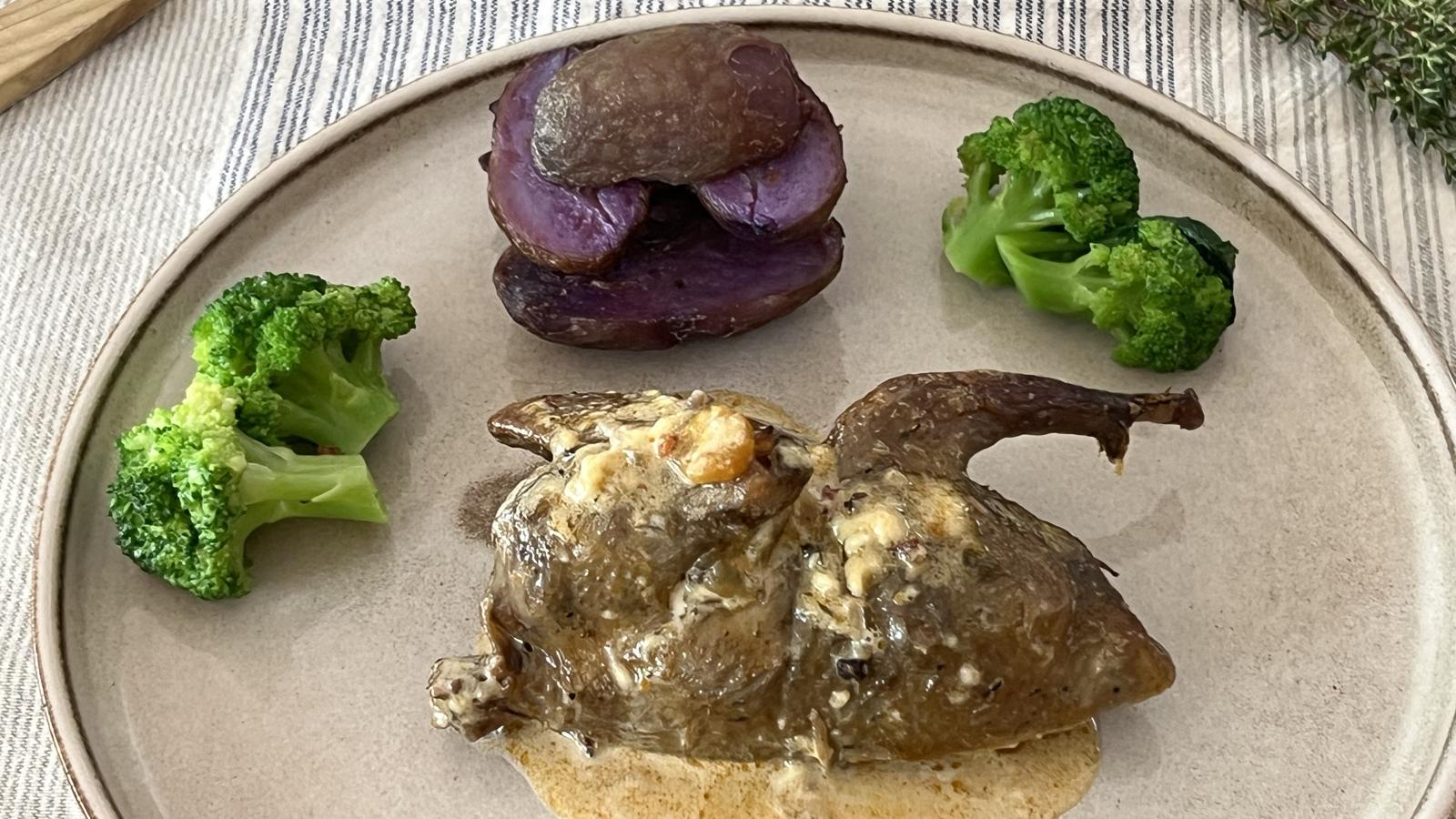
For today's recipe, I have adapted the herb-stuffed squabs collected by Antoni Tugores in Cuina d’un temps i d’un país (2024). In my case, I have cooked the birds with a little white wine and broth so that the meat would not dry out during cooking.
Stuffed squabs with herbs
Season and stuff the squabs with the herbs, the black pudding, the sobrassada, and the bacon. Tie them up and brown them on all sides. Remove them and sauté the onion and garlic. When the onion is well browned, add the carrot. Once the vegetables are well cooked, add the squabs, spices to taste, and pour in the wine. Two minutes later, add the broth and let it cook for an hour and a half over low heat, turning the birds every half hour.
Remove the squabs and cut them. Place them in an earthenware dish or an oven tray. Pour some broth into a glass and squeeze the herbs from the stuffing into it.
Make an aioli and dilute it with a little of the broth we put in the glass. Pour this sauce over the squabs and give them a quick blast in the oven. Serve them accompanied by small potatoes.
Ingredients
l 4 squabs
l 1-2 black puddings
l Sobrassada
l Aromatic herbs (rosemary, thyme, parsley, bay leaf, marjoram)
l Pork belly bacon
l 1 onion
l 2 garlic cloves
l 2 carrots
l 1 glass of rancio wine
l 1 l of chicken broth
l Clove, cinnamon stick, nutmeg, mace
For the allioli
l 1 garlic clove
l Oil
l 1 egg
Author of the blog taulaposada.com