The diversion of the Manacor torrent is not working and a third of the city is at risk of flooding
A report commissioned by the City Council warns that the diversion cannot handle a downpour of 200 liters per square meter and asks the Government to act on six conflictive sections
-
CAT -
CAST -
DE
ManacorThe torrent that crosses Manacor is an inherent part of the city's history and misfortunes, and there is even an entire avenue named after it. A 'lifelong' flood-prone area that residents fear, just as they are already accustomed to it and have learned to live with the periodic risk of a possible flash flood like the one that caused disaster in September 1989, 37 years ago. What has taken the City Council by surprise now is the confirmation that the diversion created deliberately outside the urban center, between 1994 and 2004, is not working properly and leaves a third of Manacor in a flood risk zone.
A few months ago, the Government, based on reports from Water Resources, implemented a regulatory change that increased restrictive minimums "and made official a new classification that would affect various future planned services and would cause many residents to be affected when also carrying out procedures on their homes," explained the mayor of Manacor, Miquel Oliver, who this Wednesday appeared at a joint press conference with the councilor for Urban Planning, Núria Hinojosa, and Daniel Aguiló, a civil engineer, specialist in water issues, and head of the external report that the Consistory will now send to the Government to try to resolve the situation.
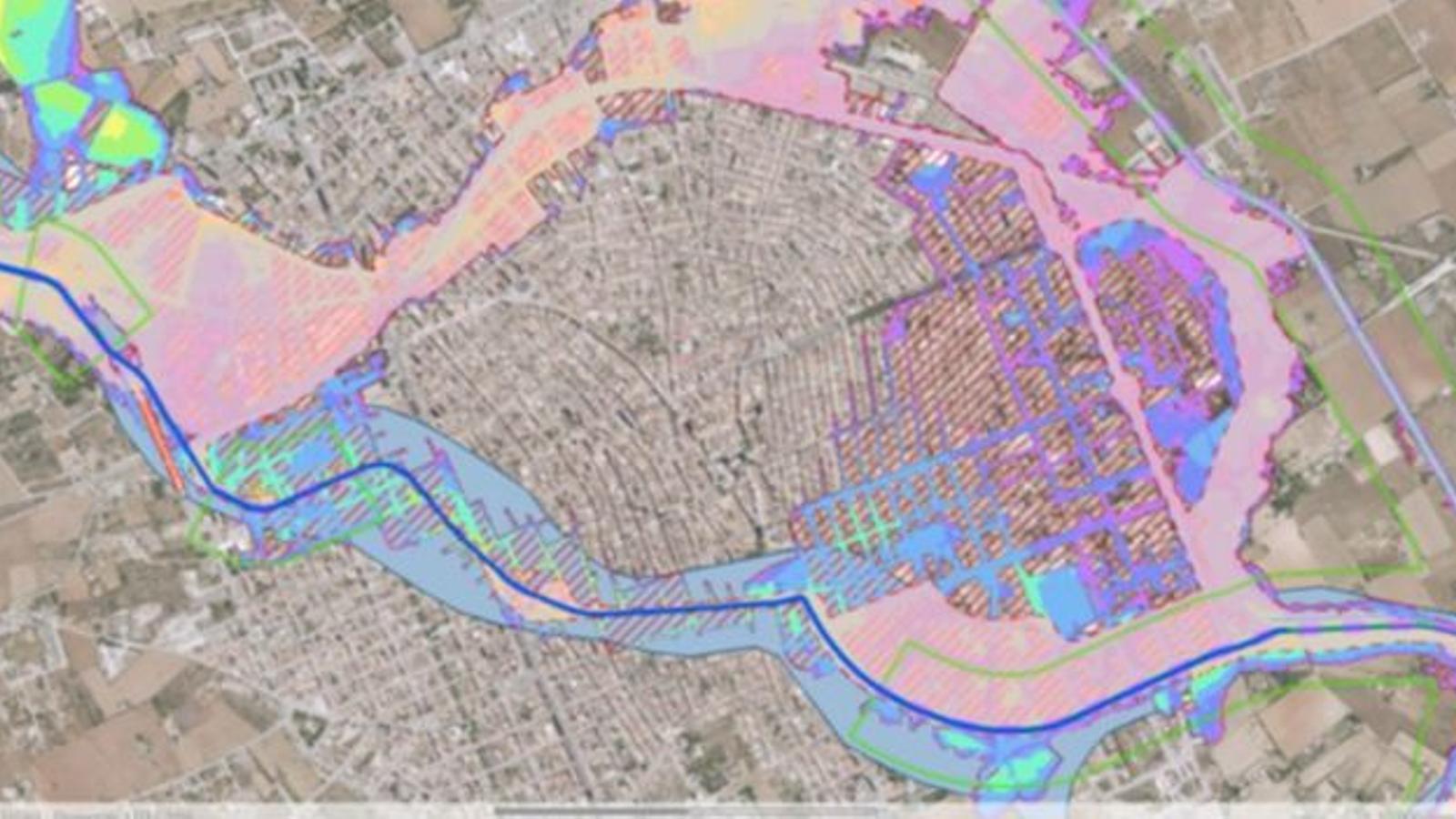
And it is that the new layer of preferential flow risk and flood risk of Manacor's urban fabric foresees a reality until now unimagined by the City Council and which at the same time restricts, for example, the possible construction of the second health center next to the municipal auditorium and improvement works at the treatment plant, near the Bandrís road. Thus, the new flood risk impact map encompasses the entire diversion passage area, to the east and north of the city, but also extends into streets, especially, in the Barracar neighborhood. Also the Torrent avenue and the surroundings of the treatment plant and its passages.

This is why, according to Aguiló's report and having verified that the diversion could not accommodate all the water that a 200-liter-per-square-meter downpour or a flow of 120 cubic meters per second would entail, the Manacor City Council will ask the Government to act urgently on six sections where the most serious problems have been detected, such as the entrance to the city from the Portocristo road and the already mentioned area of the treatment plant, which is recurrently affected even with intense rainfall. "The City Council cannot overlook such an important issue nor can it leave the report in a drawer; therefore, we ask the Administration to act on it," added Oliver.
The new cartography of the IDEIB water viewer allows this perimeter to be seen in pink, as well as the areas in Manacor at risk of flooding. "We wanted to move from the generic to being able to analyze the specific case of the state of Manacor's hydrographic network," said Núria Hinojosa, mentioning the diversion planned in 1994, but which was not inaugurated until a decade later. "It is about reducing vulnerability without building a large infrastructure, but by reviewing the calculations and correcting the six sections where intervention should take place."
The two solutions
In the external report presented to the City Council by engineer Daniel Aguiló, which will now be sent to Water Resources, two solutions are foreseen for the problem points. One, the simplest a priori and which would avoid having to expropriate land, would be to raise the side walls of the stream passage at the black spots, which would thus increase its flow rate. The other would be based on horizontally extending the width of the riverbed to ensure correct drainage without overflow problems.
"What is clear is that the diversion should work and it doesn't," criticized the mayor, who recalled that with the new classification of the preferential flow zone and the flood risk zone, all these owners would also be affected when carrying out procedures or knowing what they can do in their homes.
