The residents conquer Palma's Born with trempó and bread with oil
The meeting has been preceded by the controversial decision of the National Police to order restaurants in El Born to remove their terraces during the event

-
CAT -
CAST -
DE
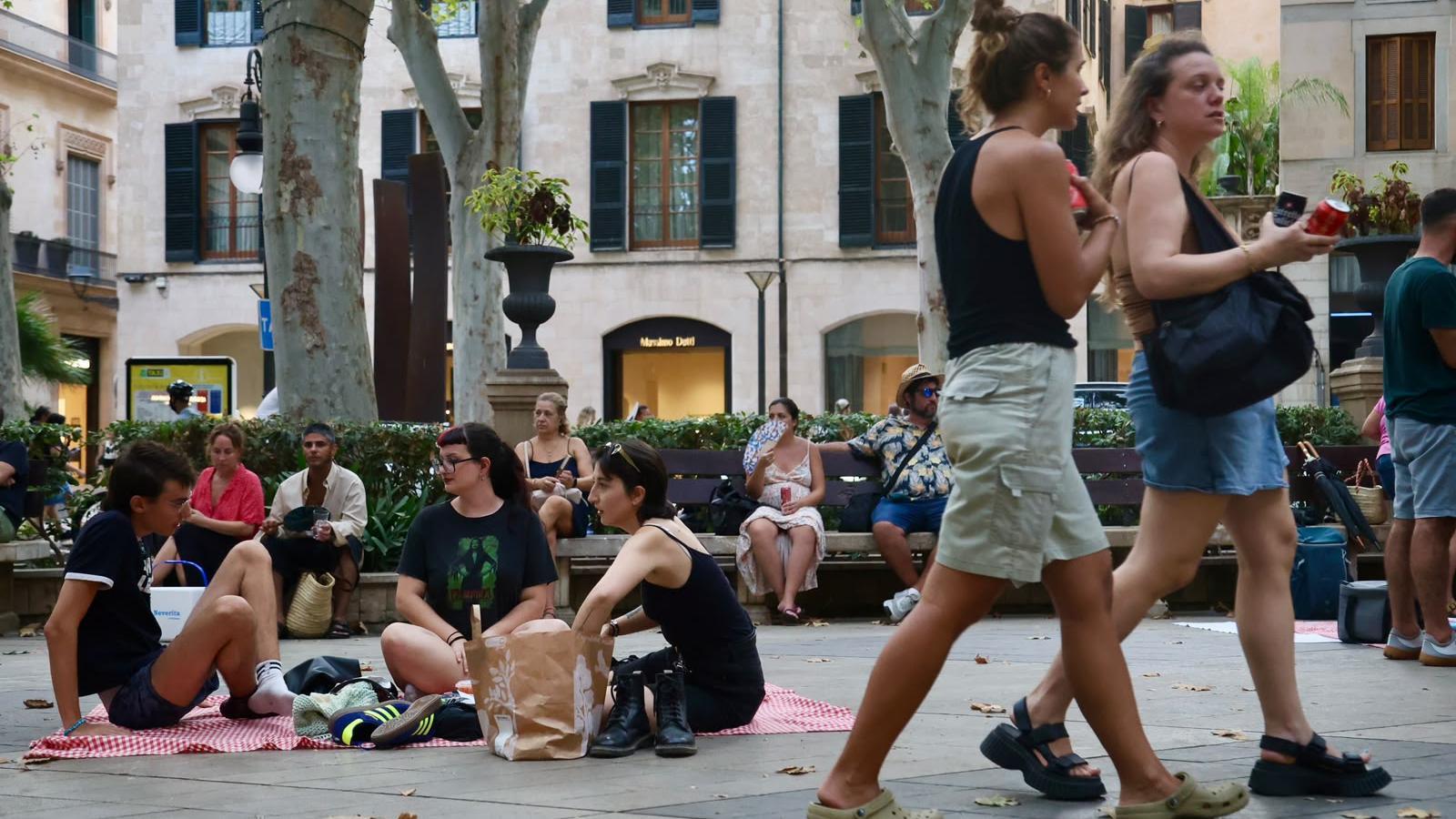
PalmaEl Born was the neighbors' tonight. Hundreds of Palma residents have conquered the promenade with lunchboxes, trempó, bread with oil, and a desire to share a table at the last Wednesday at the Llesca of the summer, a neighborhood gathering promoted by Brunzzit that has turned one of the most emblematic and touristy spaces in the city into a large outdoor dinner for a few hours. The meeting was preceded by the controversial decision of the National Police to order restaurants in El Born to remove their terraces during the event, fearing that the concentration could lead to acts of "sabotage" or "direct confrontation" with the establishments, according to the information conveyed to the restaurateurs. Hours later, however, what filled the promenade were families, young people, children, and the elderly eating together and claiming the neighborhood use of public space.

The first thing that surprises you upon arriving at El Born is that it doesn't seem like any other August evening in El Born. The tables on the terraces have disappeared, and the space usually occupied by restaurant patrons is now empty. In their place, groups are sitting on the ground, on benches, or around improvised tables while music plays in the background and they dance ball de bot. A lunchbox open here, a loaf of bread there, a plate of trempó passed from hand to hand. Some have brought dinner from home, and others have simply come with a desire to share some time with others.

Around, however, the usual Born is still there. The windows of the luxury stores, lit up, the big international brands illuminate the promenade and the surrounding streets continue to be full of visitors. In the midst of this setting, however, the scene is different: children playing, families dining, and neighbors chatting. The contrast between the commercial Born and the neighborhood Born could not be more evident.
Even the ground has another function today. There are games painted on the pavement, like hopscotch, and adults jump on it between spoonfuls. Children running, grandparents sitting on benches, young people arriving with friends, couples, families with children, and people who have come alone and end up finding a place among others. All ages fit on the same promenade. "I have been coming to the Born for years and I had never seen it like this. Now it seems to belong to the people, to the Majorcans, not to the terraces. It is very pleasant to be able to sit here and watch the children play without having to consume anything. It is a recovered public space," explains Catalina Romaguera, 74 years old, who has come with her daughters and grandchildren.
A little further on, Marga Ensenyat, 33, has brought food from home and serves it while her children play beside her. "This is what we should be able to do always. El Born is ours too. It can't be that to enjoy a public space it seems like you have to go into a restaurant and pay," she defends. Tonight's protest, however, does not take the form of a large demonstration. It is much more everyday. It is, simply, about occupying the space and demonstrating that a public place should be for sitting, playing, dining, and talking without the need to consume at exorbitant prices.
A Born in Catalan
This is where one of the most symbolic elements of the night appears: language. For a few hours, El Born has changed its soundtrack. The promenade, accustomed to receiving a multitude of foreign visitors every day and hearing conversations in English, German, Italian, and French, sounded mostly in Catalan last night. It's not that tourists have disappeared from the City. It's that residents have occupied the center of the scene. Between the luxury shops, the displays of major brands, and the terraces dismantled on one side of the promenade, conversations in Catalan have returned to be heard strongly. "It's amazing to see El Born like this. We don't want people from outside to stop coming, but those of us who live here also need to have spaces. Many times we are happy to find Catalan speakers, as if doing so were a rarity, and this is what we must reverse, because it is sad. We must reclaim spaces. A public Born cannot be a Born privatized by terraces and tourism," assures Carles Manzano, 23 years old.
The image is even more powerful after what happened this morning. The National Police had informed restaurateurs that they had to remove the terraces for the celebration of Dimecres a la Llesca, a decision that the agents justified by the risk that the event could lead to acts of sabotage or confrontations with establishments. The measure has generated unease among restaurateurs and has also been questioned by the organizers of the meeting. But the night offers a very different picture than what the police warnings predicted. "We are not criminals. The Police have treated us as if we were going to cause incidents, and in the end, look what we are doing: eating, playing, and being together. It is very sad that for wanting to reclaim a public space, they treat us as if we were a problem," laments Tonia Massana, 45 years old.
The National Police had linked fears of incidents with the Brunzzit demonstration and, especially, with the events that occurred on July 26 after the demonstration against tourist overcrowding, which brought together 70,000 people. The Information Brigade had also considered the slogan 'Liberation of public space' a risk factor, understanding that it could imply actions against terraces and other elements installed in the street. Brunzzit, on the other hand, maintains that Dimecres a la Llesca are citizen gatherings with no history of incidents and that the objective is to reclaim spaces in Palma for neighborhood use. And tonight, at El Born, the message has been expressed in a way as simple as it is difficult to misunderstand: by dining.
Bread with oil, trempó, tortillas, and casseroles have been occupying the spaces that a few hours earlier were reserved for terraces. There were no menus, prices, or reservations. Nor waiters. Just people who brought food from home and looked for a place to sit. For one evening, El Born has ceased to be just a commercial showcase or a place to pass through. It has been a place to meet. To bring children. To meet friends. To chat. To dine.
And the contrast with the usual Born has been almost scenic. On one side, the shop windows of luxury brands remained illuminated and the restaurants only served customers inside. On the other, a group of adults was playing hopscotch. A grandmother shared bread with oil with her grandchildren. A group of young people was finishing a plate of trempó. And, all around, the conversations of the residents filled the promenade.
The Dimecres a la Llesca thus arrives at the end of summer: with a demand made more of lunchboxes than of banners, more of conversations than of speeches and more of neighborliness than of confrontation. The organizers wanted to reclaim the Born as a space for citizen gathering. And tonight they have occupied it. Not to exclude anyone, but to remember that they are also there. That the Born is also theirs. And for a few hours, it has been so.
