Shipping companies warn that limiting cars in Mallorca could transfer more passengers to airports
Baleària, Trasmed and GNV will share vehicle entry and exit data with the Consell de Mallorca to prepare for the planned limitation for 2027
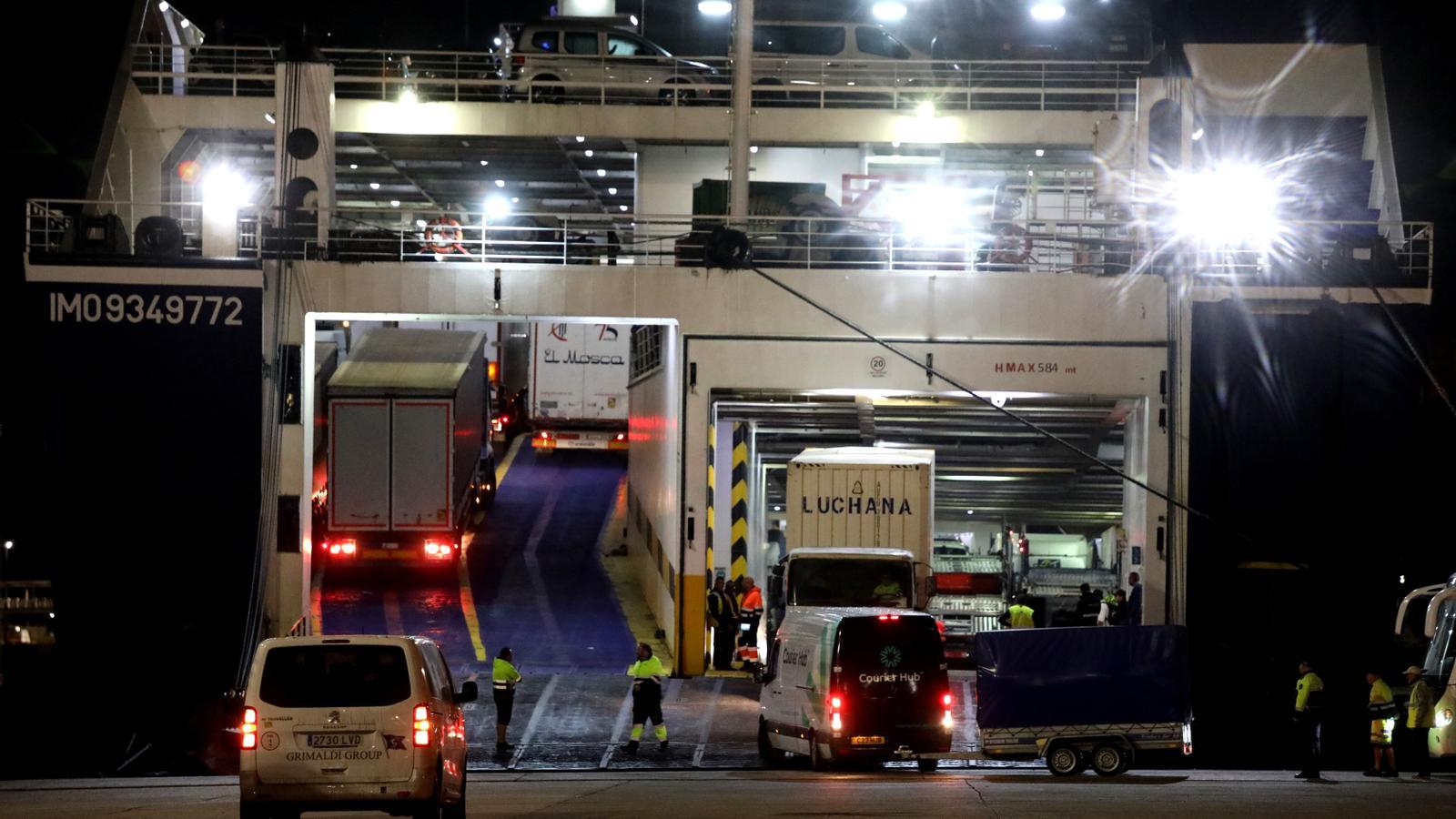
PalmaThe shipping companies have warned this Thursday that the future law to limit vehicles in Mallorca could shift some of the tourism that currently arrives by car towards air transport. The president of Baleària, Adolfo Utor, gave the example of the restrictions applied in Ibiza, where the arrival of tourist vehicles has fallen by 11% during the first half of 2026. As he warned, this limitation could end up favoring visitors arriving by plane. Nevertheless, he insisted that it will be necessary to measure to what extent the regulation is effective and what results it yields.
Utor made these statements during the signing of the agreement between the Consell de Mallorca and Baleària, Trasmed, and GNV, which will allow sharing the necessary data to implement the future law regulating vehicle influx, planned for 2027.
The shipping companies will submit data for the years 2024 and 2025 within one month and, subsequently, data for 2026 on a quarterly basis. The information will include vehicle entries and exits, the daily and annual net balance, as well as whether they correspond to residents, tourists, or rental companies. According to the president of the Consell, Llorenç Galmés, this data will allow making "the best decisions to improve quality of life" with "real and verified" information.
The director of Institutional Relations for Trasmed, Miguel Pardo, argued that any measure must be taken "with tact" and that shipping companies are "very aware" of the saturation problems. "Any measure that does not solve the problem will be nothing more than a smokescreen," he stated. He also recalled that 99.9% of goods enter Mallorca by sea and insisted on the need to analyze the data before making decisions. Furthermore, he requested that the future law does not limit the travel of residents from Menorca, Ibiza, and Formentera.
For his part, Utor reiterated that shipping companies will collaborate with the Consell and support the regulation as long as it is applied in a "rational" manner. "It will have an effect on prices and frequencies," he warned, effects that "will not be good for the shipping companies," although he acknowledged that the sector is part of the solution and that "there are many more things that can be done."
The law also provides for the creation of leaflets and information panels with information on mobility in Mallorca, the busiest points, the operation of public transport and recommendations for driving. Likewise, the Consell maintains the intention that residents of the other islands can continue to travel with their vehicles to Mallorca and is studying whether the same shipping companies will manage the collection of the future access fee, taking advantage of the experience gained in Ibiza.
Both the shipping companies and Galmés have agreed to defend that the future regulation must allow for an "equilibrium" between the mobility of residents, economic activity and the pressure on Mallorca's roads.
