"We are a majority minority"
The language, popular culture and heritage focus the debate on the identity of the Pla de Mallorca without turning it into a picture of the past
-
CAT -
CAST -
DE
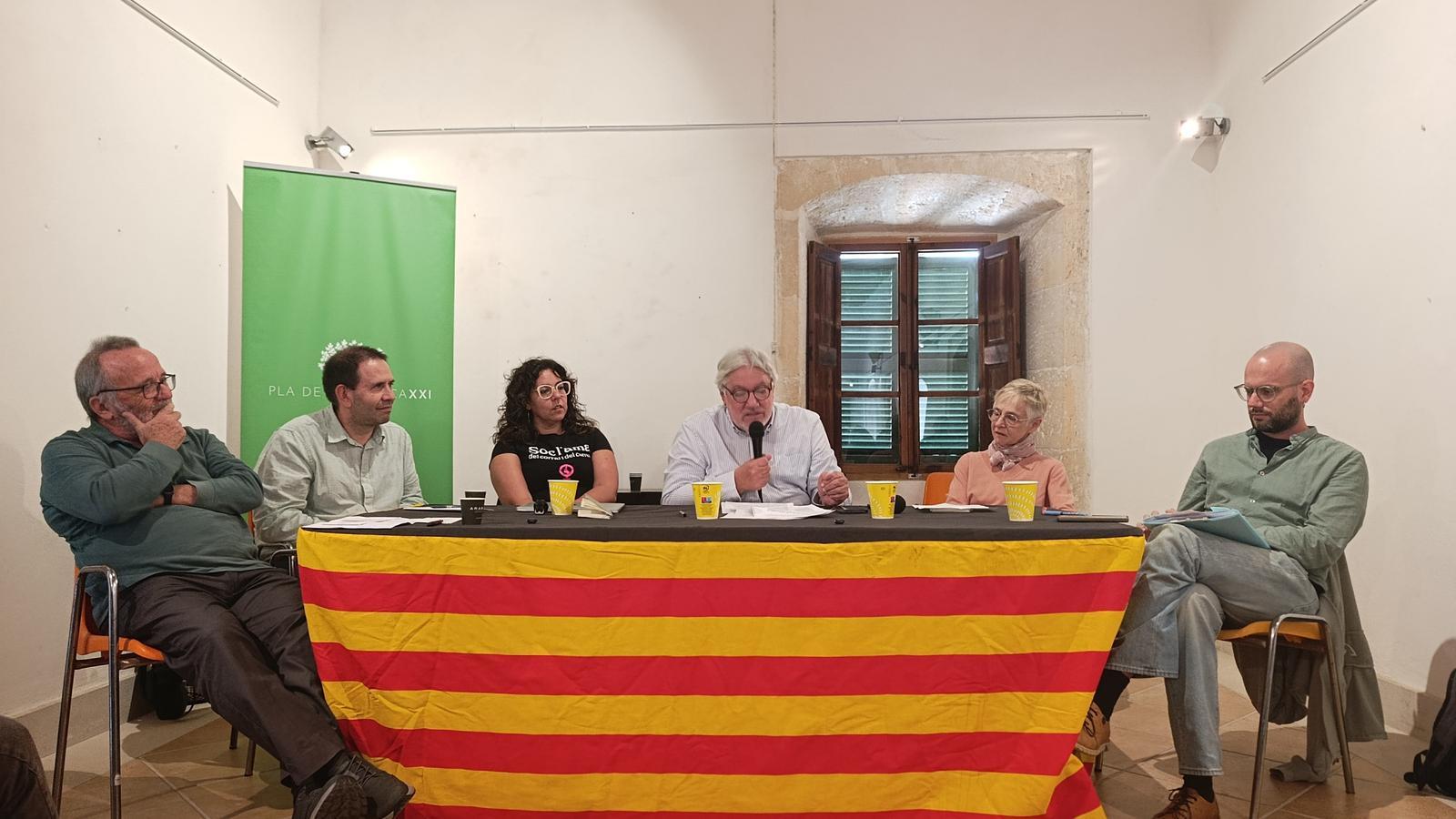
Lloret de VistalegreA few meters from the Dominican convent of Lloret, a bar displays an advertisement for a Halloween party and a costume contest. The establishment's decoration of skeletons and pumpkins contrasts with the debate taking place inside one of the halls of the convent premises, where the second day of What Plan do we want for tomorrow?, organized by the Pla de Mallorca XXI Association. A debate on the future of the region in the face of the transformation it is undergoing, like the whole island, accelerated by an economic and productive model that seeps into every corner of the geography.
“We are a majority minority”, expresses the linguist Joan Melià, philologist and former general director of Linguistic Policy, during his intervention. It is one of the ideas that cross the entire round table on society, culture, and heritage, held this Saturday. Language, heritage conservation, cultural management, the work of organizations, and the need to rethink what it means today to be from the Pla de Mallorca are the main topics of a conversation that has gathered dozens of people this Saturday morning in Lloret. The geographer Climent Picornell is at the helm, directing and moderating the conversation.
Melià has vindicated Catalan as the language of daily relationships and asks for coherence between the convictions and habits of Catalan-speaking people. He questions switching to Spanish when speaking with racialized people or with children of Maghreb origin, even when they are schooled in Catalan and know it: “We give them a message that Catalan is useless for anything”. He has also defended small gestures such as prioritizing local consumption and products labeled in Catalan, and pointed out that “the linguistic community is more connected than ever, but also more fragmented”, because we no longer know our neighbors. “Small changes are powerful”, he added, paraphrasing the well-known environmentalist television superhero of the 90s, Captain Lettuce.
The identity and social changes of the Pla have been one of the topics that have focused the speech of the anthropologist Marcel Pich, coordinator of the Inventory of Intangible Cultural Heritage of Mallorca. He has warned that the region is not a uniform reality: Vilafranca and Costitx are part of the same territory, but they live dynamics that are increasingly different. Nevertheless, in an interconnected Mallorca, he has assured, ways of thinking linked to the rural world still persist. He has also warned that tradition is often claimed when there is a sense of danger and that the discourse of locality is not exclusive to the left, since "the extreme right is currently doing it."
Pich gave an overview of his work collecting the inventory of intangible heritage of Mallorca, which gathers nearly 600 elements collected during four years of work and almost 300 interviews. As he explained, Catalan is the vehicular language of 99% of the included manifestations. The research also shows that heritage does not stay alive if it does not transform: there are young people who preserve it and, at the same time, generate new things. "Most things, if they do not transform, do not survive," he pointed out. "We Majorcans do many things," he summarized with pride, in reference to the people who maintain the festivities, the trades, and the popular knowledge.
The conservation of Heritage has focused the speech of the art historian Joana M. Palou, former director of the Museum of Mallorca, which goes precisely through knowing it and making use of it. "The basis of everything is use," she stated. The former director of the Museum of Mallorca has warned that trades and the names of things are being lost. "There are no longer artisans or farmers who know what things are," she said. She also proposed that churches, created to congregate, could host cultural and community uses, such as theater or multidisciplinary activities.
The architect Joan Vanrell, president of the OCB of Sineu, has highlighted the role of the local press to bring together newcomers so they get to know the language. At the same time, he has lamented the disappearance of neighborly relations and has claimed the conversation "a la fresca" (outdoors in the cool): "Going out 'a la fresca' should be recovered to talk with neighbors and the elderly," the sound heritage of the countryside, or the ringing of bells within the villages.
Cultural manager Joana M. Serra, art historian and museographer, has championed the work of associations, which support a large part of the cultural offerings of towns, but has warned that public policies and cultural management professionals are needed. "In the absence of cultural policies, all the work done by associations and civic and civil society entities is of the utmost importance," she said. Supporting local initiatives, she believes, must also serve to broaden horizons and connect them with proposals from outside.
The conference began on Friday with the reception and inauguration of the exhibitions Foravila fora grues, by Terraferida, and Cases que no existeixen, by M. Rosselló Xamena, and with a debate on rural and agricultural development. On Saturday, the round tables addressed territory, the environment and sustainability; society, culture and heritage, and territorial planning and management, before the conclusions and closing session.
Just across the street, the 'good afternoon' greetings of elderly men going for coffee mix with phantasmagorical costumes and waitresses with foreign accents. The reality of Mallorca summarized in a cup, also in the Pla.
