In January 1968, the English weekly Melody Maker published news that generated great expectation: the possible organization of a festival called First World Festival Of Jazz and Popular Music, which would colloquially be known as the Música 68 festival. It was to take place from July 22nd to 27th in the Palma Bullring, with a capacity for 17,500 people. The historian Tomeu Canyelles offers the details in his doctoral thesis New Musical Styles and Social Changes in Mallorca: 1960-1975. “Behind the organization was an English promoter called Music Festival Productions which, associated with musicians Ronnie Scott and Peter King, launched the idea of holding a large-scale musical show on the island.”Última Hora was the first local newspaper to pick up on that rumor. It speculated that “British, French, Spanish, German, and American stars” would participate in the festival. Later, with information coming from London, it published some of the lineup names: Donovan, Scott Mckenzie, Jimmi Hendrix, Peret, Rita Pavone, Tom Jones, Ray Charles, Ella Fitzgerald, and the groups Los Bravos, The Animals, and The Byrds. The stage setup included a filming set to later sell the tapes to various world televisions.In mid-June, a month before the event, Última Hora reported that the organizers had disappeared. “In an atmosphere of absolute silence – states the historian – the promoter Music Festival Productions backed out, and none of the journalists or chroniclers of the time remember the exact reason why this great festival did not take place. There is a possibility that the budget got out of hand, or simply that it was foreseen that it would not be profitable.”Despite the failure of that initiative, Mallorca during the tourist boom would not stop using music as a promotional tool. In 1972, Mallorca and Ibiza hosted the recording of the famous music video Un beso y una flor by the Valencian singer Nino Bravo. In 1978, the Italian diva Raffaela Carrà divided her time between Mallorca and Menorca to film her hit Hay que venir al sur. That same year, Menorca also served as the set for the filming of two popular songs of the time: Summer Love, by Phil Trim from Trinidad and Tobago, and Paquito Eche, by the Frenchman Georgie Dann.Classical music would also be an important tourist attraction. In 1962, the Pollença Festival was launched, promoted by the English violinist Philip Newman, a loyal visitor to the town. In 1964, another artist in love with the Tramuntana mountain range, the Catalan painter Josep Coll Bardolet, promoted the concert in the Torrent de Pareis. On September 3rd, 1969, the Incan shoe businessman Marc Ferragut Fluxà inaugurated the Auditorium in Palma. For the occasion, the Berlin Philharmonic Orchestra played under the baton of the prestigious Austrian conductor Herbert Von Karajan. In 1979, English musicians Patrick Meadows and Stephanie Shepard initiated the Deià International Festival. And in 1981, the Valldemossa Chopin Festival, which had been promoted in 1930 by the Palma composer Joan Maria Thomàs, was reactivated.
From 'Me lo dijo Pérez' to 'El Puente': the tourist songs that projected Mallorca to the world
Driven by the Promotion of Tourism in 1964, the International Song Festival of Mallorca turned music into a great advertising showcase for the island and popularized songs like ‘Paradise of Love’, ‘Vuelo 502’ and ‘El turista 1.999.999’.

-
CAT -
CAST -
DE
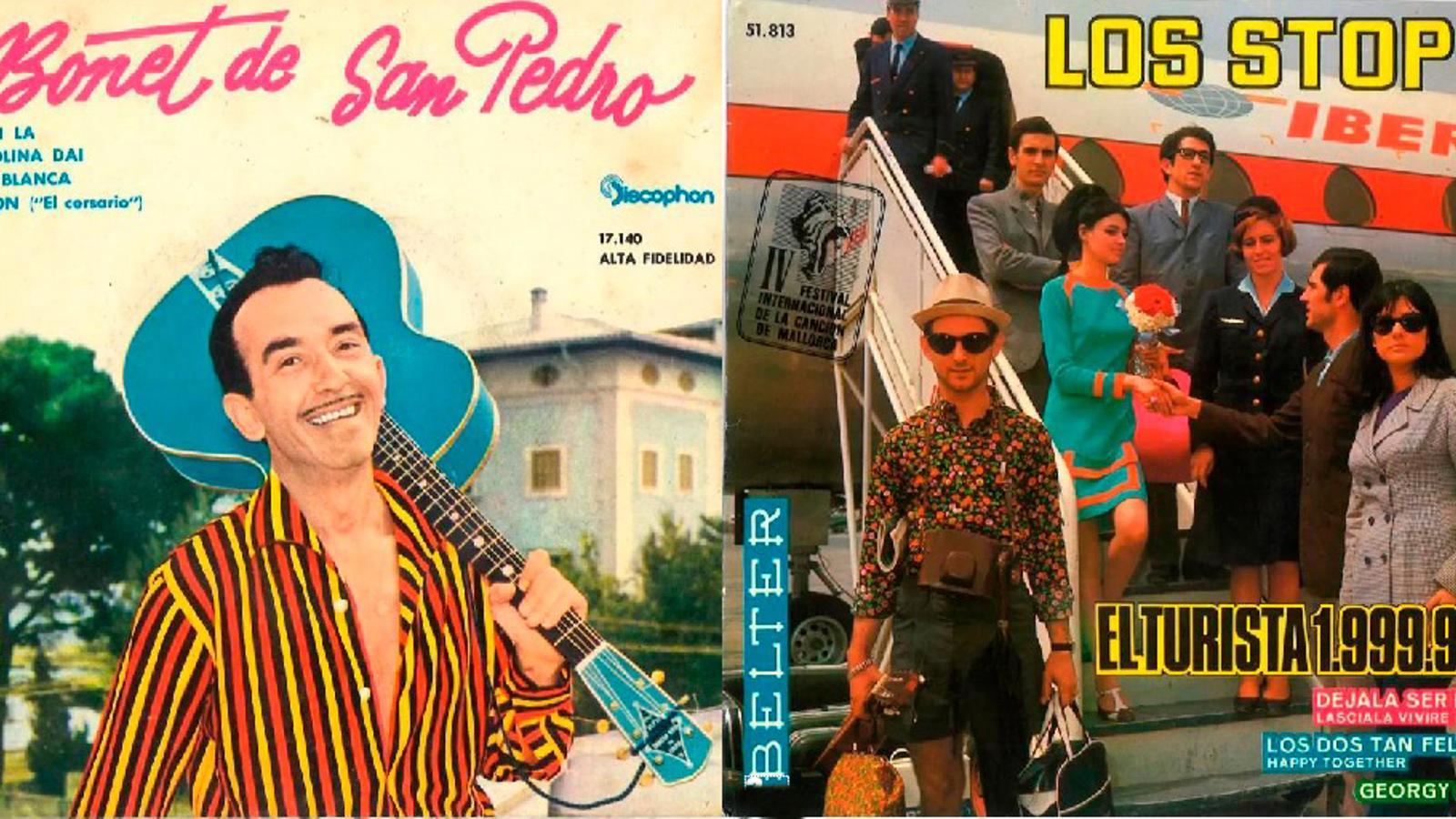
PalmaIn Mallorca, one of the great allies of the boom of tourism were the so-called tourist songs. The lyrics praised the island's scenic wonders. The seed was already sown in the 40s of the 20th century by the Majorcan musician Pere Bonet Mir (1917-2002), better known as Bonet de Sant Pere and professionally Bonet de San Pedro. In the midst of the post-war period, in the song Bajo el cielo de Palma, he proclaimed to the four winds “paisajes lindos tiene Mallorca”. He would deal with the same theme in Un viejo hogar en la isla, Juntito al mar, Cala d’Or, and Canto a Mallorca. These utterly naive compositions contrasted with the famous song Raska-yú, which in 1943 the island artist wrote as a parody of death in times of great misery (Franco's regime even censored it, suspecting it contained an implicit criticism of the dictatorship).
Bonet de Sant Pere's tourist songs were the ones that in 1950 welcomed hundreds of newlyweds, peninsular and foreign, who arrived on the island thanks to the ‘Honeymoon in Mallorca’ campaign. The initiative had been born from the Foment de Turisme de Mallorca to relaunch the sun and beach industry after the setback of the Second World War. At the beginning of the 60s, new lyrics dedicated to the island would appear. In 1961, the singer Gelu from Granada recalled a summer love in En Palma de Mallorca. And in 1963, after performing in Santa Margalida, the Hispano-Argentine Luis Aguilé composed the successful song Santa Margarita. “Spain has Mallorca –he said–, Mallorca has a saint named Margarita. Who hasn't had a nice night in Santa Margarita, in Santa Margarita? And who hasn't seen a pretty girl in Santa Margarita, in Santa Margarita?”.
The tourist boom also led to the birth of Majorcan music bands that played in hotels – some would make the leap to the Peninsula and abroad. Among others, Los Javaloyas, Los Bravos, Los Beta, Los 5 del Este, Z-66, and Els Valldemossa, by the Estaràs brothers, stood out. They mixed their own songs with international hits of the moment such as Yesterday and Yellow Submarine by the Beatles and Satisfaction by the Rolling Stones. Outside the hotels, Palma would be filled with discos designed to attract young European tourism. The kings of the night were Tagomago (1964), Sgt. Peppers (1968), and Barbarela (1969).
“Every day is a party in Mallorca”
In 1964, aware of the importance of music as a promotional tool, the Foment de Turisme launched the Festival Internacional de Canción de Mallorca. It was preceded by the success of the organization the previous year of the Festival Mundial de la Elegancia y la Belleza for the election of Miss United Nations. That musical event was in line with other world-renowned festivals such as San Remo in Italy (1951), Eurovision (1956), Benidorm (1959), and the Cançó Mediterrània of Barcelona (1959). Mallorca's festival, however, differed from the others by a special clause: any participating composition had to "disseminate and popularize the island's name, evoke Mallorca through a song".
Between July 7 and 11, 1964, the Hotel Cristina in Palma hosted the first edition of the Mallorca International Song Festival. The presenters were José Luis Uribarri and Irene Mir. They were accompanied by American musician Andy Russell, who was in charge of addressing foreign television stations in English. A total of 496 songs were submitted, of which 20 were selected, representing countries as diverse as Argentina, Ireland, France, and Greece. The winning song was "}When Palma sang, from the French couple formed by Frida Boccara and Luis Recatero. Until the moment of the performance, neither of them had visited the island. In the book Paradise of Love or the imagined island (Edicions Documenta Balear, 2012), musicologist Francesc Vicens recalls the words spoken when receiving the award: “Everyone knows Palma and not everyone has been here. We know it from what we had seen in photos and read in books and from what many, many friends had told us”.
Even though it didn't receive any awards, the most remembered song from that first edition in 1964 was Paradise of Love. Written by Bernat Pomar, it was performed in Spanish and English by Los Javaloyas. “Every day –said the tune– it's a party in Mallorca”. It was a usual tonic that the compositions with more repercussions than the festival, the winners were not. In 1965 the audience was enthusiastic about Pérez told me, by Karina. Despite its success, the lyrics were heavily criticized for being frivolous and superficial. It said things like: “Pérez told me, who was in Mallorca, that there the joy, by night and by day, never ends. If you saw, he told me, what lovely girls who love to play in the sea on the beach".
‘The 1,999,999th tourist’
In 1966 Vuelo 502, from the group Los 4 de la Torre, took much of the applause. “We are almost there –he proclaimed–, to be able to see the land that God placed”. In 1967 the most acclaimed piece was The tourist 1,999,999, by Los Stop. It spoke of the sadness felt by the tourist who had been on the verge of being the 2,000,000th visitor. In 1968 the ovation was for El Puente, in which Los Mismos assured that “if they built a bridge from Valencia to Mallorca, it would be wonderful to travel to Mallorca without needing to take a boat or plane, just by walking, cycling or hitchhiking”. In that edition, in second place was a song in Catalan that exceptionally did not speak of the virtues of Mallorca. It was I don't care at all, by Antoni Perera Fons from Manacor.

In 1970, the sixth and last edition of the International Festival of Song of Mallorca took place. The historian Margalida Pujals Mas explains the reasons in the book Leisure in the sixties. Music, song and dance halls (Edicions Cort, 2002): “The public soon realized that the results were agreed upon, that the songs did not have the minimum quality to participate in a festival and that, in short, it was more of a media spectacle than a musical event. It fell into a monotony that bored even the organizers. Year after year the same presenters were repeated, the scripts of the galas were almost repeated and the public's opinion was not respected, which in some cases greeted the jury's decision with whistles”. In 1975, it was desired to revive the old event with a new name, Musical Mallorca. The initiative, with its epicenter at the Auditòrium of Palma, was to serve to recover the island as a tourist destination after the international oil crisis of 1973. Financed by RTVE and also presented by José Luis Uribarri, it would only last three editions. In the last one, the Italian diva Raffaela Carrà participated with her mythical song Hay que venir al sur.
‘Disc-souvenir’
The Mallorca International Song Festival would mark the life of one of the participants in the first edition, the musician from León Miguel Aller, who was eliminated in the first round. The historian Tomeu Canyelles talks about it in the doctoral thesis he presented in 2013 at the UIB with the title New musical styles and social changes in Mallorca: 1960-1975. “Aller came away with two lessons learned: the first, the important business that existed around the different record labels which, by taking advantage of the great diffusion of that contest, achieved a considerable profit margin by releasing the songs that participated. The second, the lack of recording studios on the island at a time when a very large number of musical groups appeared, intended to liven up the nights of countless night-clubs, party halls, discotheques, or any tourist infrastructure”.
In 1965, Aller, at 39 years old, opened the headquarters of the first record label in the Balearic Islands, Fonal, on Sant Jaume street in Palma. The new label allowed island groups not to have to travel to the Peninsula to record their albums. Aller understood music as a business based 50% on quality and another 50% on marketability. His star product was the 'souvenir disc'. It contained 'toponymic songs' that evoked the happiness of the Mallorcan summer in a specific corner and that tourists bought at their hotel. Thus arose records such as Can Picafort, Son Vida, El Arenal, Cala Millor, Magalluf, and Cala Mayor.
Music in Catalan was testimonial at Fonal. Priority was given to Spanish songs of pasodobles, fandangos, and flamenco, and hits of the moment such as Un rayo de sol, Limón limonero, Guantanamera, Prorrompomero, Cuando salí de Cuba, Vivo cantando, and La bamba. There would also be compilations in LP format under the title Vacaciones en Mallorca and Vacaciones en España. “The striking covers –Canyelles points out– were a whole collection of clichés of that golden Mallorca: beachfront hotels, attractive swimmers in bikinis by the sea, night images of the Cathedral...”. Fonal was a resounding success. It sold print runs of record copies of 50,000 at a time. In 1973 it would transform into Maller. As a tourist promotion tool, today music has been completely displaced by Instagram.
