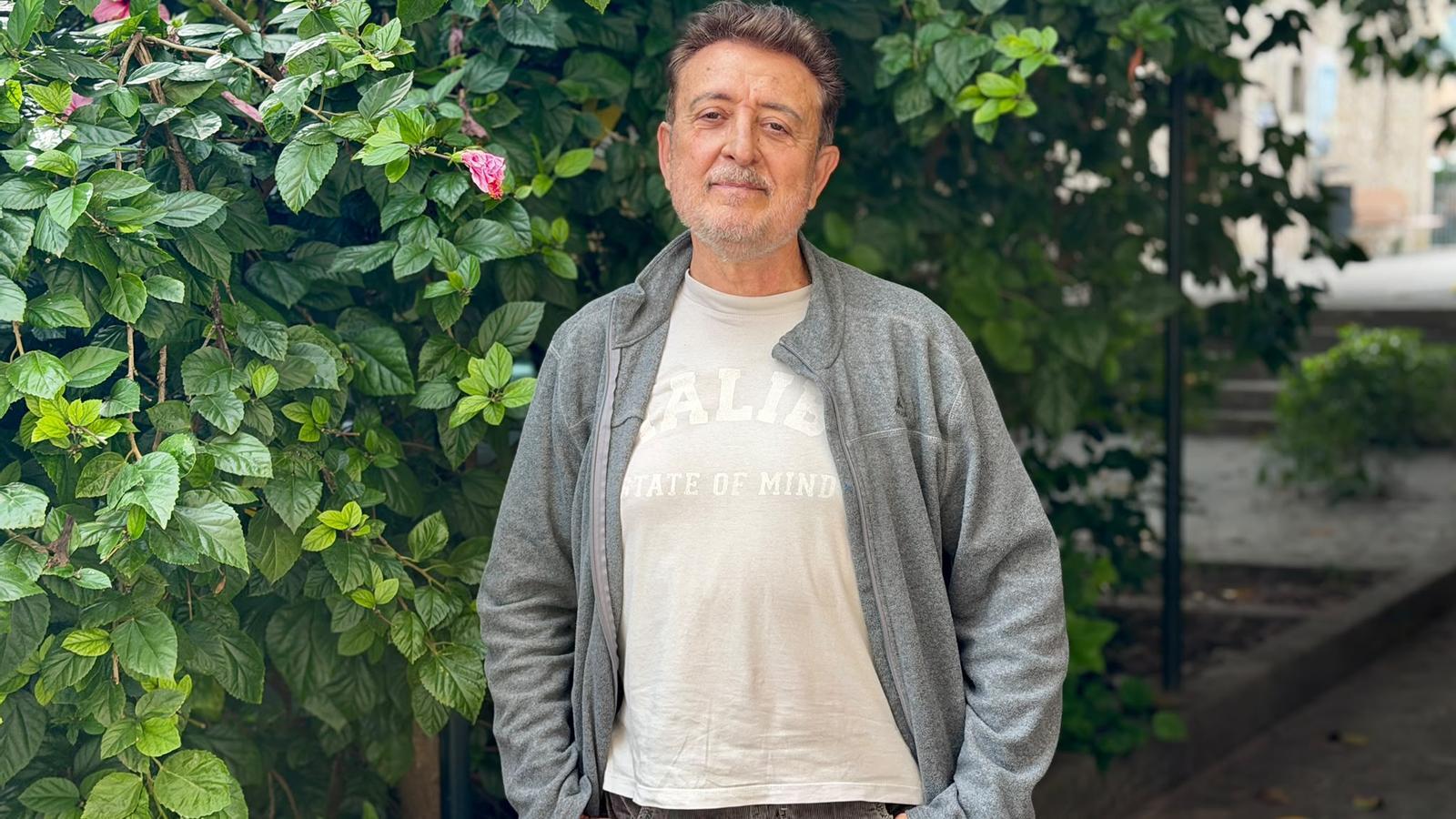
Manolo García: "That the people of Mallorca can live without being drowned"
The singer of El Último de la Fila exhibits nineteen paintings in Pollença and defends a Mallorca where the tourist business leaves space for the landscape and the life of the residents

-
CAT -
CAST -
DE
PalmaBefore knowing the Islands, Manolo García had already looked at them many times. They were in the photographs his father kept from his military service in Ibiza, where he had done his military service in 1954, and in the landscapes of the painters that fascinated him when, as a teenager, he went to the museum. "It was a paradise," he recalls of that paper Ibiza. Later he would arrive there himself, first without the memories that he would accumulate over time through concerts, trips, and friendships. Now that he returns to Mallorca to exhibit there, his father's images reappear between the explanations of his paintings and a very present concern: he acknowledges that many people live off tourism, but warns that "everything has a price."
García brings nineteen works to the Dionís Bennàssar gallery in Pollença, where La Realidad Subjetiva can be visited from October 25th to November 19th. They are mostly small and medium-format acrylics, some made expressly for an exhibition that allows one to get closer to the painter who has always coexisted with the singer of El Último de la Fila. However, when he explains what is behind a mask or a landscape, the powerful, the wars, and the residents who want to go to a cove soon appear. All of this has to do with the paintings, even if at times it seems he has stopped talking about them. "What is happening is totally surreal," he says.
An easel in the shop window
The obsession came on the way to school. In a drugstore there was an easel, some tubes of oil paint and a brush that left him mesmerized in front of the window display. At home, his father's salary did not stretch for all his whims, but he insisted to his mother and even proposed that they pay for it little by little. "I talked her into it," he recalls, without giving much solemnity to that first conquest. He does not give much to the result either: "At thirteen, I started making some dreadful paintings." He still keeps some of them; the naivety has granted them a charm that he was not looking for back then.

At the museum, on the other hand, he discovered how far everything that had captivated him could reach. He mentions Anglada Camarasa and Mir, and the impression that some landscapes of Mallorca, which he had not yet seen with his own eyes, made on him. "This essence, you are a young kid and it marks you, it touches you," he explains. Between the family photographs and the canvases of those painters, the Islands had gradually settled into his mind.
His father, who worked in a factory, wanted him to learn a trade with which to earn a living. García studied graphic design, while painting and music began to occupy a space they would never abandon. Now, when he collects stones or stops in front of a landscape, he still recognizes something of that fascination: "I look for a solitude of the soul, but a solitude accompanied by nature."
From color to a song
This solitude can have a guitar close by. In his studio, the easel and paints occupy one side of the room, and the instruments, the other; after hours among colors, an idea can make him get up and switch sides. The painting suggests a song, the music gives him a clue to continue a painting, and he goes from one thing to the other without having to decide which of the two professions he practices.
He has also taken sketchbooks and pencils to hotels during tours. While the concert time approached and the production team resolved their setbacks, drawing allowed him to stop worrying about what was out of his hands. If a truck had broken down, what was the point of him getting anxious too? He could spend the day on paper until someone reminded him that it was time to go out and sing.
He arrives in Pollença invited by Pol Font, from the gallery, who had already exhibited the work of Diego Vasallo, a musician from Duncan Dhu and also a painter. García created part of the paintings thinking about this appointment and explains his preference for acrylic with a practical reason: it dries quickly, so he can correct and paint over it without waiting long. Putting the final touch is harder. As long as he is still having fun, he can always add something to it.
A world where he sets the rules
The title of the exhibition has a lot to do with this freedom. García perceives reality as a path that is too marked, with some who decide where one must go and others who must obey, and painting allows him to create a world of his own. He puts water, stones, characters, and a nature transformed in his own way into it, at times bright, at times dark, depending on what is going on inside him.
Because the news also enters the studio. He is distressed by wars, suffering, and the decisions of powerful people who govern the lives of others; he wonders why, if people work, pay taxes, and comply, there is still so much injustice. When he speaks of the masks and the lies he sees everywhere, he makes it clear that he does not consider disinformation an invention of social networks.
Creating allows him to find a more concrete meaning to things: the public that sings and is happy, someone who looks at a painting and finds something in it that moves them. "For me, the meaning of life is to give life to others. Taking life from others makes no sense," he states. Hence also the respect he demands for those who buy a ticket, a record, or a painting: having the luck to make a living from what he likes compels him to take it seriously.
When he needs to get away from everything, he leaves the city without much of a plan, follows some path, and returns with stones, branches, or wood that the sea has shaped and that can end up turned into sculptures. In Pollença, he has already noticed the hills that surround the town. He likes that there is a landscape behind the characters, but it pains him to see how what we have in front of us is transformed. "The landscape belongs to everyone," he claims. "It is food for the spirit, it is food for the soul."
Living from tourism, being able to live in Mallorca
That Ibiza he had discovered in his father's photographs reappears when he speaks about overcrowding. García acknowledges the jobs and income from tourism, but calls for a limit that allows residents to continue enjoying the place where they live: "Let people live, but don't let them be suffocated." Going for a swim, walking through the streets, or arriving in a town and being able to park are part of that life he asks to preserve. "Think about your people," he insists.
He proposes regulating the influx as is done in natural spaces where, when the limit is reached, one must wait for someone to leave to let more visitors in. He understands that hotels and restaurants have to do business; what he questions is how long growth should continue if one can already live well. "If you already make a good living, you want more," he reproaches this ambition which, in his view, ends up making some pay for the gain of others with the discomfort of the rest. He asks to talk about it without violence, but also without covering one's ears.
And, in case the reasoning needs an image, he uses cows. In a meadow, forty can graze, but someone decides that if they put two hundred there, they will get more profit. "You will ruin the meadow," he warns. With forty, one could already live well; with two hundred, one risks losing everything: "There will be no cows or meadow." The conclusion comes out with less ceremony than any speech about sustainability: "Damn, man, enough is enough."
