Education attributes the drop in PAU results to LOMLOE: "The law has not worked"
The percentage of passes falls almost three points in one year, to 89.6%, and the Department values its commitment to reinforcing knowledge and hours of Mathematics and Physics

-
CAT -
CAST -
DE
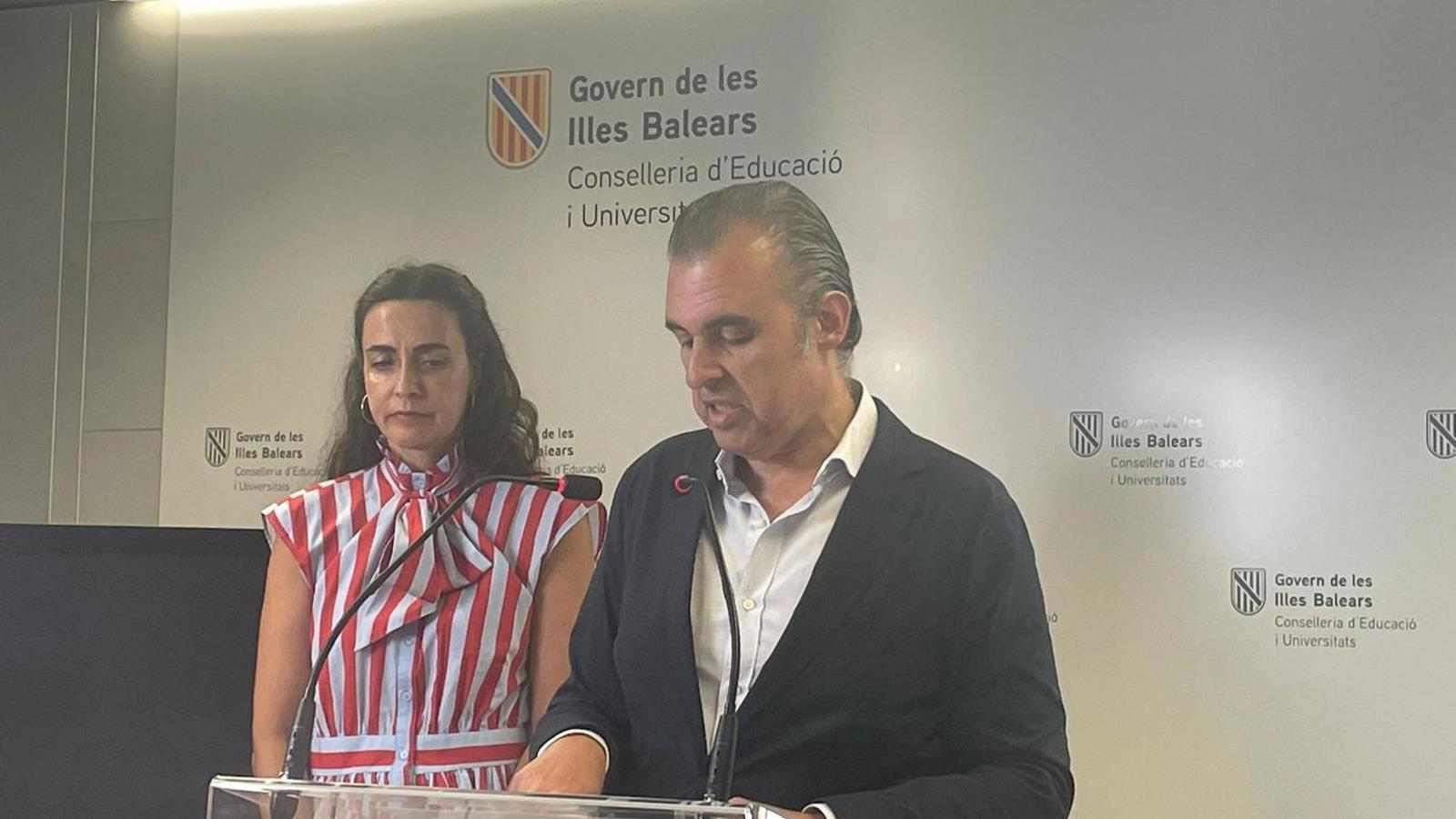
PalmaThe Ministry of Education considers that the results of this year's University Entrance Exams (PAU) demonstrate the failure of the implementation of the LOMLOE and the curricula derived from the educational reform. The minister, Antoni Vera, admitted this Tuesday that the data "are not good" after the percentage of eligible students fell from 92.5% recorded in 2025 to 89.6% in 2026, while failures increased to 10.4%.
"If we want to recognize the excellence of students with the best academic records, we must also work to improve the results of students who have not achieved the objectives," Vera stated during the presentation of the awards for the best university entrance records, an event that the Government has taken advantage of to make a political interpretation of the test results.

The Ministry has placed special focus on scientific subjects, which show the worst results. Mathematics has obtained an average grade of 5.01 and only a 57% pass rate. The situation is even more delicate in General Sciences, with an average of 4.70 and 48% of students passing, while Physics registers an average grade of 4.87 and a 51% pass rate. In linguistic subjects, the results also stand slightly above five, with an average of 5.62 in Catalan and 5.43 in Spanish.
According to Vera, these are the first PAU (university entrance exams) to have been conducted entirely under the LOMLOE educational model and the curricula approved by the State in 2021 and implemented in the Balearic Islands in 2022. The minister has highlighted that the students examined this year were in their 3rd year of ESO (Compulsory Secondary Education) when the reform was implemented and, therefore, have completed the entire final stage of their schooling under this regulatory framework.
"The Law has not worked and these are the results we have," stated the minister, who criticized that the reform "has displaced knowledge from the center of education." He also extended this criticism to the curricula approved in 2022, which, in his opinion, have prioritized methodologies over academic content.
Fewer hours of Mathematics and Physics
To justify this diagnosis, Vera recalled that previous curricula reduced the teaching load of various subjects. As she detailed, in Primary, eight hours of Mathematics and four of English were lost throughout the stage. In Secondary, a weekly hour of Mathematics was also reduced in 4th year of ESO and one hour of Physics in both 4th year of ESO and 1st year of Baccalaureate.
In this regard, she stressed that the Balearic Islands were "the only autonomous community" that taught Baccalaureate modality subjects with only three weekly hours instead of four. "This metapedaogism has caused the situation we have now," she stated. The minister also criticized the mandatory nature that the research work in Baccalaureate had acquired, a requirement that, as she explained, the LOMLOE itself did not foresee and that the Government had to regulate.
New curricula
Given these results, Vera has defended the curricular reform promoted by Marga Prohens' Government, which will begin to be rolled out progressively. As she explained, the new curricula recover knowledge as the central axis of teaching, increase the hours for Mathematics and modality subjects, strengthen languages, and recover content that, according to the Government, had disappeared, such as four centuries of Spanish History.
In Early Childhood Education, psychomotor skills, writing, and mathematics are reinforced, while screen use is limited. In Primary school, hours for Mathematics, Language, Artistic Education, and Environmental Studies are increased, while in Secondary school, Mathematics in the 2nd and 4th year of ESO is particularly reinforced, and electives are created to consolidate skills in languages and mathematics. In Baccalaureate, hours for modality subjects are increased, and research work ceases to be mandatory to become an elective.
The minister insisted that these changes aim to "improve academic results and reduce inequalities" and assured that the Ministry will continue analyzing the results of the PAU with teachers, principals, and unions. "We will put this data on all Education tables so that there is a joint reflection and we can reverse this situation," he said.
In parallel, the Ministry has announced the awards for the best university access records. Students with the highest qualifications can submit their applications between July 15 and 24 and compete for one of the 20 awards of 600 euros that will be granted this year: 10 in Mallorca, 5 in Menorca, and 5 between Ibiza and Formentera. According to Vera, the initiative aims to "recognize the effort and talent" of students with the best results.
