The first Selectivity begins with radio frequency detectors: "For the moment, we haven't detected any"
The exams mobilize 4,950 students and a large surveillance device reinforced to guarantee equal opportunities

-
CAT -
CAST -
GER
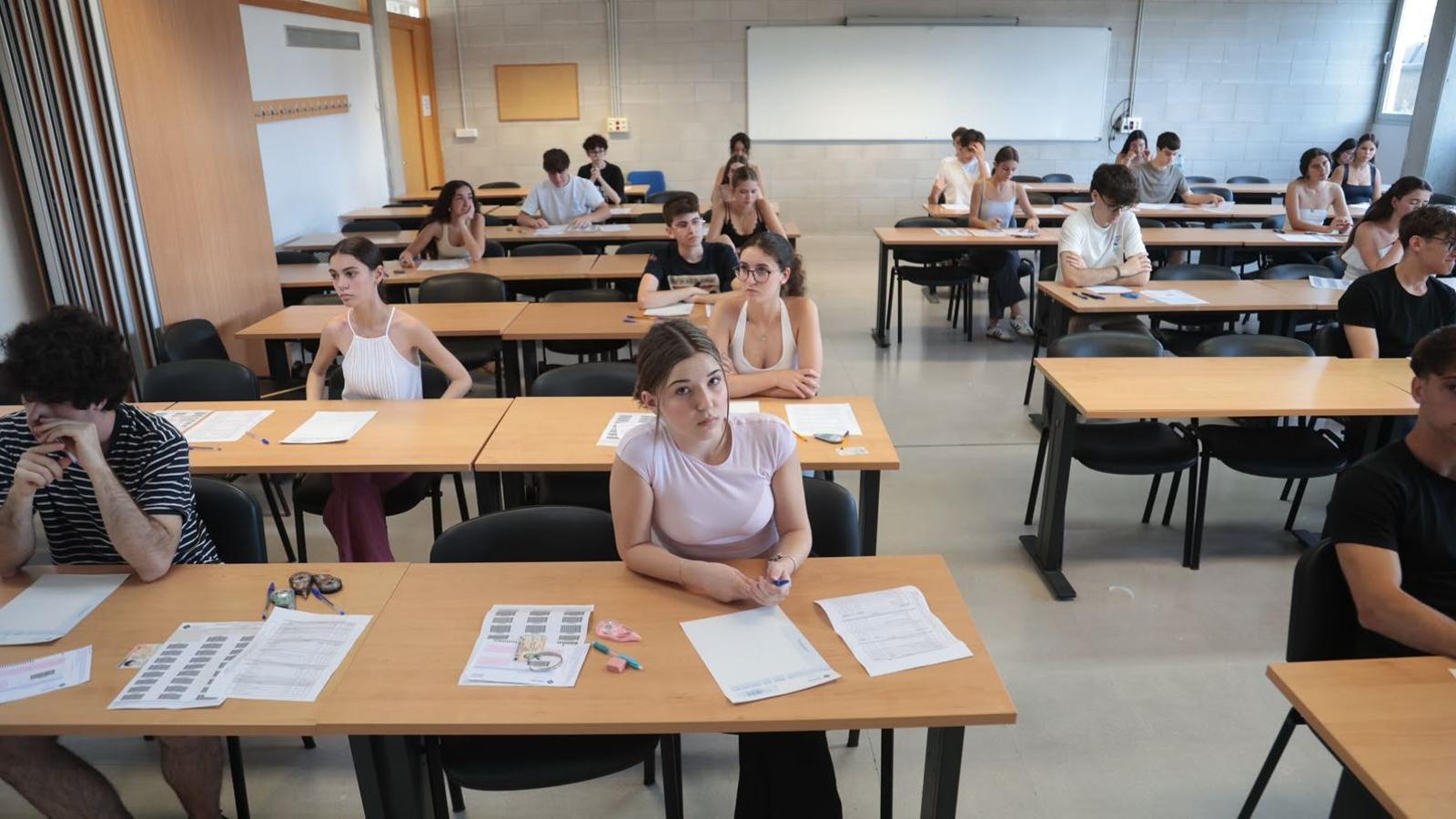
PalmaThe PAU 2026 has started this Tuesday with 4,950 students from the Balearic Islands determined to achieve the grade that allows them to access their desired higher education studies. The usual nerves of the first day have been combined with the smiles of those facing the exams with confidence on a day marked by one of this year's main innovations: the implementation of radio frequency detectors to combat academic fraud. "For the moment, we have not detected any," explained the Vice-Rector for Students of the UIB, Cristina Moreno, who detailed that these devices will circulate in all classrooms at the different examination points, although not necessarily during all tests. "We must bear in mind that students know that mobile phones must remain switched off," she added.

The system's operation is simple. When inspectors enter classrooms, they activate the detection of different frequencies to locate possible electronic devices. If one is detected, it cannot be immediately determined which student it belongs to. From here, the most likely cases are identified and students are moved to a designated area of the classroom, where a more precise detector allows the device to be located. "We are not in the classroom for more than five minutes, because we are aware that this can generate some tension," explained Moreno, who also wanted to convey confidence: "I trust fully in the behavior of all students".

This year's call arrives with a reinforcement of the surveillance device. The Ministry of Education and Universities and the University of the Balearic Islands have agreed on a new fraud control system that incorporates radio frequency detectors to locate unauthorized electronic devices within classrooms. The objective is to guarantee equal opportunities and preserve the integrity of the process.
This year, the majority of examinees are from Mallorca (80.9%), followed by Ibiza (9.6%), Menorca (9.1%), and Formentera (0.4%). Women continue to be the majority, with 60.2% of the total. The exams are held simultaneously in Mallorca, Menorca, Ibiza, and Formentera, with 9 examination points and 98 classrooms. In Mallorca, the UIB campus is the main venue, with branches also in Alcúdia, Inca, Manacor, and Sant Llorenç des Cardassar. In Menorca, the exams are held at the exhibition center in Maó and at the IES Josep Maria Quadrado in Ciutadella. In Ibiza, at the exhibition center and the university headquarters, and in Formentera, at the island's CEP.
More than 300 professors participate in the organization, including graders, invigilators, and classroom supervisors. Each venue has administrative support and an academic supervisor to ensure the correct development of the tests.
Reinforced transport and recommendation to arrive on time
Public transport services have been reinforced, especially towards the UIB campus, with additional metro frequencies from the Intermodal station. Authorities recommend arriving for the tests in advance and using public transport to avoid crowds. With the aim of ensuring traffic flow during the exam days, the UIB has established various mobility measures. In the case of private vehicles, the university community is advised to access the campus via the Son Lledó entrance, while PAU students should preferably use the access from the ParcBit roundabout.
"Everyone arrived on time. At 8:30 a.m., there were no more traffic jams at the campus access roundabout, but it is true that between 7:30 and 8:15, traffic could have been smoother," explained the coordinator of the PAU at the UIB, Joan Frau.
Access and parking restrictions have also been planned at various points on campus, especially on the paths of La Conillera, La Dragonera and Na Foradada, located behind and between the Guillem Cifre de Colonya and Gaspar M. de Jovellanos buildings, where a large part of the tests will take place. Likewise, parking will not be allowed on various sections of the Mallorca and Eivissa paths, around the Anselm Turmeda, Beatriu de Pinós, Guillem Cifre de Colonya and Gaspar M. de Jovellanos buildings.
The results will be published on June 10 on UIBdigital. The extraordinary call will take place on June 30, July 1 and 2 for students who wish to improve their grade or who have not passed the test.
