The case of Miquel Roldán leaves the school trapped in a no-win conflict
Education does not have tools to remove him and families have refused to take the children to class, a fact that has left the school in a dead end with no imminent way out

-
CAT -
CAST -
GER
PalmThe current legislation allows a teacher convicted of child abuse to continue working in classrooms once they have served their sentence. This is the current situation, pending the Spanish government finalizing the text of the reform of the Law for the Comprehensive Protection of Children and Adolescents against Violence (Lopivi) to prevent such cases, with the question still open as to whether it will be applied retroactively. The debate has accelerated following the case of Miquel Roldán, a temporary teacher convicted in 2024 to one year in prison for having abused a former student. The law does not foresee cases like Roldán's, and he has been able to return to work.

The case of the teacher has put the education system on the ropesdue to legislation that forces schools and the Administration to manage extreme situations without clear intervention tools. With the Conselleria conditioned by judicial rulings and families mobilized in protest, the school has become the scene of a conflict that already transcends the specific case. Now, with the reform of the Lopivi on the horizon, the debate broadens beyond the CEIP Son Pisà, where Roldán works: how far should the protection of individual rights go when they clash with safety and trust within the classrooms. The school is returning to its day-to-day, but the wound remains open. And a suspended question remains, hovering over the entire system: what will happen the next time Roldán changes schools?
According to the court ruling, Miquel Roldán started playing paddle tennis with the victim in 2020, after having met him during the 2016-2017 academic year. In September 2021, the minor broke off the relationship due to a loss of trust following personal messages and invitations, and Roldán began harassing behavior to find out the reason: he sent him messages, attended his tournaments, showed up at the father's home with warnings and threats, and also went to the school. Police intervention was necessary, and officers escorted the victim for weeks when entering and leaving the school.
Since Roldán returned to teaching in late 2024, there has been confusion about the crime he committed: he has been convicted of harassment of minors, not sexual harassment. The Professor of Criminal Law at the UIB, Eduard Ramon, clarifies: the Penal Code defines the crime of harassment in Article 172 ter as a set of insistent and repeated behaviors, where repetition is key. Unlike sexual harassment, it may not require a single especially serious act, but a persistence in actions such as seeking physical proximity, pursuing, or watching the victim.
Angry families
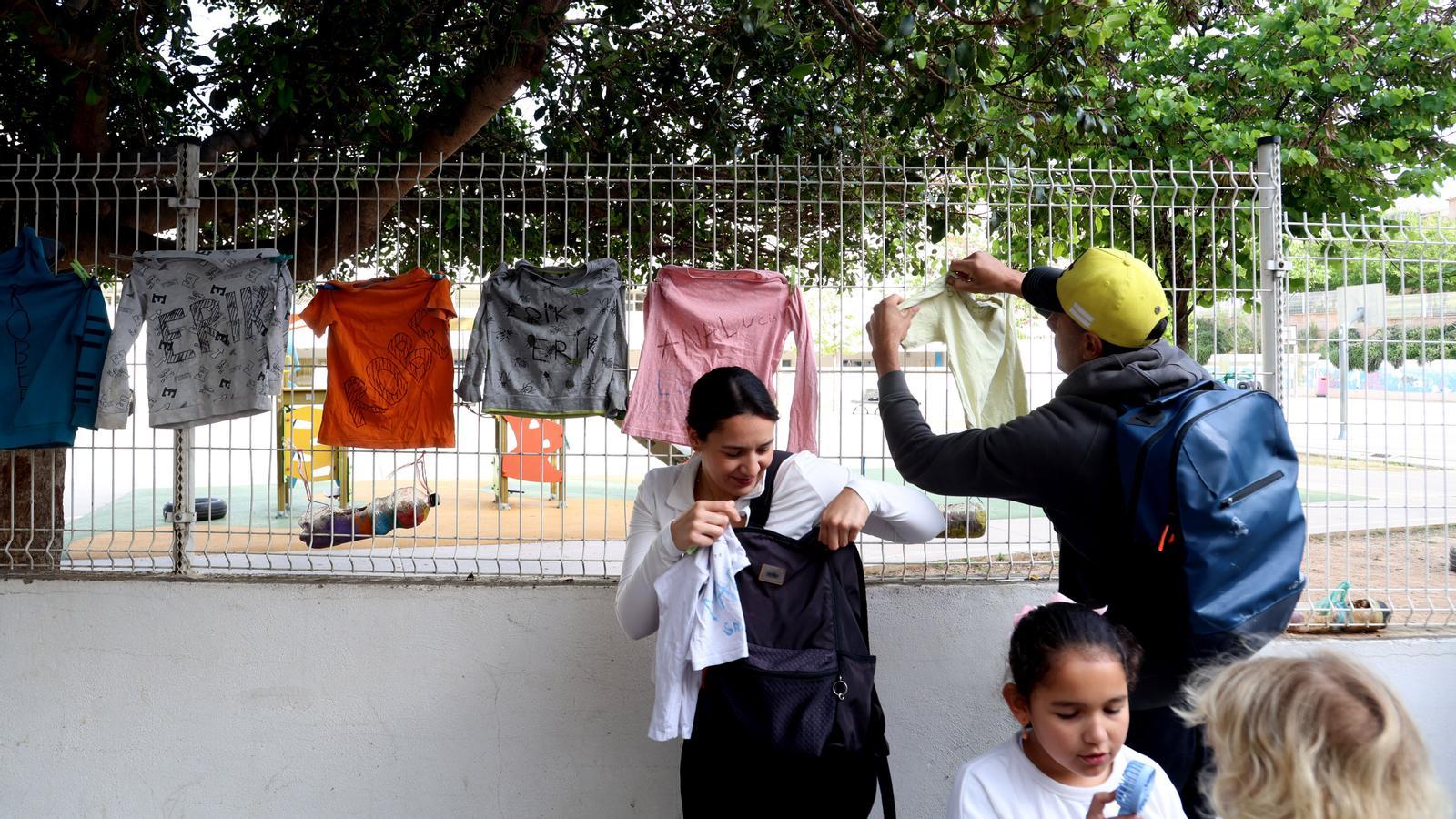
Roldán's return to the classroom has generated rejection: mobilized families, strained schools, and, in the most extreme cases – as in CEIP Maria Antònia Salvà (where years ago he had already had problems with students) and now in CEIP Son Pisà –, children who have stopped going to class to avoid coinciding with him. Meanwhile, the Department of Education is trying to manage the situation with no legal room to maneuver: with his rights restored and his sentence served, Roldán cannot be removed from the classroom.
In the schools where she has worked, unease has set in from the very first moment. “The general mood has always been one of concern,” explains Verónica Fillol, spokesperson for the Apima of CEIP Son Pisá, who describes how families have organized to contain the tension: “There are families who have acted as a buffer with others: very agitated people and very calm people. The fact that we could meet has helped us to support each other; some calmed the others down”.
The conflict, however, has had a direct impact on daily life: “Psychologically, it has been very hard for many people: if I take the child to school, I feel bad, and if I don't, I can't work and I can't make ends meet.” Added to this is the difficulty of managing it with the children: “Children chat among themselves and, if three are scared, it spreads”
¿Is school a safe space?
The incomprehension regarding the institutional response is shared. “It is not understood why the Conselleria cannot act. Yes, he has the right to reintegration, but he has not served a social sentence. People have not forgotten him, everything is very recent,” points out Fillol. A mother from the center agrees: “We are concerned about taking the children to a place we do not consider safe.” The tension, she says, is also transferred to the students: “A child does not know exactly what bullying is, but they do grasp that there is a person who has done bad things to minors, and then they don't know how they should act, if they should avoid them, and they ask us.” And she concludes: “In a private school this would be unthinkable, and it makes you think that the public one has to put up with everything. That all the bad things happen to us.”
“The Ministry has little room for maneuver, because when there is a court ruling determining that a person is not disqualified, it cannot disqualify them through administrative channels”, explain sources close to the Department of Educational Inspection (DIE). “It is understandable that families consider that this person should not be with students. However, the Ministry cannot apply a sanction if there is no judicial resolution that allows it. The Administration has its hands very tied”, they add.
The same sources focus on the fact that, despite the media impact of the Roldán case, it is common for inspectors to have to intervene in conflicts of equal or greater severity. “Nowadays, situations like Roldán’s are closely monitored. From time to time, accusations arise in the field of Secondary and Vocational Training related to sexual harassment or inappropriate pressure. Before, many of these cases remained hidden; now they are reported and protocols are activated immediately,” they explain.
Going to class is a right and an obligation
The families' protest has opened the debate on the legal limits of school absenteeism. “Minors have the right and obligation to go to school. Imagine that two months pass without attending: this is not justified”, points out Ramón, in relation to the students who have missed nearly two academic weeks of class at Son Pisà, and before, at Maria Antònia Salvà. Inspection sources defend that the families' reaction “is understandable”, but they emphasize that the chronic absenteeism protocol has not been activated because the minimum thresholds have not been reached. “It is not a political or discretionary decision. The educational center is obliged to act when the minimum days are exceeded. What is clear is that the concept of a ‘family strike’ does not exist”, they explain.
For now, the 4th grade students of CEIP Son Pisà – the group assigned to Roldán as tutor – are maintaining the protest, which at first was supported by 60% of the students at the school. The 'official' strike began on April 23rd, and if absences reach half of the school days of the month, the school will have to activate the chronic absenteeism protocol, which leads to a series of actions to ensure a return to the classroom. This will be the case because, officially, there is no impediment for students to attend class.
The role of the unions
The Roldán case has involved unions, divided between the defense of minors' rights and criticism of the Conselleria's management. SIAU has been especially critical of the Administration and voted against it in the parity tables between worker representatives and the Conselleria convened at the beginning of the school year to promote a psychological evaluation of the teacher, considering that Education wanted to transfer responsibility to the unions. The measure was validated, but it was not applied because Roldán took a leave of absence and, subsequently, Education withdrew the mandatory medical surveillance after the teacher's judicial appeal. "It was illegal," SIAU summarizes.
The union argues that it is possible to reconcile the rights of all parties and calls for a joint meeting with the Ministry, the teacher, the families, and the teaching staff to unblock the conflict, which it attributes to institutional inaction. “It is positive that there are opposing opinions, but there are red lines that cannot be crossed. Everyone has the right to disagree, but always with respect and common sense,” it argues.
Signed hands
The Department of Education, for its part, has had little room to maneuver to avoid the conflict, beyond meetings with families, unions, and with Roldán, sending teachers to supervise it, trying to reassure parents, and job relocation offers that the teacher has always rejected. Recently, when asked about various issues linked to Roldán and the families' strike –which had already been going on for several days–, the Department responded briefly or generally: "This is a delicate matter that is being continuously monitored. At this point, no decision has been made."
All of this on the same day that the Spanish government announced its intention to modify the Lopivi to prevent, among other issues, teachers convicted of crimes against minors from practicing. It should be remembered that in February 2025, the same Ministry had already requested this legislative change from the State. Now, once it has been officially announced, the Minister of Education, Antoni Vera, has lamented that the reform will not arrive in time for the next academic year.u
