Forgotten cured meats
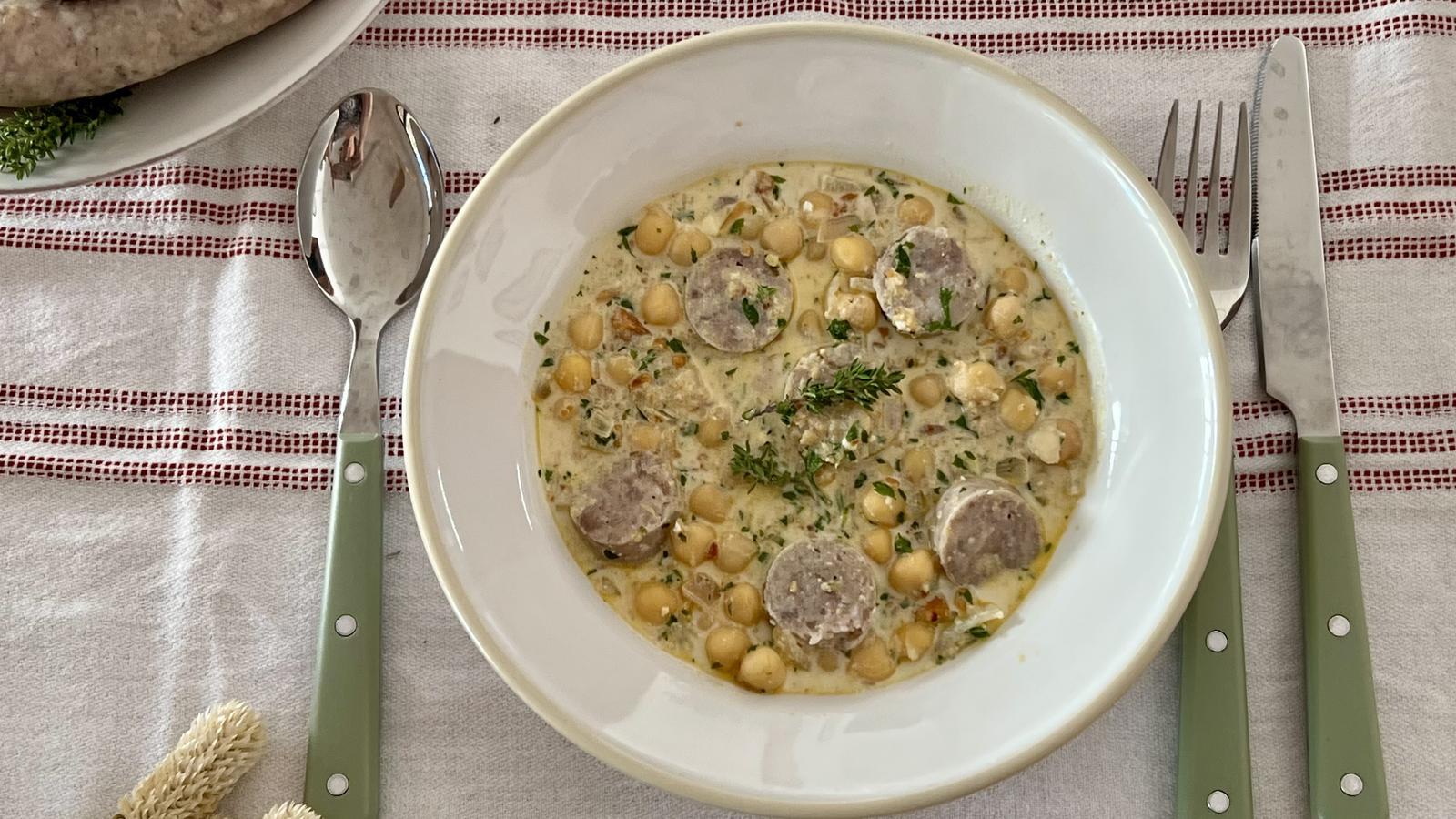
We explain to you how to prepare chickpeas à la Carmelite with white veal

PalmaMy mother used to collect fennel seeds from the paths surrounding the small house and leave them to dry on a piece of newspaper. Those little seeds in the sun were the beginning of a cycle that started with small routines: the prepared white cloths coming out of the box, the clean jars, the long and thick needles, the parts of the manual machinery being checked again, the threads and the ropes. A whole dance of objects that, when the time came, would come to life until the cycle closed once again. It has been a few years since this cycle was broken and I have a small grief anchored within me. A small, constant, and annoying prick that seeks that awakening of inanimate things. A system collapsed like a house of cards made of newspaper.
Even though we did not raise them at home, we would see the piglets that, proud and playful, would come up during the warmer months to the estates near our house. That animal we saw growing during our walks would end up in different parts hanging in the room. The cold marked the right moment. The pig was slaughtered and a day began that required many hands. It had to be skinned, butchered, and separated into its different parts, because practically the entire animal had a destination. The lean meat and fat were mixed with salt and paprika to make sobrassada; other parts were destined for botifarrons and camaiot, while the bacon, loin, and other pieces could be salted or preserved in different ways. After the work, another time began: that of drying and curing. The sausages were hung in the pantry, where the air and the passage of days would transform them into food capable of lasting many months. But when we talk about the sausages from the slaughter, our imagination focuses mainly on sobrassada, botifarró, and camaiot. The traditional repertoire, however, is much broader. Alongside these, there are others today that are much less known. This is the case of the blanquet, a preparation that we find in the recipe book of Friar Jaume Martí Oliver (18th century). The recipe incorporates brains, aromatic herbs such as marjoram and parsley, and pine nuts, which are mixed with eggs. Then the casings are filled, tied, and boiled. The author explains that they can also be made with mutton brain and bacon without rind, and that cooked and minced chicken meat can be added.
Other ways to prepare it
In Memòria de la cuina mallorquina, by Toni Tugores (2004), we find two other ways to prepare it. One, coming from Binissalem, is made with heart, kidneys, lungs, snout, cheek, nutmeg, cinnamon, allspice, pine nuts and eggs. The paste is wrapped in the caul fat and given a shape similar to that of blood sausages. The other, originating from Sineu, is made only with parts of the head tied with fat; then portions are made, which are wrapped in the spleen caul and boiled. The Diccionari català-valencià-balear also includes the 'blanquet' as a round-shaped sausage, made with minced lean meat, caul fat, pine nuts and aniseed and subsequently cooked.
The "blanquet" that we find in butcher shops today is quite different from these preparations. It is a light-colored sausage, without blood and with a more compact texture, similar to the "botifarró". In this sense, it could be grouped with a wider family of cooked, pale-colored sausages that we find in other parts of the Catalan-speaking lands. In Menorca, for example, there is the "botifarró blanc". According to Pedro Ballester in De re Cibaria (1923), it was made with the meat from the bones and the head which were previously boiled, minced, and seasoned with cinnamon, allspice, and cloves. Afterwards, medium-sized casings like the bung and other larger ones, like the "bisbe", were filled. Thus, the difference between islands would lie in the size of the final sausage.
The slaughter is a complex system of utilization where every house has its own recipes and every part of the pig has its destination. Some names and preparations have disappeared; others, like the "blanquet", have survived despite the difficulty of finding them in butcher shops.
For today's recipe, I wanted to include them in some cooked chickpeas, but while searching and searching, I found this recipe that seemed wonderful and little-known to me: some chickpeas that were made in the convent of the Teresian nuns of Palma, where the "blanquets" enrich a dish worthy of being valued.
We will sauté the onion. Meanwhile, we will make a picada with the boiled egg, garlic, parsley, cookies, almonds, parsley, and nutmeg.
When the onion is well cooked, we will add the picada and shortly after, the chickpeas. We will stir it well and keep it on low heat. We will season it with salt and pepper. We will pour in the hot milk and the sliced white sausage and let it sit for a few minutes. We will turn off the heat before it starts to boil.
l Boiled chickpeas
l 1 onion
l 1 egg
l 1 handful of toasted almonds
l 1 garlic clove
l parsley
l 1 boiled egg
l fried bread or two oil crackers
l nutmeg
l 1-2 white sausages
l 1 glass of milk
