Who educates the young people who vindicate Francoism?
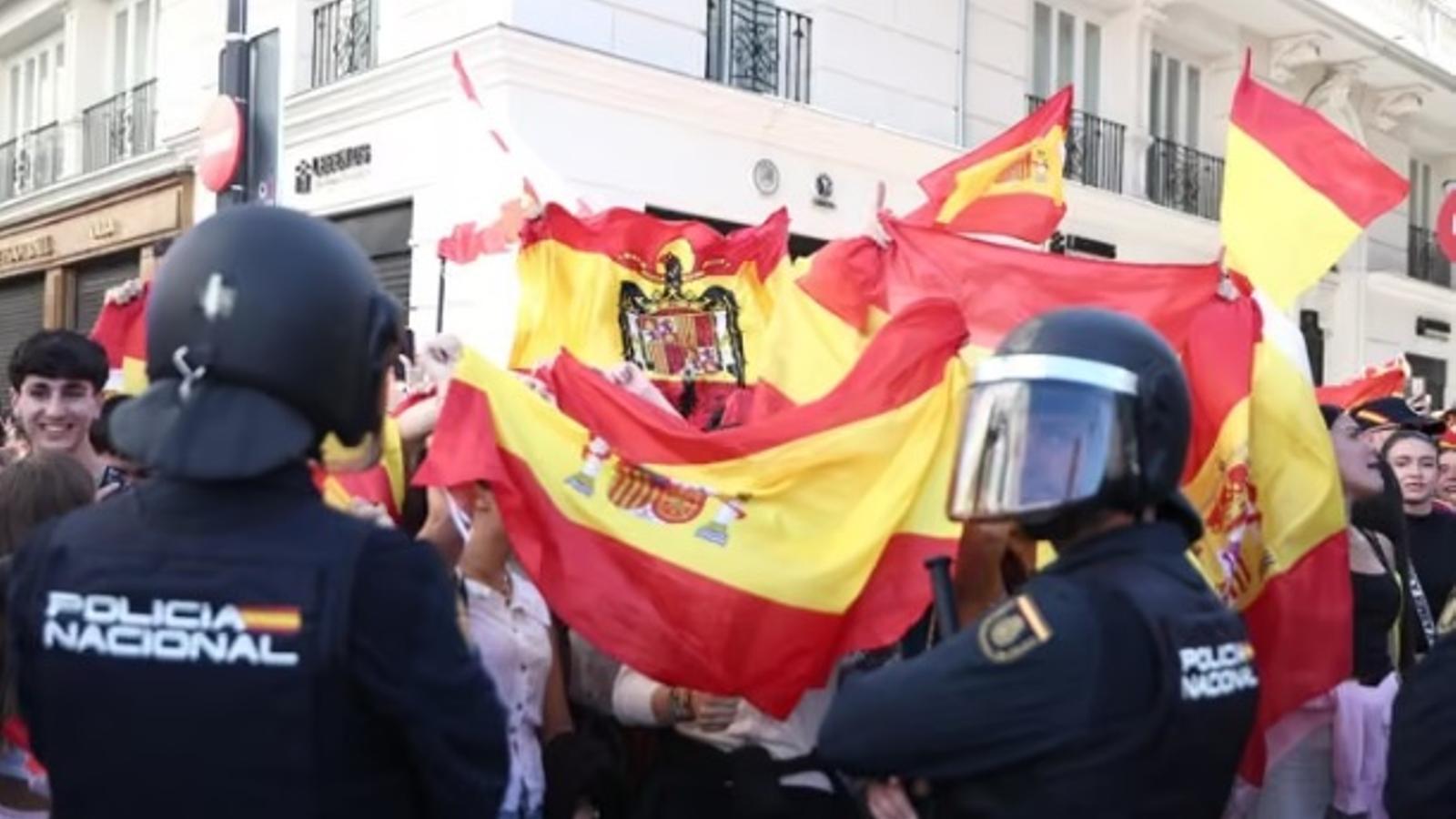

Just a few days ago, on October 12th, while the Puerta del Sol encampment for the right to housing was trying to keep Maricarmen’s memory alive, a group of young people—many of them minors—appeared with flags and Francoist symbols to berate and insult the campers. The image is hard to stomach: adolescents born in the 21st century championing a dictator against other young people who are simply asking for a place to live. A few weeks ago, I wrote here that Maricarmen had given us a lesson in dignity; on the day of the nation’s maximum exaltation, some responded to her with the eagle emblem and raised arms. This is not an isolated incident. Here, too, we have heard “vivas to Franco” that have ended up in the newspapers, and any secondary school teacher will be able to tell you what is heard in the hallways or what circulates in the students’ WhatsApp groups.
It would be easy to dismiss it by saying “these young people have no manners.” But the uncomfortable question is another one: what kind of education have they received? What kind of education have we given them? Even if it seems obvious, it is worth noting in this regard not to confuse education with school: young people spend more hours in front of screens than in classrooms, and what they consume there is not neutral. These are platforms in the hands of a technocratic elite that profits from hatred, that rewards the most extreme content because it is what retains the most attention, and that has turned verbal violence into normal language. The algorithm does not indoctrinate with speeches, but with repetition: humiliating the weak, laughing at feminists, blaming the immigrant for everything, presenting the use of force as a virtue. It is no wonder, then, that the far right is growing among the youngest, especially among men, within a society that is gradually becoming fascist.
However, just because school carries less weight does not mean it has nothing to say or nothing to do. First, by reviewing its own hidden curriculum: competitiveness, meritocracy, obedience without critical thinking, forms of domination that are learned without anyone teaching them explicitly. Second, by settling a debt: democratic memory remains the great absentee from the classrooms, another of the limitations of the Transition. Francoism is explained there, if it is reached at all, as just another chapter in a textbook, not as a wound that still conditions the present. And where there is silence, propaganda finds space. If we do not explain what the dictatorship was, and that it brought nothing good, others will do it for us, in fifteen-second videos, without hesitation or scruples.
However, it is also necessary to correct the focus: no matter how much noise they make, we are talking about a minority. Those who were in Sol and in squares everywhere defending housing are also young, as are those who in our country demonstrate for tourism degrowth or the young feminists who have managed to change the common sense of a generation. The problem is that this youth is not profitable for the algorithm nor for many media outlets: it does not generate easy clicks or moral panic. Making it visible is a political task of the first order, because it demonstrates that there are other ways of being young, capable of escaping the utilitarian machinery of social networks and the mainstream. I would say that it is also necessary to make visible the people who do good things, who fight and commit themselves to others, and who do not only think about themselves and about becoming millionaires at the cost of whatever it takes.
It is urgently necessary to think about and deploy educational models that go beyond the "no". It must be made clear (and not only from the classrooms, because television sets also have a lot to say about this) that promoting violence, fascism, or hatred against migrants is not right nor is it tolerable. But an education that only prohibits leaves a void, and the far right is an expert at filling voids: it offers belonging, clear enemies, and a narrative of the future, however false it may be. A democratic education must offer community, complexity, and, above all, a horizon. It must allow for thinking, building social bonds, and also dreaming of a better world for the young and for those who are not so young. Paulo Freire called it the viable unprecedented: without hope there is no possible pedagogy, only the management of hopelessness. And this implies listening to them, because I am convinced that many of these adolescents are not looking for Franco, they are looking for someone to listen to their grievances and take them seriously.
Months of electoral turmoil are coming, with predictable results that could make things even more difficult for us. Teachers already know the script: accusations of indoctrination against any teacher who speaks of memory, feminism, or human rights, while true indoctrination circulates freely on mobile phones. The temptation may be to lower one's head and take refuge in a supposed neutrality that does not exist in education or in life. And the fact is that in the face of hatred, there is no possible neutrality. Bad education is not that of the young people who shout: it is that of a society that has left them alone in front of a screen that indoctrinates them.
