The new authorized wells are equivalent to a Gorg Blau
Between 2023 and 2026, the Government has allowed the annual extraction of more than 5 million m3, despite having 65% of the aquifers in poor condition

-
CAT -
CAST -
DE
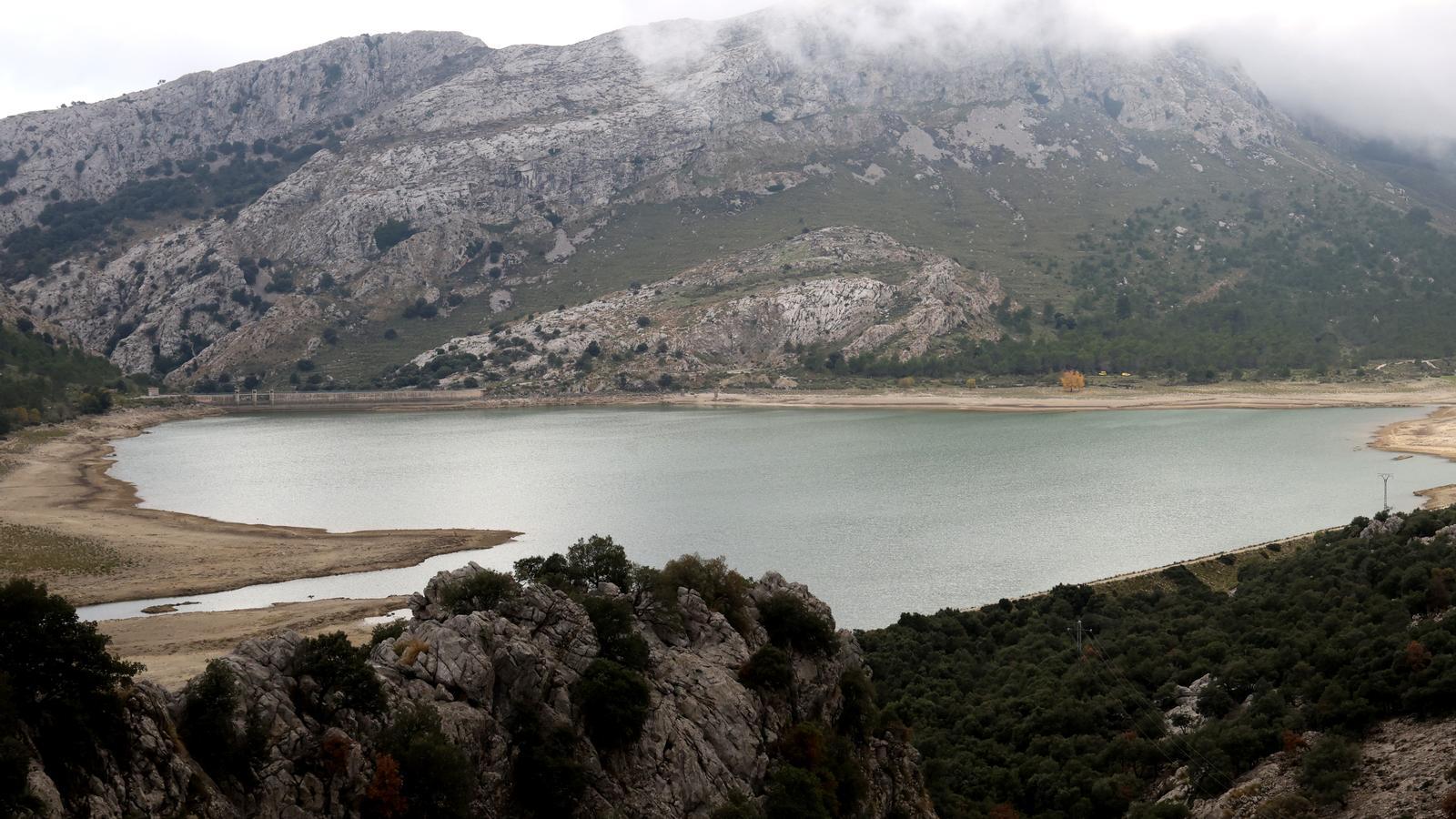
PalmaThe Government has authorized, over the last four years, new groundwater uses in Mallorca with a cumulative maximum annual volume of 5.2 million m³, the equivalent of all the water contained, on average, by Gorg Blau. In other words, between 2023 and 2026, permission has been granted to extract each year from the damaged Majorcan aquifers an amount as large as the main reservoir of the Serra de Tramuntana.
The comparison is made by the Director General of Water Resources himself, Joan Calafat, who summarizes the magnitude of the authorizations with a blunt statement: "One Gorg Blau every legislature. Every four years or so, it is authorized to extract one more Gorg Blau". All this in an Archipelago where, according to the latest official data that ARA Balears has been able to consult, 57 out of the 87 groundwater bodies are in poor condition.

The Government, according to a parliamentary response to MÉS deputy Maria Ramon, has favorably resolved 2,160 new groundwater abstractions between 2023 and 2026, which total a maximum authorized annual volume of 5,197,906 m³. 2023 was the year with the most files, with 829 authorizations and 1,892,316 m³ annually; in 2024, 376 were resolved, for 780,521 m³; in 2025, 483, for 979,637 m³; and in 2026, with the year still to end, 472 files that total 1,545,432 m³ annually. These quantities correspond to the maximum annual volumes recorded in the resolved files, not to the water actually extracted.
“No one has fixed it”
Beyond the authorized volume, the question is what control the Administration exercises over underground abstractions. Calafat acknowledges that the Water Resources databases have deficiencies that make it difficult to properly know and supervise the usage. “The databases are not good. Wells are being authorized, and in reality, we cannot access the actual information on extractions, and no one has fixed this,” he admits.
According to the director general, there are about 60,000 underground water uses in the Balearic Islands, a figure he compares with that of the entire Guadalquivir basin. The problem is not just the quantity of abstractions, but the information available regarding their operation.
“The Administration does not have any tool for the user to report the well reading, once a year, as established by the regulations,” explains Calafat. He also acknowledges that the monitoring of certain obligations of the holders, such as the submission of operating reports, is insufficient. The regional official points out that it is not always possible to “deny authorizations if the applicants meet the established requirements,” a fact that contrasts with the regrettable situation of the aquifers. For this reason, conservationist entities are calling for “an urgent revision of the regulations, especially the Hydrological Plan, with restrictive criteria, because right now this is the Wild West,” criticizes Juan Calvo harshly, from the Water Alliance.
Between 2023 and 2026, 67 sanctioning proceedings have been initiated for this irregularity in the Balearic Islands as a whole, 17 of which are in Mallorca. The Government reports sanctions for a total amount exceeding one million euros, but does not detail how many are final or what amount has actually been collected.
The situation of the aquifers, with 65% affected by salinization or nitrates, is especially serious in the east and south of Mallorca, where the ten bodies identified by the entity are deteriorated. There are also significant problems in the interior and in the bodies that supply the Palma area.
Furthermore, the estimated extractions in Mallorca in 2023 reached 143.77 million m³, while the Hydrological Plan assigns 132.54 million. This represents 11.23 million m³ above the allocation, 8.5% more. 34 of the island's 64 masses exceed the volumes they are assigned.
El Pont d’Inca, la Vileta and Penyaflor, three masses that supply the Palma area, account for almost half of this excess, according to the Water Alliance's calculations.
And meanwhile, Palma continues with its plans for disproportionate growth, with more than 12,000 apartments in process without there being enough water, as GOB Mallorca has denounced with requests to the City Council and Water Resources: “We have submitted documents because Emaya's water management plan is nothing more than a strategy to justify urban planning increases that the city's water supply cannot support right now,” laments president Joan Moranta.
They demand more control
Given these data, the Water Alliance calls for expanding restrictions on new water withdrawals. The entity recalls that the hydrological plan prohibits certain authorizations in 13 water bodies in Mallorca, but there are 20 in poor quantitative status.
Its proposal is to apply the restrictions also to the water bodies that suffer an extraction exceeding 80% of the available resource. The organization also calls for real supervision of existing water uses. It advocates for meters on all wells and periodic readings that allow knowing how much water is effectively extracted, instead of depending on incomplete records or estimates.

Regarding urban supply, Aliança proposes replacing groundwater extractions with desalinated water where possible, especially in the masses that supply Palma, which are among those that most exceed the plan's allocations.
Calafat agrees on the need to reduce pressure on underground reserves. “Desalination is not an instrument to consume more, but to recover aquifers,” he argues. He thinks the path toward sustainability requires “more infrastructure, but also more efficiency, more reuse, and more protection of natural resources.”
The director general also calls for changes in the tourism sector. Recently, in a meeting with key representatives of the sector, he reproached them for their obsession with luxury at the expense of consuming water: “This luxury model based on more water cannot be,” he warns. According to Calafat, tourism generates a third of the consumption, but it concentrates a particularly significant part of the demand in the moments and territories with the most water stress, so it must contribute to reducing demand.
Menorca joins the Balearic model
Menorca, which until a few years ago presented a comparatively more favorable water situation, is progressively incorporating the “evils of the Balearic model,” as warned by GOB Menorca. The organization warns of the consequences that the increase in tourist and urban pressure has on underground reserves that are showing more and more difficulties in recovering.
The data provided by Miquel Camps, territorial spokesperson for GOB Menorca, are especially revealing. “The Migjorn aquifer, the main one in Menorca, has dropped 13 meters since 1984,” he explains. Furthermore, he warns that the Roca aquifer, which supplies Es Mercadal, “has lost 25% of its capacity in 15 years.” The situation is also worrying in Ciutadella. Camps asserts that the municipality “has the aquifer at rock bottom, despite the desalination plant, and continues to grant swimming pool permits without control.” Added to these tensions are water losses in the distribution networks of Es Migjorn Gran and Ferreries, two of the municipalities that, according to the GOB, register the highest leak percentages on the island.
The group considers that Menorca is reproducing the water imbalances associated with a growth model that increases demand without guaranteeing the recovery of the aquifers. Calafat has also warned of the gravity of the Minorcan situation. Regarding the aquifer that supplies Es Mercadal, he points out that it has been dropping for years and shows no signs of recovery. And he calls for placing the water issue at the center of the debate on the island’s development because he admits that the situation has worsened in a short time.
