Islanders: the forgotten ones of the Crown of Aragon
The difficult fit of the Archipelago into the old confederation, now that president Marga Prohens has reclaimed it at a board of trustees of Poblet that had not met for fifteen years

-
CAT -
CAST -
DE
PalmaThe Crown of Aragon: this is the shared history of centuries that the president of the Balearic Government, Marga Prohens, reclaimed last October 15th, when the board of the Poblet monastery met for the first time in fifteen years, shared with Catalonia, the Valencian Country, and Aragon, and responsible for the management of this space, a pantheon of the common sovereigns. Well, yes. Or no? The truth is that the Balearic Islands were systematically sidelined –what a surprise!– throughout their membership in this confederation, practically during all the time they were part of it.
They were so forgotten that they did not even exist. The American Perry Anderson, a professor at the University of California (UCLA), when referring to Aragon in the late Middle Ages, in his reference study Lineages of the Absolutist State, specifies, in a footnote, that “the kingdom of Aragon was the union of three principalities: Aragon, Catalonia, and Valencia”. But this is nothing new: in 1462, the Valencian jurors –equivalent to current councilors– referred to the common “nation” of “all the natives of the kingdoms of Aragon, of Valencia, and of the Principality of Catalonia”. Islands? What islands?
The history of the Crown of Aragon began with a wedding. Around 1137, the king of Aragon, Ramiro the Monk, wanted someone to leave his realm in good hands and chose his neighbor Ramon Berenguer IV, Count of Barcelona: he designated him as prince regent of the territory and betrothed him to his daughter, Petronilla, only one year old. From then on, their descendants ruled over both realms.
The Crown came to be integrated by seven kingdoms –like Game of Thrones–: Aragon, Catalonia, Valencia, Mallorca –that is, the Balearic Islands–, Sardinia, Sicily, and Naples. A part of Occitania belonged to it, but it was lost, and the Greek duchies of Athens and Neopatras were part of it for some decades. It was a confederation: territories each with their own self-government and a common monarch. Some were part of it and then left: the Islands and Roussillon became part of the new lot arranged for James II of Mallorca by his father, James I the Conqueror.

As is well known, the kingdom of Mallorca was definitively reintegrated into the common Crown around 1343, when the Aragonese monarch, Peter the Ceremonious, snatched the Archipelago from its sovereign, James III, who, by the way, was his brother-in-law – from here, surely, must come the bad reputation of brothers-in-law. But with him nothing changed: the Islands maintained their institutions and the monarchs remained absent, now on the Peninsula; before in the continental territories, especially in Perpignan.
However, as Miquel Àngel Casasnovas points out, the kingdom of Mallorca would never be considered “on an equal footing” with the kingdoms of Aragon and Valencia and the Principality of Catalonia, “but as a second-class state”. It was a small and peripheral territory without its own courts; it was considered a kind of appendix to Catalonia, to whose courts, certainly, representatives of the Islands attended, although sporadically and without continuity.
The humiliation of the islanders in Caspe
The most bloody proof of that consideration of the Balearic Islands as a second-tier territory occurred in 1411, when the courts met to address the succession of King Martin the Humane, who passed away without succession, among the candidacies of several relatives. Curiously, back then Mallorca was divided into two factions: the 'Majorcan' one: merchants, artisans, and rural folk, and the one that, fittingly, was called 'Aragonese': the nobility.
The three delegates sent from the Islands met with the unpleasant surprise that Aragonese, Catalans, and Valencians excluded them from the decision-making process. Much as if, nowadays, Salvador Illa, Juan Francisco Pérez Llorca, and Jorge Azcón had slammed the door in Marga Prohens' face.
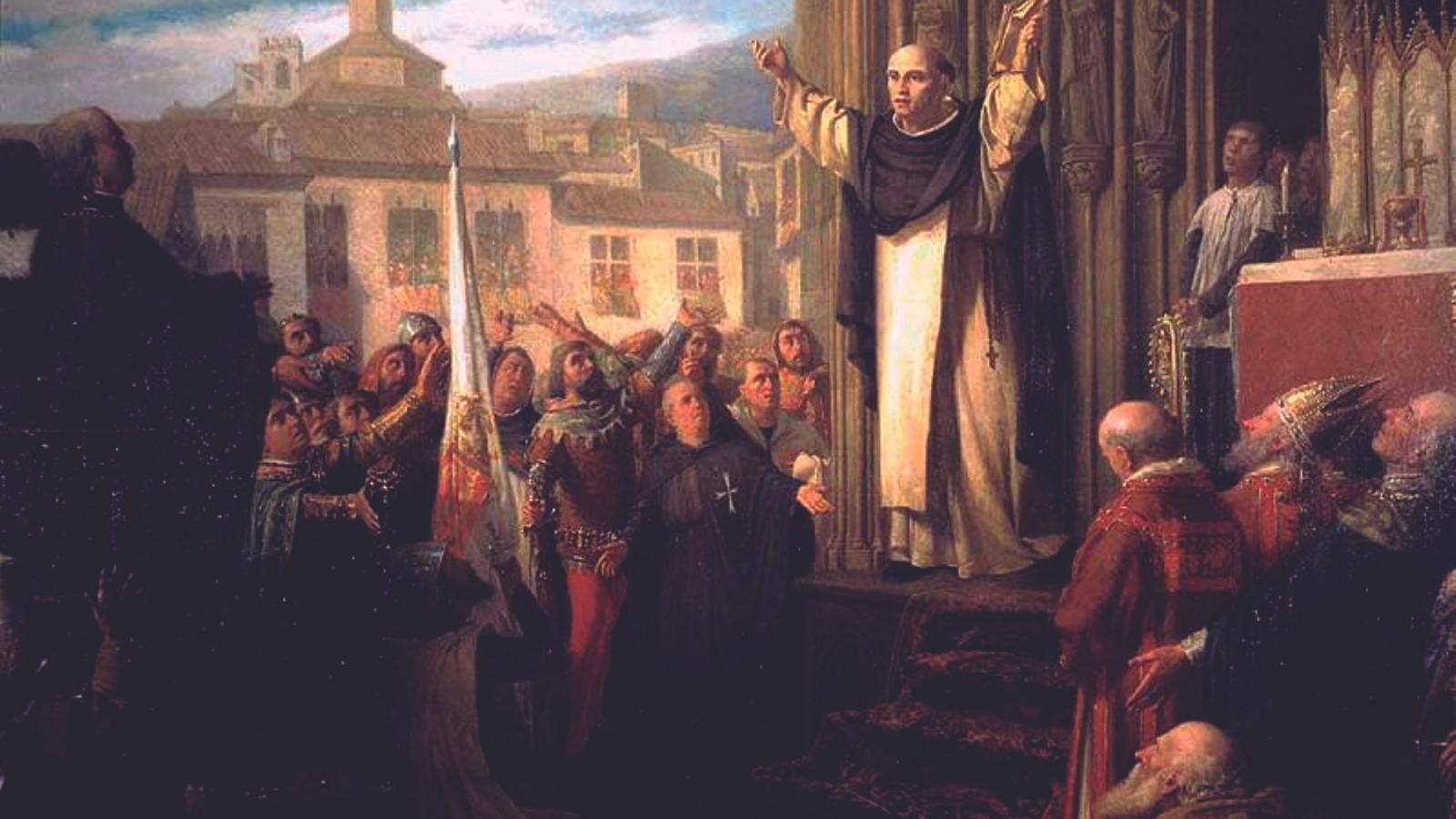
The verdict was entrusted to a commission composed of three Aragonese, three Catalans, and three Valencians –one of them, Saint Vincent Ferrer, and another, his brother–: on June 24, 1412, in Caspe, in Lower Aragon, they elected as the new king Ferdinand of Castile, nephew of Martin, who became Ferdinand I. Hence the name Compromise of Caspe by which this episode is known. Four days later, another delegate arrived from the Archipelago –alas, this islander lack of punctuality!–, when it was all over.
With that 'nevertheless...' and 'what can we do' that has always characterized the islanders –perhaps not so much now, or maybe so?–, the verdict was accepted without a peep, in which the Islands had taken no part. Not only that: the proclamation of the new monarch was celebrated, and the same three ambassadors who had tried to intervene in the talks to choose the new king, until they were kicked out, were sent to the coronation in Zaragoza.
At the end of the Middle Ages, as Antoni Riera i Melis notes, the head cities of the respective territories divided the roles, so to speak: “Barcelona assumed the role of directing, insurance, and financial center; Valencia and the City of Mallorca acted, on the maritime front, as commercial hubs”; and Zaragoza played a similar role to these two, but for land transit. Not everything was always so harmonious: the Majorcans fought against the Catalans when the latter revolted against King John the Faithless; while Ciutadella and Mahón –a true classic– sided, the former with the monarch and the latter, with the rebels.
With the integration into the Hispanic monarchy, things did not change much either. A specific entity was created to deal with the affairs of these territories: the Council of Aragon. Its powers were not insignificant. It proposed to the monarch the candidates for viceroy of Mallorca, who always came from the rest of the territories of the old Crown: Catalans, Valencians, or Aragonese, and acted as a transmission belt between the viceroy and the sovereign. It also served as an appellate court for the Audience of Mallorca. Two of its judges had to be Majorcan, and another two, from the rest of the territories of the confederation.
A Crown council without islanders
It is clear that, since the Islands continued to have no say, they could not exert any influence on the Council of Aragon, because there were no representatives of the Islands in it. The weight of the Archipelago was minimal. By way of example, when the prime minister Olivares wanted to establish a contribution from the different kingdoms to the army, 38,000 would have corresponded to the Crown of Aragon; of these, 2,000 to the Islands, just 5% of the total.
The old Crown of Aragon lived its swan song when the Habsburg dynasty ended and, by a genealogical fluke, the Spanish throne went to Philip of Bourbon, a grandson of the French king Louis XIV. There existed in these states, as Casasnovas observes, an “anti-French sentiment”, especially in the border areas; a suspicion towards “a monarchy more identified with Castilian interests”, and a justified distrust towards the Bourbon “centralizing antecedents”.
That was how Aragonese, Catalans, Valencians and islanders made a common front, in favor of another candidate for the Crown: Archduke Charles, against the new king, Philip V. We already know how that ended: the rebels were defeated and, as punishment, in the four territories, by virtue of the Nueva Planta decrees, their own institutions were abolished, except for Menorca, where they were maintained for a few decades.
The Council of Aragon was also suppressed and its functions were assumed by the Council of Castile: perhaps they could have changed the name and called it the Council of Spain, to disguise it a little, but they did not. The four capitals of the four territories: Zaragoza, Barcelona, Valencia and Palma, in a gesture that perhaps wanted to be one of magnanimity, were graced with individual seats in the Cortes of Castile, which, in any case, did not serve for much either. When meeting in 1724 in Madrid –where else?–, their representatives were placed in the back row. Just in case they hadn't realized they had lost a war.
It was the deputies of these same four cities who, in 1760, presented to Charles III a Memorial of Grievances –almost half a century had already passed since the Nueva Planta–, in which they criticized the standardization, the Castilianization and the fact that the regulation that reserved positions in the institutions for the natives of each territory had been removed, Aragonese, Catalans, Valencians and islanders were replaced by Castilians. Of course, without much success.
It would be a regime change, with the –temporary– expulsion of the Bourbons, which would foster a fleeting reunion: the Pact of Tortosa, in 1869, which Aragonese, Catalans, Valencians, and islanders shared in favor of a federal republic, and which was nicknamed Coronilla de Aragón”. Since then, the Aragonese connection practically disappeared from the perspective of the Archipelago... Until now.
As Antoni Mas i Forners notes, the monarchy itself fostered the common name of Aragon –'tota Aragorum nacio'– for the set of territories, and the war cry 'Aragon, Aragon!' was the one used in military actions, “regardless of the origin” of the warriors. With one important exception: in the maritime sphere, the generic denomination was 'Catalans', since the Aragonese, from a landlocked territory, represented a small percentage.
Certainly, Aragon held the status of a kingdom –as did Mallorca and Valencia, though newly created–, while Catalonia was a collection of counties. But this is an inconsistent argument for alleging Aragonese supremacy. The Duke of Burgundy was one of the most powerful monarchs of his time –while being only a duke–, whereas Emperor Charles V had no effective power over his empire, no matter how high-sounding his title might have sounded.
The expressions 'Aragonese troops', 'Aragonese squadron' or 'Aragonese conquest', which appear on web pages, contrast with the fact that the capture of Mallorca in 1229 was a primarily Catalan enterprise, that Catalans made up the bulk of the conquerors, and that Catalan is the language they transmitted. Santamaria calculates 7% of Aragonese settlers in the part of the island assigned to Nunó Sanç. But also 24% of Occitans, 16% of Italians, and almost 6% of Navarrese. Should we say “the Catalan-Occitan-Italian-Aragonese-Navarrese conquest of Mallorca”?
Information prepared based on texts by Miquel Àngel Casasnovas, Álvaro Santamaría, Antoni Mas i Forners, Antoni Riera i Melis, Pere Xamena Fiol, Pere Salas Vives, Josep M. Salrach and Anton M. Espadaler, Gabriel Ensenyat Pujol and Ernest Belenguer.
