The centenary schools of the White House
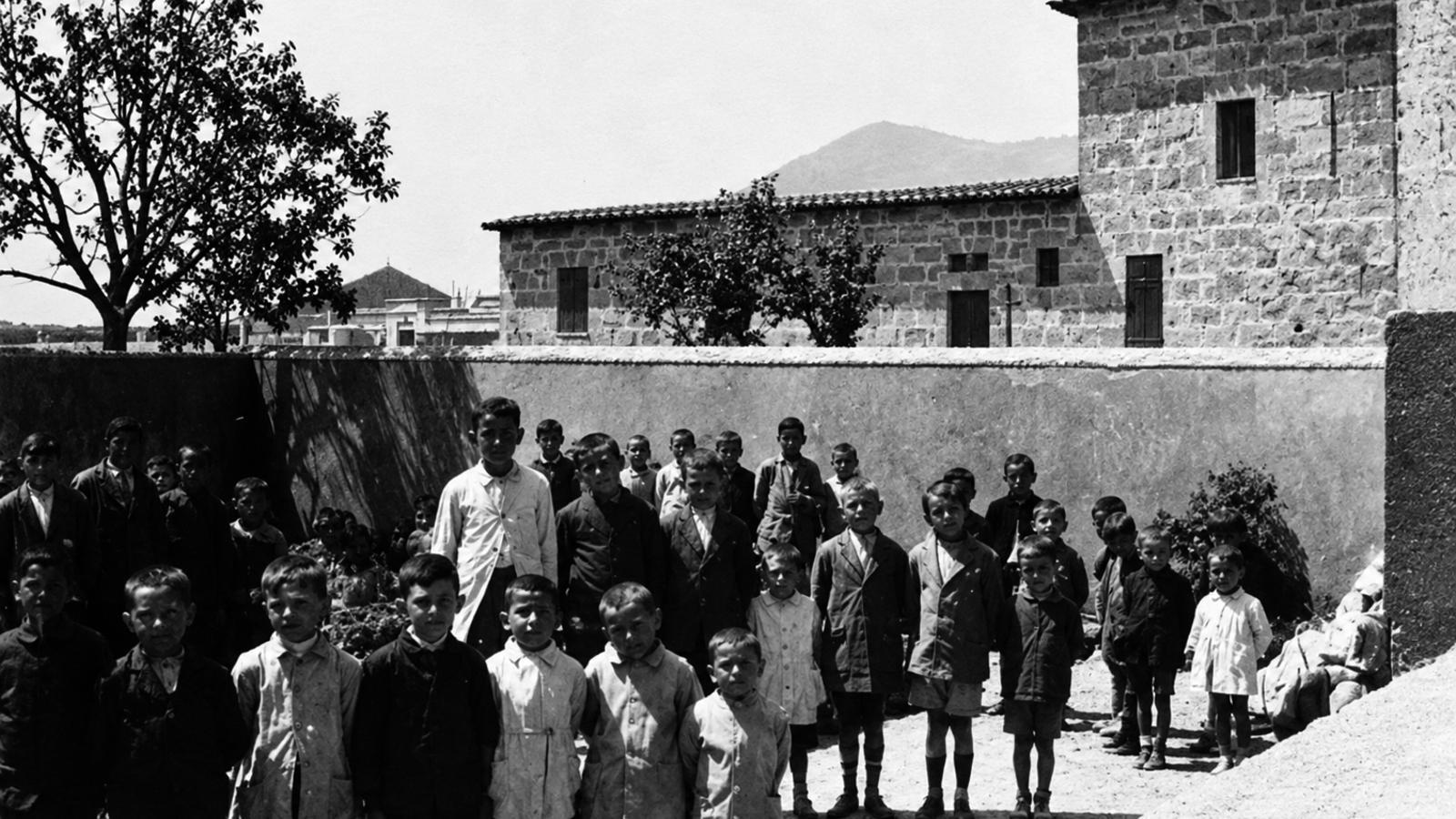
In 1926 the first of the two educational centers was built which, in a pioneering and ambitious way, were made in this small center of the outskirts of Palma
-
CAT -
CAST -
DE
Palma“The aforementioned building will constitute a model of its kind, a true palace of primary education, with simple yet elegant lines, large proportions, and a perfect finish...”. This is how the newspaper La Almudaina defined, in October 1929, the girls' school building that had just been constructed in Casa Blanca. A few years earlier, in 1926, the first one had been built, which became the one for the boys.
Today, Casa Blanca is a district of Palma formed by a vast expanse of orchards and one of the smallest population centers in the municipality, in which the two school buildings stand out. But, returning to the quote from the newspaper La Almudaina, why were such prominent school buildings built in such a small village? To understand this, we must go back a little further in time. In the mid-19th century, the Casa Blanca estate was part of the old swamp called Prat de Sant Jordi, an unhealthy terrain, flooded all year round, mostly unproductive and full of mosquitoes that wreaked havoc on the population and which the Belgian engineer Paul Bouvy, starting in 1845, with his drainage project, had turned into a habitable and productive place.

Following the drainage, the village of Casa Blanca was built, and its main promoter was Antoni Mulet Ferragut (1869-1928), a major business figure in Mallorca, president of the Drainage and Sanitation Syndicate of the Sant Jordi and Son Sunyer meadow, and owner of many properties, including Can Mirabò and Can Morei in Casa Blanca. The businessman, with his keen eye for business, thought that by dividing the aforementioned properties and selling the resulting plots, he would make a very profitable deal. And to make the purchase of the new plots more attractive, he considered it essential that this new village have schools. The schools, therefore, beyond being a basic institution for society, which they certainly were, were also bait, an attraction, a hook. So much so that Antoni Mulet himself donated the land to the City Council to build the first of the buildings. As can be seen, the business of real estate speculation goes back a long way.
The national school
The Casa Blanca school buildings were among the first erected on the outskirts of Palma; they were built during the dictatorship of Primo de Rivera. At the end of 1924, the City Council received a request from the residents of Casa Blanca in which they offered a plot of land to build a school. The City Council heard the request and a Board of Trustees was established, chaired by Antoni Mulet Ferragut himself, which would manage the works under the direction of the municipal architect Gaspar Bennàzar. The building was finished in 1926, although it was inaugurated in the 1927-1928 academic year.
But the issue did not stop there. The intention was to build a new one, the girls' school, and houses for the teachers. Thus, a donation of a new plot of land was obtained from the lady of Son Santjoan, Maria dels Dolors Truyols Villalonga, widow of Lluís Despuig. It would be finished in 1929, but it would not be inaugurated until 1931.
Teachers and educational innovation
With the first school subsidized by the City Council, from 1925, or perhaps a little earlier, begins the history of education at the Casa Blanca, a place of educational innovation with teachers who were pioneers in this regard.
The first teacher of that school, which must have been located in an apartment or house, was Miquel Capó Capó, replaced by Antoni Ques, who would later be a teacher at the boys' school and, later on, at the Sant Jordi National School. In the month of August 1926, a teacher was also assigned there, Francisca Bosch Terrassa.
Until the Civil War, there were many committed and passionate teachers who implemented the pedagogical postulates of the new school, but the one who best exemplifies this is the teacher Francesc Rosselló Gil, who was at the Casa Blanca between 1928 and 1933. Rosselló Gil was a prominent figure in the Majorcan pedagogical landscape; director of El Magisterio Balear, a columnist, a frequent collaborator of the Provincial Pedagogical Museum of the Balearic Islands, author of several books on pedagogical themes, and a follower of Freinet's methodologies. Furthermore, he was a great illustrator and understood drawing as a fundamental tool for a child's development. He argued that through pictorial arts, creation, personality, spontaneity, and capabilities were enhanced.
Arrival of the Second Republic
The arrival of the Second Republic meant a fundamental boost for Education. The appearance of the Pedagogical Museum, established in the Balearic Islands in 1918 by the renowned and dynamic inspector Joan Capó i Valls de Padrines, was essential in the work of the schools. It had been influenced by the creation of the Institución Libre de Enseñanza (founded in Madrid, in 1876, by, among other professors, Francisco Giner de los Ríos), an innovative pedagogical project with deep ethical, rational, and human convictions. It is in this context that we must place the Casa Blanca school until the Civil War.
Due to their significance, we can highlight two moments that well define those initial years of the Casa Blanca schools, which are applicable to the entire Spanish geography. These are two inaugurations. The first, of the school building renovations (September 1931), by the republican authorities. The second (October 1936), the ceremony for the replacement of crucifixes, by the rulers who emerged from the coup d'état.
The republican atmosphere
On Sunday, September 20, 1931, a delegation of republican politicians, accompanied by journalists, went to the Casa Blanca to reopen the National Girls' School, which had been renovated following hygienist measures. The boys' school was also renovated.
The renovations, carried out by the republican City Council, sought to ensure that the school buildings had the necessary facilities to develop progressive educational innovations. This can be gathered from the chronicles of that day in the various newspapers. The event was attended by various councilors from Palma, led by Emili Darder, then president of the Culture Commission and representative of the mayor, inspector Joan Capó, and the new governor of the Balearic Islands, Máximo Cajal. A large public awaited them. The official opening of the school's doors was performed by Emili Darder. Among the Casa Blanca public were members of the Board of Trustees, the teacher Francesc Rosselló, and the teacher Magdalena Lladó, with the boys and girls from the schools.
The chronicles state that the school facilities are all spacious, well-ventilated, and with plenty of light. The building consisted of two classrooms, one for lessons and another for a sewing room, a cloakroom, and a room for books, a large bathroom with sinks, a toilet, and two showers, a small school field, a garden, and two completely independent pavilions for the teachers to live in. Joan Capó urged for this school to be taken advantage of because in the city there were still many without these services.

In this sense, and due to the concern for health, often expressed by the doctor and councilor Darder, the journalist from La Almudaina noted in words, which we translate from Spanish, but which Darder pronounced in Catalan: “You have a dignified school that meets the pedagogical and hygienic conditions that many do not have. This must encourage you to send your children to school for their own benefit”. And he indicated to the teacher that “these facilities must not be simple decoration. Every morning the showers must work for each of the girls”.
The teacher Rosselló Gil, a few days after the inauguration, published an article in Correo de Mallorca, enthusiastic about the schools, ‘Realities of the school problem. Palma complies’, in which he congratulated the authorities: “They have known how to work with determination and care. [...] capable schools that the Republic has finished covering, and which it has endowed with every detail that the most demanding pedagogue or the most scrupulous hygienist could dream of”.
The blessing of the crucifixes
In contrast, and to see what the atmosphere of the national-Catholicism school was like, one can look at the 1936 inauguration, after the coup d'état against the legitimate republican government, of the crucifixes in the two schools, and the consecration of the girls' school.
From the newspaper La Almudaina (21-10-1936) we transcribe several details from the article ‘In the village of Casa Blanca. Blessing of crucifixes’: “They organized a beautiful celebration for the blessing of Crucifixes [...] with a large turnout of people from Casa Blanca and neighboring villages. The cooperation of the Local Falange, especially the leaders, Messrs. Torregrosa and Verger, gave great relevance to such a pleasant moment [...]. For the blessing and celebration of the mass, an altar was set up in the courtyard of the National Schools for girls and infants, in the center of which stood a large cross made of natural flowers. Zaforteza [the mayor] [...] explained to the schoolchildren a beautiful lesson in patriotism, praising as it deserves the work and personality of the head of State, General Franco, who as a new Constantine knows how to make the sign of the cross the emblem of the fatherland that is born from the heroism of the Spanish youth”. During the mass, one of the air force's trimotors flew over the ceremony, “very low, before and after, and during the mass itself”.
Meanwhile, the republican promoters of the schools, such as Francesc Rosselló Gil and many other teachers, were repressed, persecuted, imprisoned, and murdered.
