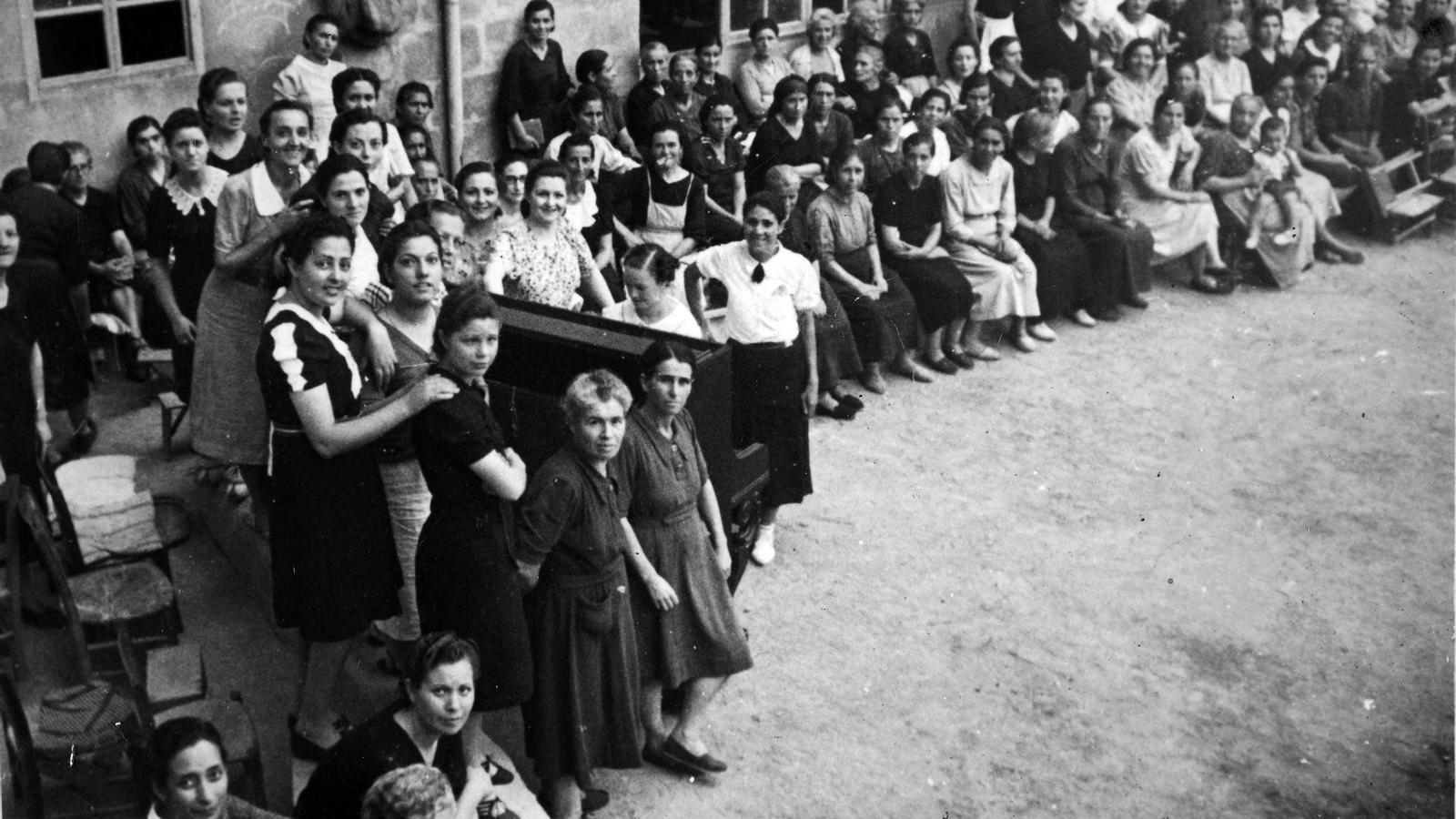
The Mahón historian Miquel López rescues from oblivion the Francoist mockery that a hundred Minorcans suffered. The female population had a fundamental role in the rearguard on the only island that remained faithful to the Republic almost until the end of the Civil War
6 min
Can Sales women's prison in Palma (September 24, 1941), where there were women from Menorca imprisoned.Arxiu privat de Matilde Gomila
PalmaOn July 21, 1936, three days after the coup d'état, the Catalan Marina Ginestà Coloma, a 17-year-old communist girl, accidentally became the great icon of the anti-fascist militia woman. She was working as a translator at the Hotel Colón in Barcelona, which had been converted into the headquarters of the PSUC, the Unified Socialist Party of Catalonia. Her determined pose did not go unnoticed by Juan Guzmán, a Mexican photojournalist of German origin who was in the city to cover the People's Olympiad for the Efe agency, the alternative to the Olympic Games in Hitler's Berlin that, due to the military insurrection, did not take place. Guzmán asked the young woman if he could take a special photo session of her. He had her go up to the building's roof and lent her a rifle. The proposal caught her attention, as she had never touched one before. Due to the circumstances of the moment, however, she agreed to act as a model dressed in a militia uniform. In front of the camera, she exhibited a defiant attitude with the weapon hanging on her back.
The famous snapshot was not published during the war. It remained stored in the Efe archives and was not discovered until 2002. Four years later, the protagonist, then 87 years old, became aware of it. “They say,” she stated, “that in the photo I have a captivating look. It is possible, because we lived with the mysticism of the proletarian revolution and the images of Hollywood, of Greta Garbo and Gary Cooper.” The well-known ‘young woman with the rifle’ died in 2014, at 94 years old, in Paris, where she had established her residence after a long exile in Latin America.
The Mahón historian Miquel López Gual has kept the mythical image of Ginestà very much in mind to write his latest book published by Lleonard Muntaner: Women at war. Mobilization, resistance and repression in Menorca (1936-1945). “It is,” he says, “a clear example of propaganda, because, in reality, she never went to the front. A great symbol of a heroic militiawoman was the Catalan Lina Ódena, who in September 1936, at 24 years old, committed suicide in Granada upon finding herself cornered by some Falangists. However, after the first months of the war, women ended up relegated to the rearguard, victims of the sexism of the time.”
The Menorcan women of Operation Bayo
Before being banished from the trenches, there were female militiamen who participated in important campaigns. One was the republican expedition of Captain Bayo, which on August 16th, coming from Catalonia, landed in the east of Mallorca with the intention of restoring republican legitimacy on the island, as another column from the Valencian Country had already done a week earlier in the Pityusic Islands. Out of about 5,000 militiamen, 147 were women – the figure represents 3% of the total according to data from the Virtual Museum of the Combatant Woman. "They were part – points out López – of the Association of Anti-Fascist Women that had been constituted in 1933. It was an initiative of a group of communist women who that same year, with Dolores Ibárruri at the helm, created the World Committee of Women Against War and Fascism to combat the rise in Europe of figures like Hitler and Mussolini and parties like the Spanish Falange".
The landing in Mallorca was prepared from Menorca, where the military uprising did not succeed. An investigation by the historian Gonzalo Berger points out that in that operation there must have been 12 Menorcan women. One was Sofia Sintes Rosa from Mahón, who in 1933, at 16 years old, had co-founded the Unified Socialist Youth of Sant Lluís. She enlisted with Bayo's men as a nurse without yet knowing she was pregnant. She did so alongside her partner, Valentí Orfila Vinent, who would fall mortally wounded. The republican expedition ended up being a failure. It had to retreat after three weeks.
Workers at the Casa Gomila silver bag factory.Margarita Caules Ametller Collection-Image and Sound Archive of Menorca-CIM
Upon returning to Menorca in 1937, Sintes helped create the Association of Antifascist Women on the island. Once the war was over, she was saved from repression thanks to the help of a very monarchist man whom the fascists had appointed as mayor of Sant Lluís, but whom they immediately dismissed. Other expeditionaries of Bayo would have worse luck. In 1940, the Mahón native Anna Pons Nadal was sentenced to three years in prison for 'aiding the rebellion'. Sara Colero, a widow and mother of seven children, was given the maximum penalty: death. It was commuted, however, to 30 years in prison and later to 6 years and 1 day. The fact that she was a mother of a large family meant that she was finally released after 18 months.
The 'pain' of motherhood
After the failure of Bayo's expedition and with the insurgents having recovered the Pityusic Islands, Menorca became the only republican bastion in the Balearic Islands. Behind the lines, the women of Menorca were occupied, among other things, with caring for the sick and orphaned children and with making and collecting clothes to send to the front. “Mothers –asserts López– became the paradigm of the anti-fascist woman par excellence. Left-wing parties and unions exhorted them to participate in the war effort and to encourage their children to defend the Republic”. In July 1937, the communist leader Dolores Ibárruri was already in charge of exploiting the ‘pain’ of motherhood for the republican cause in a speech: “Listen to the painful cry of our mothers and our women who walk their affliction along the bloody paths of Spain, which fights for peace and freedom in the world”.
Can Sales women's prison in Palma (September 24, 1941), where women from Menorca were imprisonedPrivate archive of Matilde Gomila
In April 1938, Nostra Paraula, the newspaper of the Communist Party in Menorca, urged women to occupy the jobs that men had left vacant upon leaving for the front. “We must demonstrate, the women of Menorca, that we are prepared to fight, with whatever manner and type of work it may be. Just as we know how to put on makeup and show off in the street, we also know how to show off in the field and in the workshop and in any other workplace. Our beloved island must continue its normal life, without it being noticed that it is the women who are in the places of production. Let us unite, comrades, all of us, without exception!”. During the war, the involvement of Menorcan women in politics was also significant. “In several towns –notes López–, the first female councilors in history entered. This would not happen again until the recovery of democracy”.
After two and a half years of resistance, on February 9, 1939, Republican Menorca capitulated to the insurgent forces. After the fall of Barcelona on January 26, all hopes had been lost. The surrender of the island is an unusual case within the Civil War, as it was negotiated. The reprisals were immediate. According to Antoni Pons Melià, author of the book Víctimes del silenci (2001), the fascists ended up ordering 202 executions. Furthermore, in the first days, nearly 5,000 people were imprisoned on an island that at the time had about 43,000 inhabitants.
Stigmatized
As for the women, about a hundred passed through the prisons set up in Ciutadella and Maó (today occupied by the Casa de la Infància) and about twenty were transferred to the Can Sales prison in Palma. “The imprisonment –notes López– sought the submission of women, the renunciation of political identity and, in mothers with minor children, it directly affected domestic organization. Many women were accused of having looted the churches. Others were denounced by a neighbor for revenge or to try to obtain some benefit”.
The violence exercised against the female population in Menorca was the same as that which occurred in the rest of the State. There were those who were raped and who suffered 'purifying' punishments such as having their hair shaved off and being forced to ingest castor oil. According to the historian Bartomeu Garí, in the Balearic Islands as a whole, 32 women lost their lives, of whom 18 died during the war and 14, just after. "In Menorca –says López– there was not a single one who was executed by firing squad. About twenty suffered death sentences, which were finally commuted to 30 years in prison. Only one died while she was imprisoned. However, the repression did not only take the form of prison. It persisted with hunger, social control, and stigmatization for being on the side of the losers. There was no shortage of women with imprisoned husbands who were extorted with sexual abuse, which, in some cases, caused unwanted pregnancies. Others were driven to prostitution as a way to survive."
There were also several Menorcan women condemned to assume the economic sanctions imposed on absent husbands by the Court of Political Responsibilities. Those who were saved from that scorn were those who, on the day of the surrender, went into exile by ship. This was the case of Margalida Vila, from Es Castell, the leading voice of the Anti-Fascist Women's Group. In 1946, she had a prominent role in Toulouse (France) at the first congress of the Union of Spanish Women. Vila did not return to Menorca until 1977, with Franco already dead. "Although the case of Menorca –concludes the historian– is not exceptional in the republican territory, it is in the Balearic Islands, since it was the only island where women played an active role in the resistance of the civilian population." Today, the hundred who were repressed have no street dedicated to them nor any monument that honors them.".
The historian Mary Nash, born in Ireland in 1947, was the first person to begin studying the role of women in the Civil War in the early 70s, while Franco was still alive. She settled in Barcelona at the end of the 60s. In 1974, she taught the first course on the history of women in Spain at the UB, and in 1977 she received her doctorate with the thesis La mujer en las organizaciones políticas de izquierdas en España, 1931-1939. In 1982, she founded the pioneering Centre for Historical Research on Women at the same university. In 1999, now as a professor of Contemporary History, she published her major reference work: Rojas: las mujeres republicanas en la Guerra Civil española.
Nash rescued from anonymity many women who had been overshadowed by the men who had fought the war. The androcentric historiography of the time only spoke of female political figures such as the Basque communist leader Dolores Ibárruri, known as La Pasionaria, and the Catalan anarchist Federica Montseny, who in 1936 became the first female minister in Spain as head of the Ministry of Health and Social Assistance. Thus, photos of female militiamen that had had a wide international impact were not sufficiently valued. This was the case of Miliciana rebent instrucció a la platja (Militia woman receiving training on the beach). The snapshot was taken in Barceloneta by Gerda Taro, Robert Capa's partner, and was published on August 29, 1936, in the French magazine Vu.
The Republic wanted to exploit the image of female militiamen as a symbol of the anti-fascist struggle. Their figures appeared on numerous propaganda posters. The intended recipients, however, were men, who, with the lure of a desirable woman, had more reason to pick up a rifle. However, the myth soon fell from grace. Women were blamed for the poor performance at the front due to their lack of military training. They ended up being accused of engaging in prostitution and spreading venereal diseases among their comrades. At the end of 1936, the Minister of War, Largo Caballero, approved a series of decrees to expel women from the front.
In his radio broadcasts, Queipo de Llano, one of the main leaders of the military insurrection of July 1936, never tired of encouraging soldiers to rape all the female militiamen they found. "Now," he said, "at least they will know what real men are and not sissy militiamen." In Mallorca, a key figure in the recovery of the female memory forgotten during the war is Margalida Capella, sister of Llorenç Capellà, author of the Diccionari vermell (1989). Between 2003 and 2007, she published 170 interviews with repressed women in the newspaper Última Hora under the title Republicanes del 36. Years later, the publisher Lleonard Muntaner published them in three volumes. Recently, their voices have been reclaimed again by feminist groups in Porreres and Felanitx in the form of two documentaries: Més enllà de les bales (2024) and Silenciades (2026).