PalmaFalsification of electoral records? Alteration of the census? Bribery or pressure on voters? Dubious results? Over the centuries, shenanigans have been a constant in elections for public office in the Balearic Islands, not much different from the rest of the State and the surrounding area. We review this wide collection of irregularities, tricks, and manipulations, at a time when some voices, in the purest Trumpian style, have cast surreal suspicions on the elections that are to be held on November 29th.
When, following the Christian conquest, the specific institutions of each island were put into operation, that is to say, the 'universitats' –equivalent to current city councils and island councils–, the monarchs did not complicate their lives with campaigns, votes, and scrutinies. The jurors themselves –councilors– handpicked the advisors they pleased. And they themselves also designated those who were to succeed them. In this way, the dominance of the privileged over each territory was perpetuated. The abuses must have been so scandalous that, in 1425, a revolt almost broke out in Ciutadella due to fraudulent elections.
The 'sac i sort' (sack and lot) system was established by Alfonso the Magnanimous: Menorca was the second territory in the entire Crown of Aragon where it was put into practice, only behind Xàtiva. Apparently more impartial, it was not distinguished by its good practices either. It involved introducing, into small scrolls, the names of those who met the conditions to hold public office, and the innocent hand of a child would draw the names of the fortunate ones. Of course, it was limited, with all sorts of conditions, to the number and characteristics of those who could be elected. Where the headquarters of the Palma City Council is now, visitors can admire the Ark of Insaculations, which was used for this mode of election.
What was the trick in this case? As Álvaro Santamaría recounts, the monarch's representative would conspire with the scribe, and the names he published were not those contained in the scrolls, but those of the people he wanted to be elected. Since the voters were illiterate, like the vast majority of the population throughout the centuries, the falsification could be carried out with impunity.
The ideas of the Enlightenment, in the mid-18th century, and their translation into politics –liberalism, at the beginning of the 19th– opted for the election of public officials by citizens. However, at first, not everyone could be a voter, only those with a certain economic level. Of course, neither could women, who had to fight hard to achieve the right to vote.
Election caricature published in Foch y Fum. ‘Carnaval, codolades i teatre popular’ by Isabel Peñarrúbia.Documenta Balear
Depending on political fluctuations, the conditions surrounding the electoral process could change. Upon ascending to the crown, the disastrous Philip V, the first Bourbon, wasted no time in removing from the list of eligible Menorcans those who, as Miquel Àngel Casasnovas notes, seemed to be "presumed disaffected to the new dynasty".
The British, whose domination over Menorca has been so idealized, also did not miss the opportunity to interfere in the election of municipal offices in the Menorcan universities. It is clear that, since the representatives of the Spanish crown had already done so habitually, this surprised no one. The British also imposed who could, and who could not, be an elector: those who owned land could exercise suffrage, while those who obtained their earnings from commercial activity were excluded.
The elections of the liberal period, upon the closing of the absolutist era with the death of Ferdinand VII in 1833, were not exactly a prodigy of cleanliness either. In 1844, the Diario Constitucional de Palma stated, at the time of the constitution of the City Council, that the election had not been carried out in compliance with legality. According to this newspaper, the census included people lacking this right; voters had been intimidated, using police guards, and it accused the promoters of that trickery: "You have even led the dead and the absent to the polls".
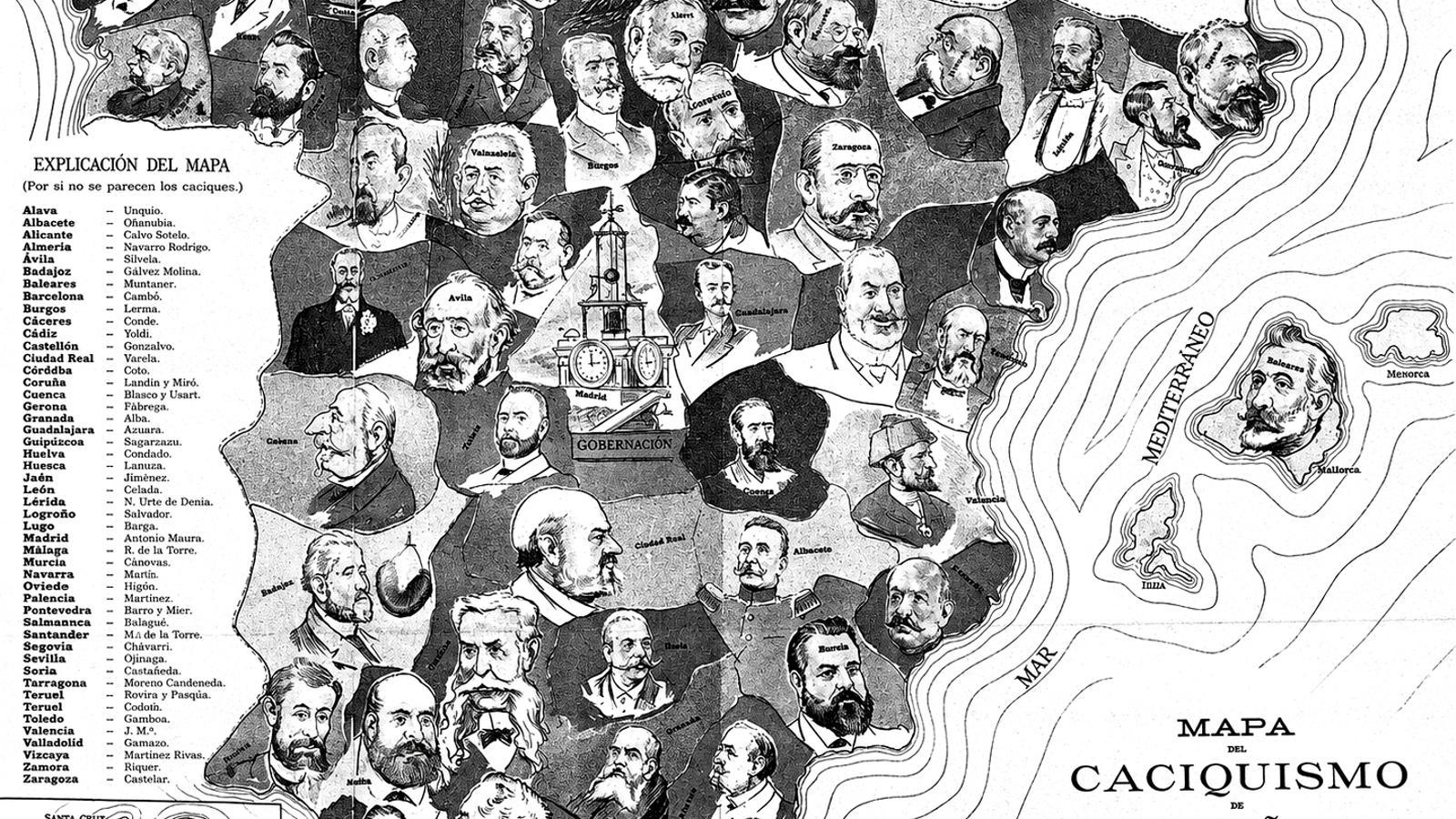
With the Bourbon restoration in 1875, after a brief republican stage, a new system was put into motion, the 'peaceful turn': the alternation between the two great parties of the State, conservatives and liberals. First, they would decide who was to govern and then the elections would be held. The bosses (powerful men in a municipality or region) were in charge of ensuring that the results were as desired, guiding the vote of the neighbors. If that failed for any reason, the records were falsified without further complication.
In the Majorcan Part Forana, a clear dominance of local bosses was recorded. J. Torrendell and R. Salvà stated that the rural vote was a farce and that the voters were led to the polls just as if they were sheep – more or less as is done now with passengers at airport security checks, but perhaps not in such a humiliating way. Palma was not free of shenanigans either: municipal officials were used in favor of the party in power.
The examples were quite numerous. In 1881 in Marratxí, reported El Isleño, there were already 74 ballots in the box, when there was still half an hour left to open the polling station; a notary appeared there to draft a record of it, but they did not allow him to access it. In those elections, it had to be stopped, at any cost –at any cost!–, the momentum of republicanism in the City. Even so, their candidate, Ramon Obrador, was elected. How was that fixed? Very simple: the Courts annulled his record and granted the seat to another candidate, a liberal, who had obtained fewer votes.
Antoni Maura and Joan March
In 1884, La Opinión denounced that in Llucmajor, with an electoral census of 431 voters, including the dead and absent, 433 people had voted –oh, a miracle–: “The 431 from the census, plus the author of the miracle, plus the medium who made it possible”, it was said. In 1909, Es Moscari from Santanyí revealed that, in the City Council's budget, what had actually been spent on bribes to voters had been registered as expenses for the transfer of monitors and paper for the voting.
The introduction in 1890 of universal suffrage –only male, of course– did not fix things, since the vote continued to be manipulated. Miquel dels Sants Oliver, a visionary in so many aspects, harshly criticized the systematic manipulation of suffrage in that period of caciquism. It was, he denounced, “worse than the mafia”.
The Majorcan Antoni Maura, throughout his period as president of the Spanish government, from 1907 to 1909 –the ‘long government’: imagine how short the rest must have been–, tried to put an end to that systematic falsification of the vote. But he himself managed to get elected as a deputy, election after election, thanks to the cacique machinery. When he was Minister of Governance –now Interior–, of the five representatives in the Cortes for Mallorca, four were Maurists –pure coincidence, surely.
Caricatures of Joan March published in Baleares in 1922. ‘Carnaval, codolades i teatre popular’ by Isabel Peñarrúbia. Documenta BalearDocumenta Balear
The multimillionaire Joan March, upon entering politics, proved to be a true master of manipulation. In 1923, when he won the elections to the Cortes, some events were recorded that were, at the very least, curious. In Escorca, all the candidates who ran there tied with the same number of votes, 35: a somewhat suspicious coincidence. From Artà, as reported by the weekly Foch i Fum, a good handful of votes that no one had cast into the ballot boxes were sent to Palma. Josep Socias, a conservative candidate defeated by 'en Verga', filed a complaint with the electoral board, claiming that he held, as cited by Antoni Marimon, “notarial acts that attested to the illegality of some counts, in addition to the existence of coercion and vote-buying”.
The elections that brought about the Second Republic, the municipal ones of April 1931, were challenged by the left due to alleged anomalies and had to be repeated the following May. And, curiously, the results were completely different: either the voters had suddenly changed their minds, or someone had tampered with the ballot boxes. The elections of the republican period were not a bed of roses either: in Menorca, the 1936 municipal elections had to be suspended due to political instability. And what would arrive just a few months later would be even worse.
From Franco's referendums to the Formentera case
Obviously, Franco's dictatorship was not an exemplary time in terms of electoral integrity. In the 1947 Law of Succession referendum, as noted by Joan Mas Quetglas, campaigning in favor of the 'no' vote or even abstention was not permitted. Thus, the overwhelming result should surprise no one: 92% of affirmative votes in the Balearic Islands.
In a second Francoist referendum in 1966, on the Organic Law of the State, one—just one!—position against was recorded: a letter from a notary in the newspaper Menorca. It seems the regime wanted to give the impression of a certain leniency. However, the results were even more favorable: only 5% of negative votes in the Archipelago, one of the lowest percentages in the entire country.
Nor were municipal elections known for being impeccable. The Mayor of Palma was chosen directly by the Minister of the Interior. As for the rest of the municipalities and councilors, the manipulation must have been so flagrant that in 1951, instructions came from Madrid to act with caution, lest the voters notice and stop going to the polls. Or that it might damage the good image the regime was desperately trying to project abroad to break its isolation.
Once democracy was restored, perhaps the most notorious case in the Balearic Islands was the one known as the Formentera case or the Mapau case, in 1999, ahead of an autonomous regional election: Diario de Mallorca revealed that 74 descendants of emigrants from the Islands, residing in Argentina, had been registered on the Formentera electoral roll, apparently without any direct connection to that island.
In those elections, Jaume Matas's People's Party wanted to obtain 12,000 votes in its favor from descendants of islanders in Argentina and Uruguay, using the collaboration of the Balearic social clubs. The deputy for Formentera was key to achieving a majority, but the results were not favorable to the conservatives: that highly desired seat remained in the hands of the left.
Information prepared based on texts by Isabel Peñarrúbia, Antoni Marimon Riutort, Joan Mas Quetglas, Antoni Janer Torrens, Àlvaro Santamaría, Miquel Àngel Casasnovas, Francesc Sáez, Susana Sueiro Seoane and José María Marín Arce.