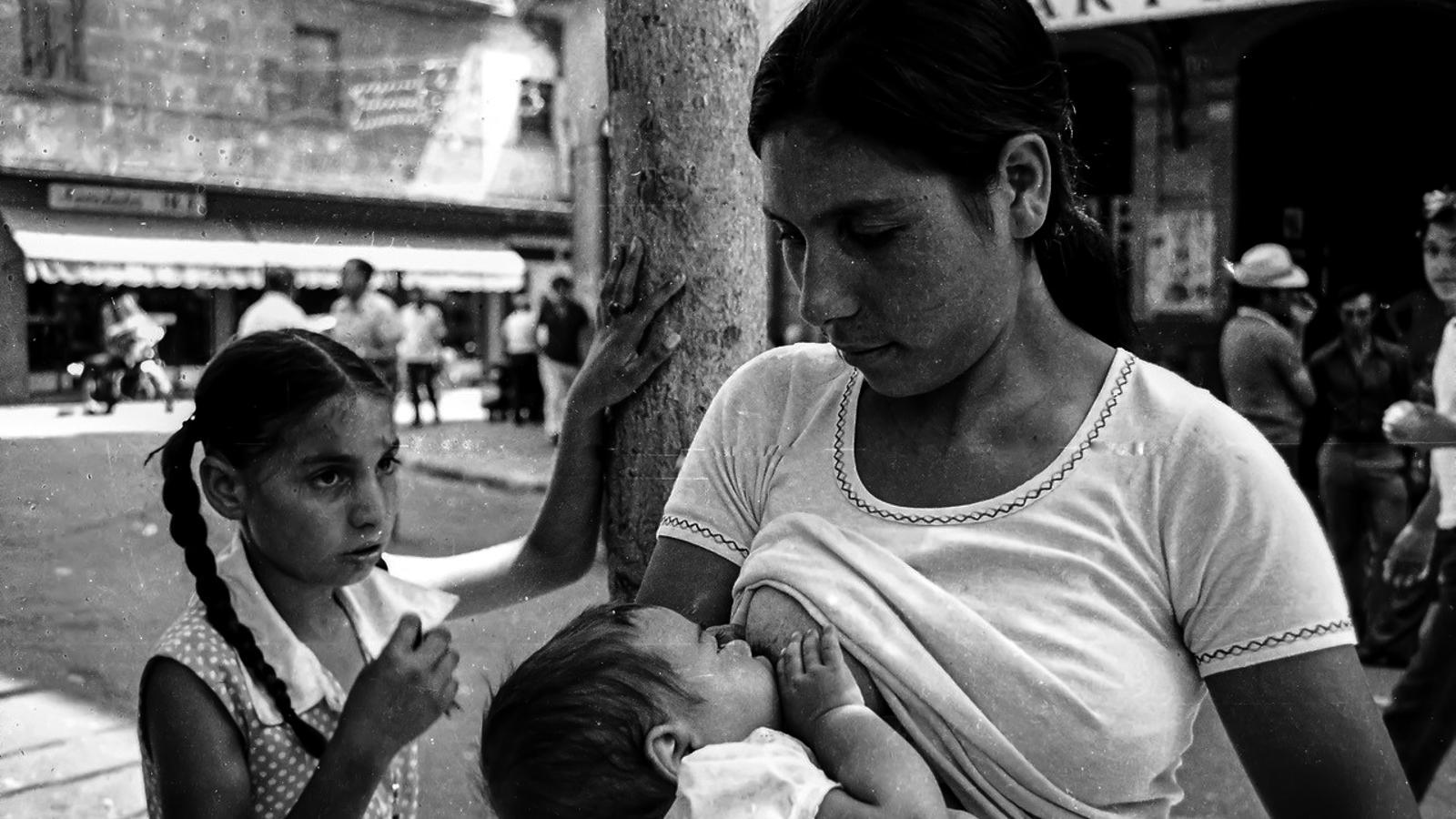
The gypsy seasonal workers who saved the Majorcan countryside
From the 60s, hundreds of Gypsy families arrived from the Peninsula to harvest almonds, especially in the south of the island, on estates that had been emptied of labor by the tourist boom. This is one of the episodes that journalist Laura Jurado rescues from oblivion in the book 'Mallorca romaní'.
6 min
A gypsy woman with a child at the Llucmajor market (1977).Coloma Julià Adrover
PalmaThe Romani people left India about a thousand years ago, besieged by other cultures. They did so with their own language, Romani. They arrived on the Iberian Peninsula in 1425 thanks to a safe-conduct granted by the monarch Alfonso V of Aragon. At that time, it was mistakenly thought that they came from Egypt, hence the demonym was created from the Latin aegyptanus and which in English would give gypsy. In the time of the Catholic Monarchs (1474-1504), the group was forbidden from practicing a trade, so they had to earn a living as best they could.
Gypsies with the giants of Llucmajor in 1978.Coloma Julià Adrover
According to documentary sources, that nomadic people arrived in Mallorca five centuries ago, at the end of the 16th century. It was, however, in the 19th century that Palma welcomed the first clusters of entire Gypsy families. Faced with the stigma they suffered, they settled on the outskirts of the walls, in the neighborhoods of Santa Catalina and El Molinar. Decades later, there would be Catalan speakers, coming from Catalonia, who settled mainly in the interior, in the area of the Porta de Sant Antoni. Journalist Laura Jurado has just reclaimed their memory in the book Mallorca romaní. Una història de la comunitat gitana (Lleonard Muntaner Publishing). She began writing it in 2021 thanks to the Ciutat de Palma Research Award. The second part of the work focuses on the presence of the collective during the boom in tourism. The Son Banya settlement dates back to 1969, five kilometers from the center of Palma, right next to the airport. It was a pioneering project in Francoist Spain, which was presented as a hub of integration, when in reality it was one of segregation.
“In Son Banya –asserts the researcher– they brought a hundred Gypsy families, completely marginalized, who were living in shacks made of cardboard in the Molinar neighborhood, which was in the process of urban renewal. The authorities considered that their presence gave a bad image to the tourism industry”. The governmental animosity had been brewing for a long time. “In 1952, the City Council had already ordered the burning of the entire Molinar camp. Then they put the Gypsies on a ship bound for Valencia. However, that settlement would be rebuilt a few years later with nearly 200 shacks. The Gypsies who practiced begging were also shipped back to the Peninsula. For those who returned and reoffended, the Ley de vagos y maleantes (Vagrancy and Thuggery Act) was applied”. In the mid-70s, a thousand Portuguese Gypsies arrived in Mallorca, coming, for the most part, from Asturias. The majority settled in the Palma neighborhood of Puig de Sant Pere.
Gypsies at the Llucmajor market (1977)Coloma Julià Adrover
Labor problems
Despite the weight of all these prejudices, in the 60s the Majorcans did not hesitate to turn to the labor of the Roma people when tourism emptied the countryside. “They did not come from Palma –notes Jurado–, but from the most impoverished areas of Spain, mainly from Jaén, Granada and Albacete, but also from Badajoz. There were hundreds of them. The phenomenon was repeated in many parts of Spain. Most families moved from one region to another to work the season within what was considered a seasonal subsistence. Every year they usually repeated their destination”. By the mid-80s, the Balearic Islands were already one of the three provinces with the highest presence of Roma seasonal workers, along with Andalusia and the Valencian Community. They arrived mainly to harvest almonds. In Binissalem there were also those who worked in the grape harvest, and in Santanyí, searching for snails during October, taking advantage of the first rains of autumn.
The researcher points out some labor problems that those newcomers encountered. “Although many arrived hired through the Labor Delegation by the owner of some estate, there were always groups that came on their own to try their luck. When the harvests were not good, the three-month contracts could be reduced to three weeks or they directly lost their job and were forced to leave”. Sometimes, however, the situation of the workers was so precarious that the town councils had to cover the travel expenses so that they would return to the Peninsula. “Of the 200 that arrived in August 1979 in Llucmajor, only 20 or 25 were hired. That is why it was the first town to develop measures aimed at avoiding these imbalances, such as the creation of a placement office”.
“Everyone lived their own life”
The municipalities in Mallorca where the most Gypsies were hired were Campos, Santanyí, and Llucmajor. Joan Tomàs Simó from Llucmajor, 80 years old, still remembers them. “They came to harvest almonds from August to September. Some settled in to live with their families in the barn of the estate where they went to work. Others, about forty of them, stayed to sleep at the old train station. There were some who slept inside abandoned train cars. The rest improvised a kind of camp with fabrics, cardboard, and plastics. During the day, in the summer heat, they must have had a very hard time. I don't think they showered, because they didn't have any bathroom within reach”.
The presence of those newcomers caused some surprise in Llucmajor. “The older people –says Tomàs– were not used to dealing with outsiders. The situation, however, would change with the arrival of the first people from the peninsula, known as ‘forasters’ [outsiders], some of whom also dedicated themselves to harvesting almonds”. The coexistence between Gypsies and Llucmajor locals was marked by indifference. “It is the same relationship we have today with the Maghrebis. Each person lived their own life. It was not, however, a relationship based on racism. Back then, the only racism that Mallorcans knew was against the Xuetes [the descendants of the Jewish converts from the Middle Ages]”.
Cases of mistrust were occasional. “The Gypsy seasonal workers –states the Llucmajor native– did not usually walk through the town. One day, however, a Gypsy woman appeared with a pitcher. She asked the neighbors if they could fill it with water. A woman shouted at her to leave. She told her: ‘Come on, get out. Go to work, go to work!’”. Not everyone, however, reacted the same way. “I remember one afternoon, when I was 14 years old, and everyone was sitting out in the street enjoying the cool air. A Gypsy woman came by with a boy my age to ask us if we could give her something to eat. My father felt sorry for them and offered her a slice of bread with sobrassada”.
Tomàs gives the following X-ray of the rural life of the 60s. “The Gypsy seasonal workers were very good for the owners of large estates, of 40 or 60 quarterades, who had been left with no one who wanted to harvest almonds. The young people preferred to do other, less strenuous jobs. There were those who went to work in the shoe factories. At that time, in Llucmajor, there were about forty of them. Others turned to the hospitality and construction sectors. I myself dedicated myself to working as a painter in the hotels of Arenal”.
Slave labor
In the summers of the 70s, the Gypsy seasonal workers of Llucmajor got an extra job: carrying the figures of the two giants during the Santa Càndida festivities, in mid-August. The photographer Coloma Julià Adrover, who is now 77 years old, was in charge of immortalizing them with her camera. “The smear campaign –she says– that the giants suffered during the Franco regime had meant that no one from Llucmajor wanted to be one. If it hadn't been for the Gypsies, perhaps we wouldn't have recovered the giant tradition. With the little they earned, however, they were slave labor both at the patron saint festivities and in the fields. On market days, you could see many Gypsy women shopping with their young children. It was very striking to see how they lived in poverty at the camp near the old train station”.
Gitanos with the giants of Llucmajor in the year 1978.Coloma Julià AdroverGitanas at the Llucmajor market.Coloma Julià Adrover
Regarding residential precariousness, Laura Jurado makes the following point: “There were owners who did not fulfill the agreement to offer accommodation to Gypsy seasonal workers. The ethnic group's nomadic past was sometimes used as an excuse to claim that they were accustomed to living anywhere in the open air. This was not the case. Most had a fixed residence, despite their frequent moves between regions”. There were unions like the UGT that did not hesitate to denounce that “most unfortunate way of life”, which a part of the press romanticized, moved by the fascination that Gypsies still generated. “The chronicles spoke of ‘bucolic images’ with churumbeles (children) who slept under the shade of a tree while their parents were working. They also mentioned the bonfires in the field on summer nights or ‘the unusual spectacle’ of seeing them while they sang ‘cante jondo, cante de ‘güeno’’”.
From the 80s onwards, the hiring of Gypsy seasonal workers from the Peninsula began to decline. At the beginning of the 2000s, there were still some who came to harvest carob beans. Today it is estimated that in the Balearic Islands the Romani community is made up of about 12,000 people. “Many –concludes Jurado– are dedicated to street vending, construction, and the hotel industry. However, we already have the first generation of university-educated Gypsies. They are people who still have to face many prejudices”.
Exploited by tourism
In 1749, during the reign of Ferdinand VI, the infamous Great Gypsy Round-up took place. Between 7,000 and 9,000 Roma people were arrested from a community of nearly 12,000 across the state. According to scholars, it was one of the “most controversial systematic measures that a European monarchy planned against a segment of its own subjects.” With the intention of making the ethnic group disappear from the social sphere, the men were taken to work in arsenals in different parts of the Peninsula. Meanwhile, women and small children were confined in houses of mercy. However, that operation would be an organizational failure, and so the detainees ended up returning to their places of origin under certain conditions.
Despite having been mistreated for centuries, the Roma became quite an attraction in Mallorca during the tourism boom of the 20th century. “They were presented,” points out Laura Jurado, author of Mallorca romaní, “as the ultimate representatives of ‘Spanish folklore.’ Thus, flamenco became a very good job opportunity for the community.” In the 1950s, when actress Ava Gardner became a regular visitor to the island, her host, the English writer Robert Graves, said that in Palma there were already “too many places” where Roma played guitar and danced flamenco all night long. These were the well-known tablaos. Soon, nightclubs and hotels also included flamenco shows in their programs. “This entire network of venues and stages favored the arrival and settlement of artists from the Peninsula, among whom were members of at least three important Roma lineages: the Crespos, the Habichuelas, and the Amayas.”
Tourists also sought out the Roma outside of the tablaos. “They did so,” highlights Jurado, “imbued with the romantic gypsy-philia that arose in the 19th century based on the stereotype of the artistic Roma, a lover of nomadic life and freedom.” In 1958, Diario de Mallorca reported on a foreigner who had taken a photograph with some Roma women to whom she had given alms. “That’s all the Roma were missing!” the article denounced, “to be an attraction for tourists.” It would not be an isolated case. “In addition to beggars,” the researcher notes, “the flea market became another point of attraction for travelers who wanted to photograph them. In exchange for a photograph, some Roma managed a sale or an alms.”
In search of more very typical scenes, bus tours were also organized to visit the Roma settlement in the El Molinar neighborhood of Palma. At the passengers' request, there was no shortage of taxis making the same stop. “Immediately,” affirms Jurado, “the authorities became concerned about the bad tourist image that this phenomenon gave, which was picked up by the national and international press, such as in Sweden. Mayor Joan Massanet ordered the municipal police to file the corresponding complaints against the infringing tours.” The controversy would end in 1969 with the relocation of the El Molinar settlement to Son Banya.