Scientists reiterate the alert: "The emissions of the Balearic Islands are 80% above those of 1990"
The Climate Academy and the LINCC of the UIB warn that the Archipelago has not reduced emissions at the committed pace and demand transforming the economic and tourist model to curb global warming

-
CAT -
CAST -
DE
PalmaThe Balearic Islands are increasingly far from meeting the greenhouse gas emission reduction commitments set for 2030, as current emissions exceed those recorded in 1990 by 80%, despite the established goal being to reduce them by 40% compared to that year. This is one of the main warnings in the manifesto for the life and future of the Balearic Islands, which has been drafted by the Climate Academy and the Interdisciplinary Laboratory on Climate Change of the Balearic Islands (LINCC), on the occasion of the International Day of Climate Action, which takes place this Saturday, October 24th.
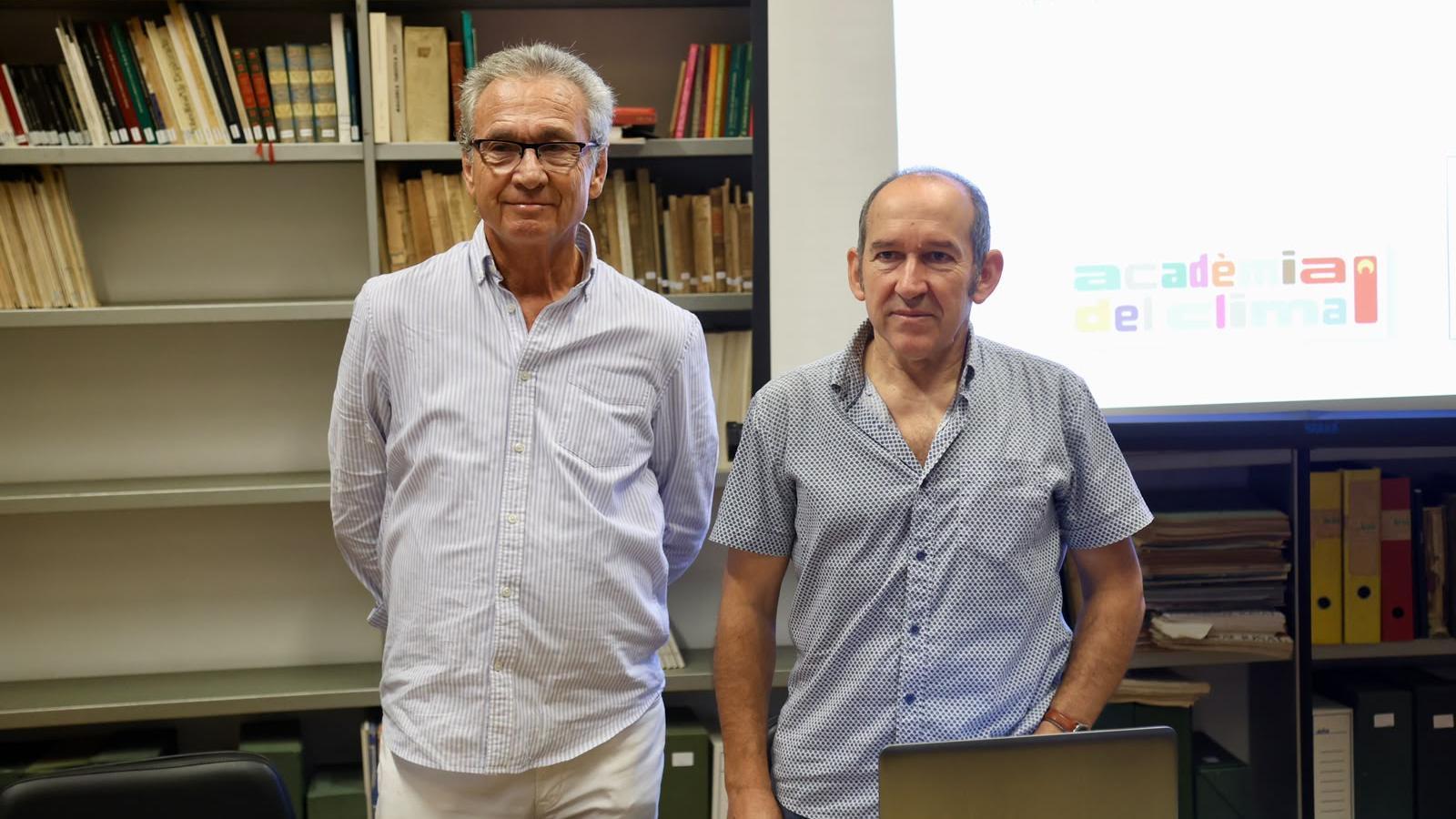
The manifesto, presented this Friday in Palma by the physicist and professor of Earth Physics at the University of the Balearic Islands (UIB) Damià Gomis and the president of the Climate Academy, Jaume Garau, focuses on the need to act in the face of a situation that is no longer a matter of the future, but rather one that affects the territory and the population. Both entities have called on institutions, political parties, companies, professional associations, and civil society to get involved in the coordination of resilient actions against global warming.

"The situation we are already experiencing is discouraging," warned Gomis, who highlighted that the effects of climate change not only affect terrestrial and marine ecosystems, but also the health and safety of people. In this sense, he recalled that the commitment to reduce emissions by 2030 derives from international climate agreements, especially the Paris Agreement and the Climate Change Law. However, data from the Balearic Islands show that the Archipelago is not moving in the necessary direction to reach this goal.
The scientist recalled that the global temperature has already increased by approximately 1.4 degrees compared to the pre-industrial period, very close to the 1.5-degree limit that was set as an international reference. In the Mediterranean, the increase in sea surface temperature has been 1.6 degrees over the last 40 years. The entities warn that, if the current trajectory is maintained, warming could reach an increase of 3.5 degrees by the end of the century. To avoid this, they consider it essential to reduce emissions substantially and move towards a decarbonization scenario.
Tourism and transport, at the center of the problem
The manifesto points to human activity, both globally and locally, as the main cause of global warming. In the case of the Balearic Islands, the organizations identify the economic model focused on tourism as one of the main factors contributing to this situation. Greenhouse gas emissions derived from land, air, and sea transport account for approximately three-quarters of the total, while the rest comes from electricity production and other minority sectors.

This distribution highlights the difficulty of reducing emissions without addressing mobility and the tourism model. Transport continues to be one of the main sources of pollution in the Archipelago, while electricity generation has begun to reduce emissions thanks to the incorporation of renewable energies and the improvement of process efficiency. In this sense, the data point out that electricity production has advanced in the reduction of emissions, with a lower dependence on fossil fuels and an improvement in energy efficiency. However, these improvements are not enough to compensate for the impact of transport.
For this reason, one of the central messages of the manifesto is that the Islands are too dependent on tourism, an activity that exerts great pressure on the territory, natural resources, energy, and infrastructure, and that causes emissions and impacts that worsen climate change. "It is not about giving up tourism, but about reducing its weight and diversifying the economy," point out the promoters, who demand a broad involvement of all organizations, institutions, economic sectors, and civil society to make the transformation of the model viable.
Longer stays and fewer short-haul trips
One of the measures proposed to reduce the climate impact of tourism is to encourage longer stays. The proposal is based on the idea that if visitors stay more days on the Islands, the emissions associated with travel are spread over more days of stay. In contrast, short-duration trips, especially those involving long-distance air travel, have a high climate footprint in relation to the time spent at the destination.
In this sense, the entities consider that certain tourism practices, such as getaways to distant destinations to spend only a few days, contribute to aggravating the problem. The manifesto argues that there are measures that can be adopted without the need to resort to drastic restrictions, but that require reviewing mobility habits and the leisure model. Reducing the weight of tourism in the economy and diversifying productive activity are, therefore, two of the lines of action they consider necessary to move towards a more sustainable model.
A summer with exceptional temperatures
The manifesto also gathers the data that evidence the evolution of warming in the Balearic Islands. The global average temperature in 2025 has increased by 1.42 degrees compared to the pre-industrial period, while the average surface temperature of the Mediterranean Sea has risen by 1.6 degrees over the last 40 years.
In the Islands, the available data show an upward trend in both atmospheric and sea temperatures. The document highlights that climate change is already translating into episodes of extreme heat, tropical nights, and a decrease in precipitation, with consequences for health, water, the countryside, biodiversity, and the economy. This summer, July was the warmest in the Balearic Islands since official records began, with a temperature 2.9 degrees above the climatic average. Furthermore, more days of extreme heat and tropical nights were recorded, as well as 66% less precipitation.
The sea has also experienced exceptional temperatures. During the summer, the surface temperature reached unprecedented values, with anomalies of more than three degrees, and regional averages exceeded 29 degrees for prolonged periods. The organizations warn that the warming of the water degrades essential ecosystems, such as Posidonia meadows, and causes a continuous rise in sea level, which threatens the beaches and a large part of the coastal strip.
The document warns that the effects of climate change are already evident on terrestrial and marine ecosystems. Among the consequences, it highlights the increase in tree and plant mortality, changes in the phenology of agricultural species, and impacts on marine ecosystems, especially Posidonia meadows.
On the coasts, the rise in sea level endangers the continuity of beaches and other low-lying areas, while higher temperatures increase the vulnerability of ecosystems. Human health is also at risk. Heatwaves and increasingly virulent storms threaten the population, especially the most vulnerable groups, and can affect the availability of water and the resources necessary for the functioning of the Islands.
Emissions remain far from the targets
The manifesto dedicates a specific section to global greenhouse gas emissions, which have not stopped increasing since the pre-industrial period. The entities warn that the last few years have shown insufficient stabilization and that, without a drastic reduction, it will not be possible to avoid the most severe scenarios.
In the case of the Balearic Islands, greenhouse gas emissions have increased compared to 1990. The document notes that in 2024 they stood at 12,218 kilotons of CO₂ equivalent, compared to the 14,229 registered in 2008, a decrease that, according to the entities, is not sufficient to achieve climate goals. The promoters of the manifesto also question whether the reduction in emissions foreseen in the Energy Transition Plan of the Balearic Islands can be achieved with current measures. The document calls for a reduction in external energy dependence, more electrification, and a transformation of the transport system, which continues to be the main source of emissions.
2050, the horizon for net-zero emissions
The entities remind that the climate goal is not limited to reducing emissions over the coming years, but implies moving towards climate neutrality by 2050. To achieve it, it will be necessary for the greenhouse gas emissions that are generated to be compensated by those that are removed from the atmosphere. This process is essential to stabilize the climate. As long as emissions continue to accumulate in the atmosphere, the global temperature will continue to rise, even in the event that they stop growing at the current rate.
For this reason, the manifesto considers that the reduction of emissions must be an immediate priority and cannot be postponed until the coming decades. The entities demand accelerating the energy transition, reducing dependence on fossil fuels, and acting on the sectors that concentrate the majority of emissions. The document also warns that, if the current trajectory is maintained, the Balearic Islands will head towards a warming scenario far exceeding international targets.
The need for a change of model
The manifesto recalls that the Climate Change Law establishes the goal of reducing greenhouse gas emissions by 40% by 2030 and by 90% by 2050 compared to 1990. The entities consider, however, that the current rate of reduction does not allow these commitments to be met. Furthermore, they warn that climate scenarios point to an increase in global temperature that could exceed 3.5 degrees by 2100 if more ambitious measures are not adopted.
Therefore, they demand that climate policies not only focus on emission reduction, but also on resilience and adaptation, with actions that allow for the protection of the population and ecosystems against the effects that are already inevitable. The manifesto concludes with a call to strengthen coordination between institutions, economic sectors, and civil society to drive a transformation that allows reducing pressure on the territory and guaranteeing a more sustainable future for the Balearic Islands.
