Antònia Verger Jaume: "Opening a restaurant gave work to the women of the town"
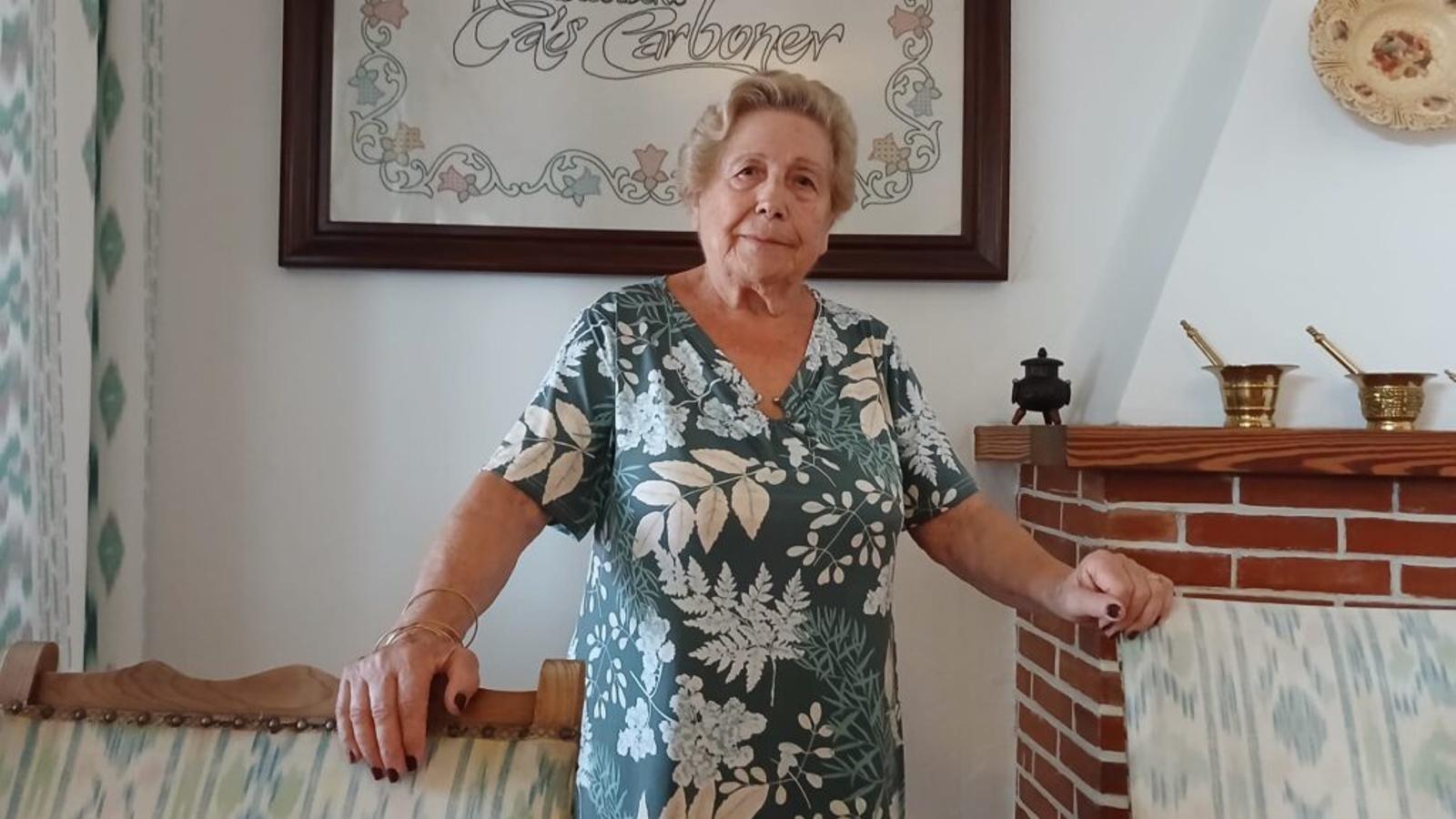
MontuïriBorn in Montuïri in 1944, Antònia Verger Jaume Sopeta is one of those anonymous but key figures in the local history of Pla de Mallorca and, in this case, Montuïri. Antònia Verger was for many years the lady of the Puig or of Cas Carboner, later. Without realizing it, she was a leader, a reference for other women who in the last quarter of the last century too often did not escape household chores. Verger began like this, not in vain when she is asked about her studies, she explains that she managed to take exams at the Institute of Felanitx, but, "the boys continued their studies and the girls, as was usual at that time, ended up doing household chores or as seamstresses". It was at the beginning of the seventies – and not without difficulties, as you will see in the interview – that she embarked, together with her husband, Biel Bennàssar Mayol Carboner, on the adventure of managing the bar and restaurant of Puig de Sant Miquel. In this conversation, Verger reviews from the beginning the success of her cuisine to the tensions and the social transformation that, without knowing it, it represented for the women of the town.
How did your relationship with Puig de Sant Miquel begin?
— This was four or five years after I got married, it was in the early seventies. My husband, Biel, was very good friends with don Guillem Rigo Amengual and don Joan Miralles Riera Porrerenc – the priest and the mayor, respectively. They had connections with football and it was during the years when the 'Torneig de la Llum' was set up. I don't know for what reason they went to look for Biel to do some work as a tractor driver and fix a few things at the Puig de Sant Miquel.
— El puig was and is a place much loved by the people of Montuïri, back then there was tia Xiva –Margalida Mayol Miralles, madò Xiva– who was the lady of the Puig. There, in the large room of what is now the restaurant, the villagers used to go for celebrations. They ordered food from the village ovens and then, almost always, that little lady was in charge of cleaning it and maintaining order. I remember that every morning I went up with the donkey and the cart towards the Puig. So when the commotion of the Tournament of Light started, with the mayor and the priest at the forefront, that space became the meeting and gathering place. And it was as if between Biel's stays for work up there and these commotions we started to make some bread with oil, a bit of embers...

And when does it finally become your draw, your profession?
— En Joan Porrerenc showed up at our place one day. "I've come to talk to you." Biel wasn't there and he waited for him to arrive. "I want you to take the Puig and open a bar up there." At first, I wasn't too keen on it, but, as I was telling you, that year 1972 we had already started going there seasonally, and in 1973 we set it up as a restaurant properly. It all happened when one month we saw that we had made more money there than Biel earned as a tractor driver, and that made us take it seriously.
— Remember that there was no bar at the beginning. The mayor had bought or picked up the kitchen of a bar in Petra that was closing and they took it to the hill. We made a small kitchen, a laundry room... the chimney with those wooden vaults was already there. And so it all began. Every day it got better.
Those beginnings were not easy. You lived through moments of social and political controversy.
— Yes, at the beginning there was some controversy. There were people in the town who did not see well that the management of the space was given away. They said it was being privatized, because the people of the town used to go there for communion or to spend their free time there. They were complex times of the Transition, where right-wing and left-wing ideologies mixed, and we did not understand politics, we just wanted to do our job.
— It also coincided that the Vermelletes nuns, with land there from a legacy, closed off a large part of their land. Walls, barriers... that didn't help us either.
Did you ever think of letting go?
— Yes, of course. As I tell you, we found ourselves in the middle of it, where many people from the town linked to entities and associations did not want us. And it was the mayor who asked us "please, do it for me", that is, to keep the bar open. But, I must also say that it gave us a lot of publicity, we were in the newspapers and people found out that a bar had opened there.
Did you manage to get through?
— With that, a little yes. But the day we were really scared was when we had already opened Cas Carboner and were running both restaurants. We were warned that a bomb had been planted in Puig. The caller linked it to Macià Manera, who had recently been arrested. It was a day when both places were full. From that day on, we were scared for weeks or months. In the end, it all turned out to be a scare or a false threat, but I had a very bad time those days. Fortunately, people from the town encouraged us to hold on: "You have to hold on here, for yourselves and for the whole town," they told us.
How did the fame of the kid from Puig de Sant Miquel originate?
— The fact that goat was the star dish was thanks to the people, word of mouth, not us. Joan Bauzà Capità told me one day that we had to prepare goat. I went to see my mother and told her: "Now I have to make goat". I applied my mother's recipe and it turned out so good, so good, that from then on people asked for it. That's how the baked goat from Puig became one of our star dishes. We ordered and slaughtered goats from different farms and markets, we even went to look for them in the Serra de Tramuntana and in Lluc. We did an enormous amount of work with the goat and also with the suckling pig.
And what is the recipe for Puig's goatling? How did you season it?
— It is a very easy recipe to make, but it requires time and patience. The first secret is in the marinade: the kid is left to marinate from one day to the next in a basin or bucket. We marinate it well with salt, black pepper, and a good splash of lemon juice, and leave a plate at the bottom so that it marinates.
— After this time, we place it in the baking dish to go into the oven. We add salt, carrot, and a good finely chopped mixture of garlic and parsley. Then we water it well with olive oil and lard on top and add the same amount of liqueur or wine, not red, as it gives it a bad color. A good splash of cognac, white wine, or whatever we had on hand; we weren't picky! This splash of liqueur on top of the meat makes it not too strong and gives it an excellent aroma.
— And then comes the most important part: the cooking, which requires many hours in a very slow oven. It should be kept for about three hours or three and a half hours at around 100 degrees, so that the meat just simmers slowly in its own juices. If we were doing it in a wood-fired oven and saw that it was burning too strongly, we would cover it with aluminum foil to protect it. At the very end, if we want it to have a good crispy crust, we give it a strong blast of heat in the oven – or add a bundle of wood – for the last few minutes. It remains tender inside and crispy outside. As you can see, it holds no mystery; the secret is to do it with patience and love.

What did it mean for the women of Montuïri to start working at the restaurant in those seventies?
— This was a huge change, it was too much! At that time, most women were at home. And with Puig's kitchen, they started to have paid work. At that time, we didn't consider it, but now we see how that was a great opportunity to have an economic income. At first, it was my mother, myself, and family members, but little by little we needed more hands: we had women from Montuïri, Petra, and Vilafranca. I remember the teamwork we did, eating together... We had an excellent kitchen team.
In addition to women, many young people earned their first salary as waiters...
— And so on. Toni's friends, when they finished classes or the entire summer season, used to come work as waiters. They earned their money, had a good time, and did a first-class job. Among them, we also had professional waiters, because the room was very large and very well-prepared staff was needed. I know I've said it, but we did a lot of work. In all those years, the busiest day, economically speaking and, therefore, in terms of work, that I remember from that whole period was one year for Mother's Day.
Later you opened Cas Carboner and for a season Ses Roques, near Colonia de Sant Jordi. What memory do you have of this entire journey?
— I was always committed to the work: in the kitchen, taking control and responsibility. I never shied away from work. I am left with the memory of having lived a very intense and full stage of life. Despite the difficulties, the fear we experienced at certain moments, or the fatigue of the kitchen, we created a space where people felt good, built community, and shared many good times. El Puig de Sant Miquel has undoubtedly been a fundamental part of my life, and that is why I hope and wish the best to those who have taken over the new management.
— Cas Carboner and Ses Roques were also spaces that worked very well and that for one reason or another we eventually had to close, but the memory of it all is more than positive and pleasant.
