Spinach and eggplant omelette recipe
We explain to you how to prepare spinach and eggplant omelet at home

-
CAT -
CAST -
GER
PalmaI would crumble bread a couple of days old with my fingers and collect it in an earthenware plate that had a little rim painted red. Then I would crack the eggs into it, beat them, and make that tasty and consistent omelet in a small, blackened frying pan. Sometimes I would add garlic and parsley, but I preferred the primitive simplicity of the one that only had bread. We would eat it on the porch, sitting at the low table protected by a floral oilcloth battered by the cut of some knife. I still seem to taste it. It was so good that I was in no hurry to finish it and tried to make the bite last.
Although the omelet, as we understand it today, is a preparation that has taken shape over time, the idea of mixing eggs and curdling them with fat is very old. We already find preparations that resemble it in Roman cuisine. The De re coquinaria, attributed to Apicius, collects, for example, the ova spongia ex lacte: eggs mixed with milk and oil, cooked in a pan until forming a compact preparation that is turned over and served with honey and pepper. Also appearing there are various patinae, curdled preparations of very diverse composition that took the name of the container in which they were cooked. They are not yet an omelet in the modern sense, but they show a technique that, in some aspects, seems familiar to us.
Eggs curdled and cooked in a pan
The origin of the word ‘truita’ (omelette), applied to eggs curdled and cooked in a frying pan, is uncertain. The Diccionari català-valencià-balear points to a possible relationship with the Latin ‘torta’, in the sense of a flat piece or cake, while other interpretations have related the name to the trout fish, due to the movement it could have inside the pan when shaking it. The etymology, however, remains debated and does not allow for a definitive explanation to be established. What we can document is that the word was already circulating in Catalan in the Middle Ages. In the 13th century, ‘truyta’ appears in the Crònica by Bernat Desclot, when he speaks of a meal of “pa e de vi e de truyta e d’ous”. It is not a recipe, but it is a very early testimony of the word applied to a culinary preparation. In the 14th century, the Llibre de Sent Soví already includes ous en truyta among the ways to prepare eggs. In the 15th century in the Llibre del Coch by master Robert we find formulas that could incorporate herbs and other ingredients.
In the Balearic Islands, the omelet begins to be mentioned as a way of preparing eggs in the 18th century. In the case of Mallorca, it appears very timidly in the collection of Friar Jaume Martí Oliver, which only includes one omelet recipe cooked with onion. In Menorca, the plaguetes (kitchen notebooks) of the 18th century include a wider repertoire of these types of preparations, with ingredients such as cod, cheese, eggplant, spinach, and onion. The Italian-style omelet from the Caules cookbook is especially interesting, more complex in its preparation and stuffed with a sautéed mixture.
However, it will be especially from the first decades of the 20th century onwards that the omelet will acquire a more extensive presence in Mallorcan cookbooks. Cuina popular de Mallorca, published in Sóller in 1931, and La cuinera pràctica, from Felanitx, in 1935, show a much more varied repertoire. The omelet then becomes a fertile ground for experimentation, with ingredients as diverse as herring, minced meat, rum, aged wine, pine nuts, and aromatic herbs. There are sweet and savory ones, some stuffed and others placed one on top of the other to form an authentic rainbow. And it is also on this long journey that the potato will find its place. Arriving from America many centuries after eggs were already being cooked in the form of an omelet, it would eventually become its best-known companion. So much so that today, when we simply say 'omelet', it is often the potato one that first comes to mind.
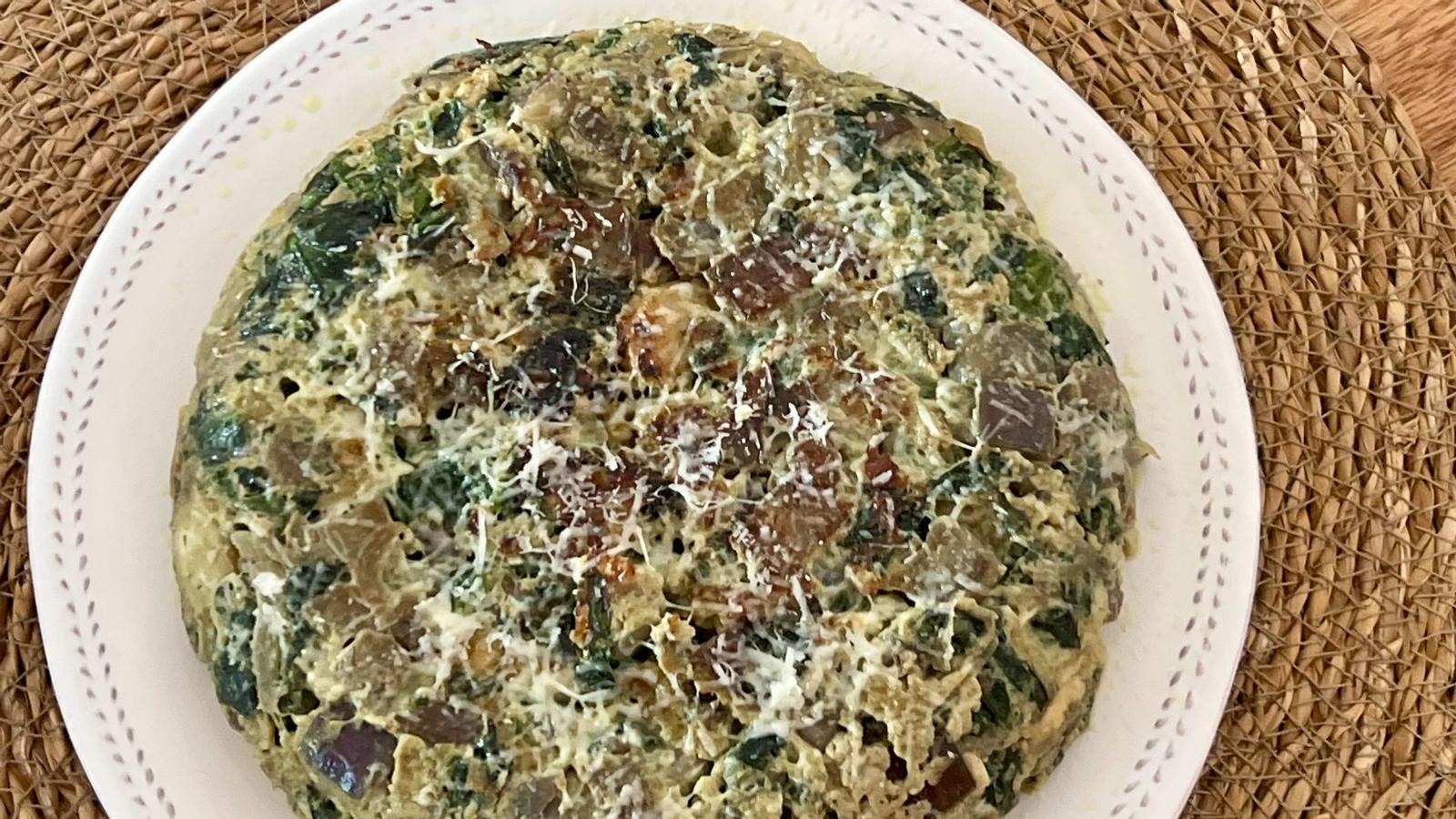
For today's recipe, I have started from the spinach and eggplant omelet from the Caules cookbook. A dish that says goodbye to summer and welcomes autumn.
We will cut the eggplant into cubes and place it in a bowl with water and a handful of salt. After half an hour, we will drain it.
We will sauté the onion and garlic, and when it is well browned, we will add the eggplant. When it is cooked, we will add the chopped spinach. We will season it with salt and pepper. Two minutes later, we will remove it from the heat and drain any liquid it has released.
We will beat the eggs. We will put the vegetables back into the pan, add grated cheese to taste, and pour the eggs over them. We will let them set, flip the omelet, and serve it.
l 2 medium eggplants
l 1 bunch of spinach
l 1 onion
l garlic cloves
l 6 eggs
l dry cheese
